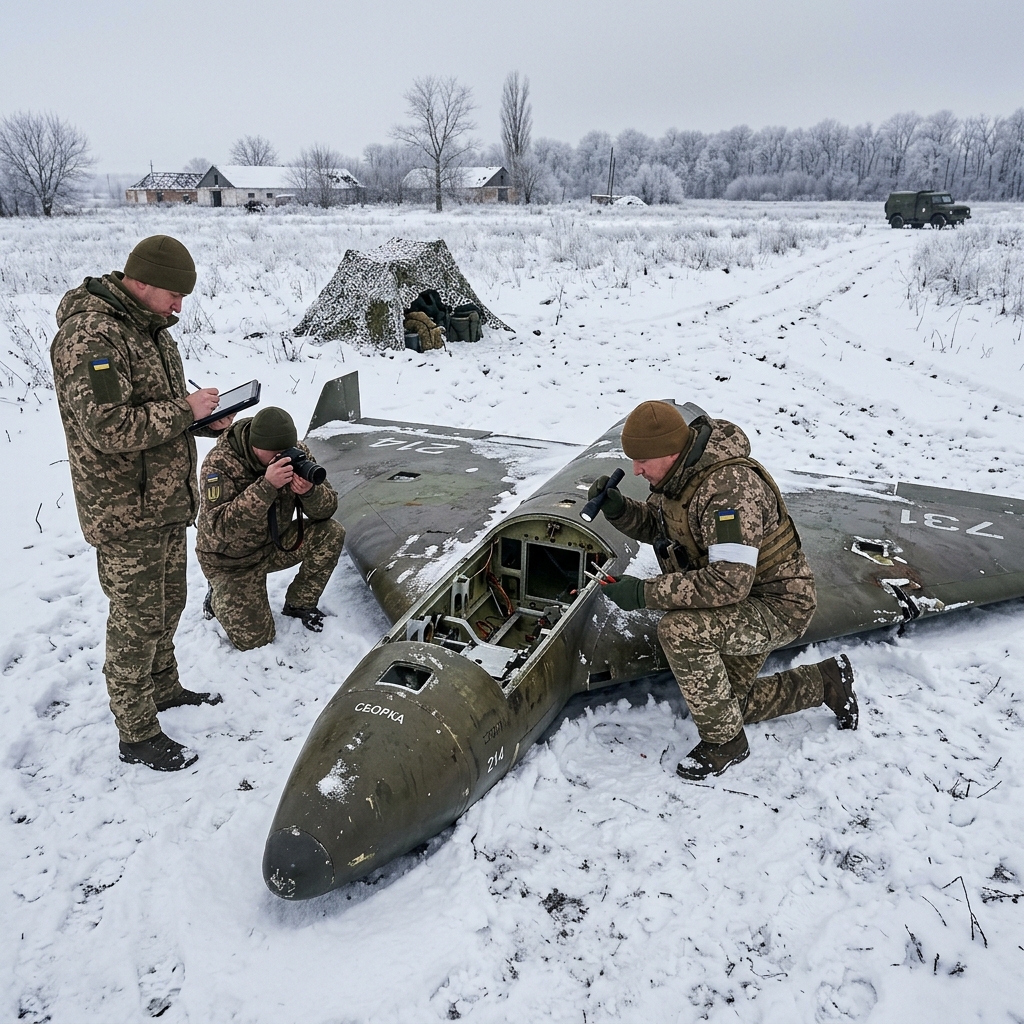
A Baffling Discovery in the Snow
Over the past several weeks, Ukrainian air defense units and explosive ordnance disposal (EOD) teams have reported a highly unusual trend: an increasing number of downed Russian “Shahed-136” (Geran-2) loitering munitions are being found completely intact, but entirely devoid of their explosive payloads. Instead of a 40-50 kg high-explosive warhead, technicians are discovering hollow compartments or crude concrete counterweights inside the nose cones. This shift in the composition of drone swarms marks a significant change in Russian aerial strike tactics.
- Up to 30% of drones in recent swarms are estimated to be “empty” decoys.
- The acoustic signature and radar cross-section remain identical to armed variants.
- EOD teams are recovering these decoys largely undamaged from agricultural fields.
Initially confusing, military intelligence has now pieced together the strategic rationale behind this seemingly wasteful deployment of expensive aerial assets.
Exhausting the Shield
The primary objective of the “empty” Shahed tactic is the deliberate exhaustion of Ukrainian air defense interceptors. By mixing a large number of unarmed decoys with a smaller contingent of armed drones or cruise missiles, Russian forces force Ukrainian air defense operators to engage every incoming contact. Because it is impossible to distinguish an armed drone from an unarmed one on radar or via acoustic sensors, defenders must expend valuable, limited-supply surface-to-air missiles (SAMs) to neutralize the threat, rapidly depleting ammunition stocks.
Mapping Radar and Frequencies
Beyond simply draining ammunition, the decoys serve a critical intelligence-gathering function. When a swarm approaches a city, it forces the activation of multiple Ukrainian radar systems, from early warning arrays to target illumination radars. Russian electronic intelligence (ELINT) aircraft and satellites monitor these emissions, attempting to map the exact locations, frequencies, and operational procedures of the Ukrainian air defense network. This data is then used to plot optimal flight paths for subsequent, more destructive strikes.
Adapting to the Decoy Threat
To counter this tactic, Ukrainian forces are rapidly adapting their engagement protocols. There is an increased reliance on mobile fire groups (MFGs) equipped with heavy machine guns and searchlights, which can visually identify and destroy low-flying drones without expending costly missiles. Additionally, advanced acoustic sensor networks are being deployed to track the flight paths of the drones, allowing commanders to better prioritize targets based on their trajectory toward critical infrastructure versus open fields.
| Drone Configuration | Estimated Percentage in Swarm | Primary Function |
|---|---|---|
| Standard Armed (HE Warhead) | 60% | Infrastructure Destruction |
| Unarmed Decoy (Empty/Ballast) | 30% | Air Defense Depletion / Radar Mapping |
| Thermobaric Warhead | 5% | Enhanced Anti-Personnel/Structural Damage |
| Reconnaissance/Relay (Camera) | 5% | Real-time Strike Assessment |