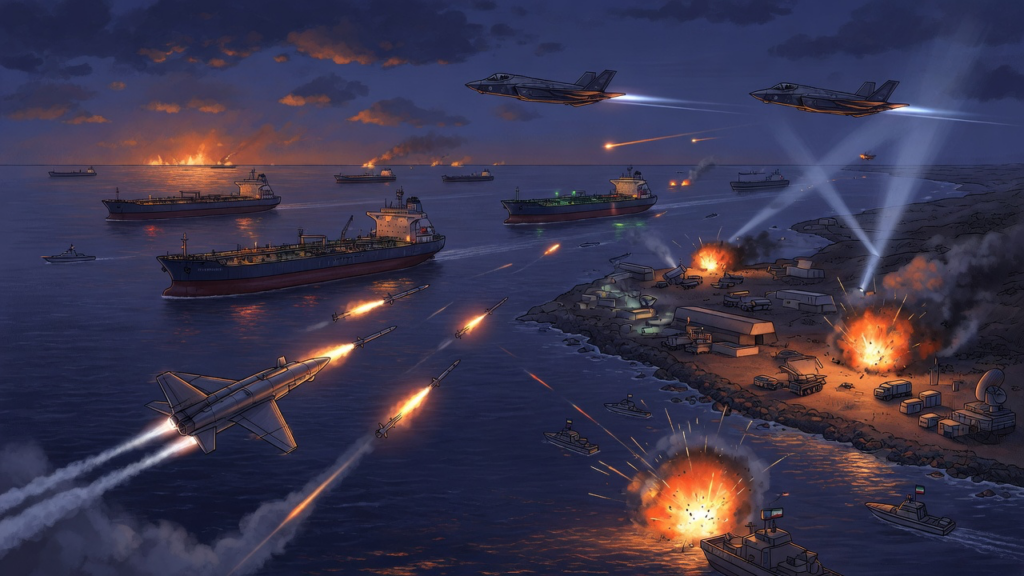
US Airstrikes Near Strait of Hormuz: Axios Reports Direct Action
According to Axios, the United States has conducted strikes on Iranian targets in the vicinity of the Strait of Hormuz. The report, citing multiple US officials, indicates that the action targeted military infrastructure believed to be supporting Iranian naval and missile capabilities in the region. This marks a significant escalation in the long-running shadow conflict between the two nations, moving from proxy engagements and sanctions to direct kinetic operations in one of the world’s most critical maritime passages.
The Strait of Hormuz, located between Iran and Oman, serves as the primary transit route for approximately 20% of global oil and liquefied natural gas shipments. Any disruption here immediately sends shockwaves through energy markets and global supply chains. The reported US strikes appear aimed at degrading Iran’s ability to threaten or interdict commercial and military traffic in this narrow waterway, which is only 21 nautical miles wide at its narrowest point.
Iran has long positioned itself as the guardian of the Strait, maintaining a significant arsenal of anti-ship missiles, naval mines, fast attack boats, and submarines designed specifically to contest control of the waterway. The Islamic Revolutionary Guard Corps Navy (IRGCN) specializes in asymmetric tactics that could close or severely restrict passage through the strait in a conflict scenario. US Central Command has historically maintained a strong naval presence in the region, including carrier strike groups and mine countermeasures vessels, precisely to ensure freedom of navigation.
The choice of targets near the strait suggests Washington is sending a clear message: threats to this vital artery will not go unanswered.
| Factor | Implications for Hormuz |
|---|---|
| Oil Transit Volume | ~21 million barrels per day; 20% of global seaborne oil trade |
| Iranian Assets | Anti-ship cruise missiles (Noor, Qader), fast boats, Kilo-class submarines, mines |
| US Response Options | Carrier-based air strikes, Tomahawk missiles, special operations, partner coordination |
| Global Impact | Potential 20-50% spike in oil prices if transit disrupted for weeks |
| Escalation Risks | Iranian mining operations, proxy attacks on shipping, closure threats |
Military Analysis and Global Ramifications
US strikes in this region would likely have targeted command nodes, missile storage sites, coastal radar installations, and fast-attack boat bases along Iran’s southern coast. Precision munitions from standoff ranges would minimize risk to US aircraft while maximizing damage to fixed infrastructure. However, Iran’s strategy relies less on large fixed bases and more on dispersed, mobile forces and pre-positioned mines that can be activated rapidly.
Historical patterns from the Tanker War of the 1980s and more recent incidents show that Iran can impose costs on shipping even without controlling the strait outright. Mining operations, swarm attacks by small boats, and anti-ship missile salvos remain credible threats. The effectiveness of US strikes will depend on whether they degraded Iran’s ability to execute these tactics quickly or simply forced a temporary dispersal of forces.
Even limited disruption in the Strait of Hormuz triggers immediate market reactions. Insurance rates for tankers transiting the area spike, shipping companies reroute around Africa, and oil prices climb on fear of supply shortages. Major importers in Asia, particularly China, India, Japan and South Korea, would feel the impact first and most severely. European markets, already sensitive after years of energy volatility, would face renewed pressure.
The US itself is less directly dependent on Gulf oil than in previous decades due to domestic production, but it remains committed to the security of global energy flows as a matter of strategic interest. Attacks or threats in the strait also affect US allies and partners, creating pressure for American involvement regardless of direct energy imports. The economic weaponization of the strait remains one of Iran’s most potent tools of asymmetric deterrence.
Escalation Pathways and Regional Dynamics
Iran has multiple response options short of full closure of the strait. These include selective harassment of shipping, increased proxy attacks in the Red Sea and elsewhere, cyber operations against energy infrastructure, and diplomatic mobilization among non-aligned nations. Full closure would invite overwhelming international military response and self-inflicted economic damage, making calibrated escalation more likely.
Regional actors including Saudi Arabia, the UAE, and Israel would be directly affected. The strikes occur against a backdrop of fragile normalization efforts and ongoing conflicts. Any perception that the US is distracted or overcommitted could encourage further adventurism by Iranian proxies or direct action.
From a naval perspective, the incident underscores the enduring importance of sea control in critical chokepoints. Modern anti-access/area denial (A2/AD) capabilities make operations in confined waters extremely dangerous for surface fleets. The US Navy’s investment in distributed maritime operations, unmanned systems, and long-range precision strike reflects lessons from exactly this kind of scenario.
FoxyShield Editorial Assessment
The reported US strikes represent a high-stakes gamble in one of the most strategically sensitive locations on Earth. While degrading Iranian capabilities near the strait may temporarily reduce the immediate threat to shipping, it risks accelerating a cycle of retaliation that could make the waterway even more dangerous in the medium term.
For defense planners, this incident reinforces several hard truths: chokepoints remain vulnerabilities even in an age of long-range precision weapons; asymmetric threats like mines and fast boats retain outsized influence; and energy security remains inextricably linked to military posture. Nations dependent on Gulf energy flows, including many European states supporting Ukraine, should treat this as a warning about supply chain fragility in a multi-conflict world.
The true test will be whether the strikes achieve lasting deterrence or simply demonstrate that both sides can impose costs on the other in this critical theater. History suggests the latter is more likely without accompanying diplomatic off-ramps. Source: Axios reporting, June 2026.