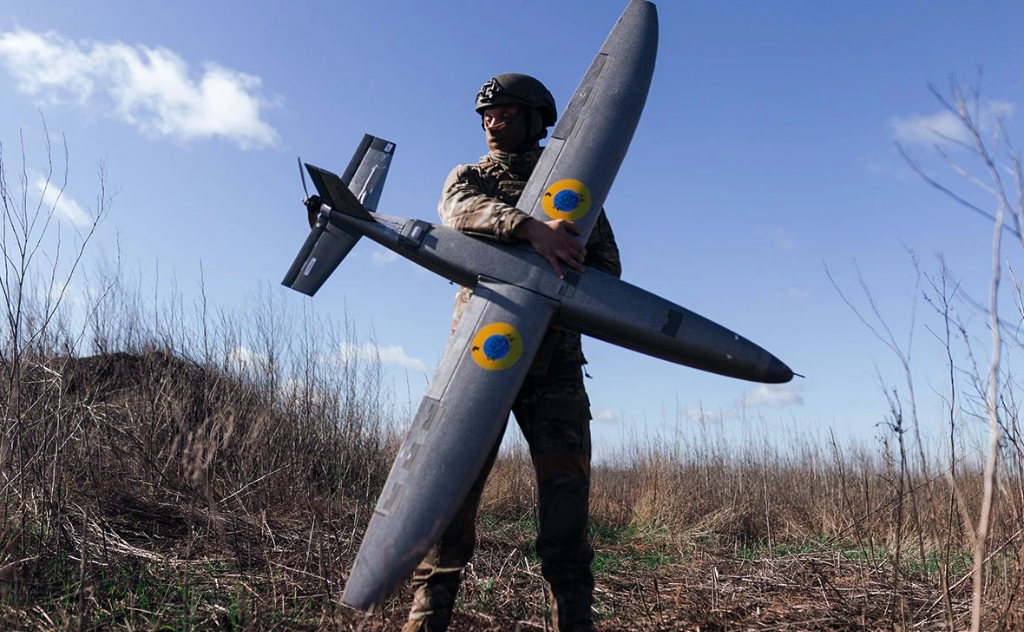
Deep Technical Breakdown: HORNET AI – Next Generation Autonomous FPV
The Ukrainian tactical strike drone HORNET AI represents a fundamental shift in the paradigm of unmanned systems. Unlike classic FPV drones that rely entirely on a radio channel, HORNET integrates hardware acceleration for Computer Vision and Visual Inertial Odometry (VIO) algorithms. This allows the system to perform autonomous lock-on of moving armored targets in the terminal phase, guaranteeing absolute invulnerability to classic electronic warfare (EW) systems that suppress the control signal. Thanks to the use of advanced SLAM (Simultaneous Localization and Mapping) methods, the drone can navigate in space even under total GPS/GLONASS jamming.
For comparison, the Russian loitering munition Lancet-3 (produced by ZALA Aero Group, part of the Kalashnikov concern) relies on a more conservative and expensive architecture. Lancet often requires constant communication with a relay drone (e.g., ZALA 421-16E) for correction and target confirmation, making the entire complex vulnerable to electronic intelligence (ELINT) and EW systems. In addition, the dimensions and ‘double X’ aerodynamic scheme limit the Lancet’s maneuverability in complex urban environments or forest lines, where compact quad and hexacopter platforms of the HORNET have a clear advantage.
| Specification | HORNET AI (Ukraine) | Lancet-3 (Russia) |
|---|---|---|
| Cruising Speed | 120-140 km/h | 110 km/h |
| Max Speed | 200+ km/h (in dive) | 300 km/h (in dive) |
| Flight Range | Up to 35 km (depends on battery) | Up to 40 km |
| Warhead | 2.5 – 3.5 kg (HEAT/EFP) | 3 kg (KZ-6 or thermobaric) |
| Guidance Architecture | Autonomous optical (Edge AI, VIO) | Optoelectronic (relay dependent) |
| Estimated Cost | ~$3,000 – $4,500 | ~$35,000 – $40,000 |
Hardware: Qualcomm, Sony, and Global Supply Chains
The heart of the HORNET AI computing platform is a high-performance ARM-based SoC (System on a Chip), often utilizing solutions from Qualcomm Snapdragon Flight or similar industrial SBCs (Single Board Computers). Built-in NPUs (Neural Processing Units) from Qualcomm (like the Hexagon DSP) or Hailo chips allow executing neural network target recognition models (e.g., optimized YOLOv8) at over 30-60 frames per second directly on the drone (Edge Computing). This minimizes latency to milliseconds, which is critical for hitting moving targets. Optical perception is handled by sensors from Sony (IMX series), providing wide dynamic range (HDR) and high light sensitivity, while uncooled thermal matrices from Teledyne FLIR can be used for night operations.
To ensure high thrust and maneuverability, brushless motors from leading FPV component manufacturers such as T-Motor or EMAX are used. Electronic Speed Controllers (ESCs) support DShot600/1200 protocols, guaranteeing an instant response to flight controller commands. In contrast, the Russian Lancet relies on motors from the Czech company Model Motors (AXi) or their Chinese analogues, and for computing used NVIDIA Jetson TX2 modules and Field Programmable Gate Arrays (FPGA) from Xilinx (owned by AMD). Western sanctions have significantly complicated legal purchases of these military-grade components for the Russian Federation, forcing them to rely on ‘gray’ schemes and market leftovers.
Communication Systems and EW Resilience
The HORNET AI radio channel is built on modern SDR (Software Defined Radio) transceivers using Frequency-Hopping Spread Spectrum (FHSS) technology over a wide range (from non-standard low frequencies to 5.8+ GHz). This makes interception and jamming by classic trench EW equipment difficult. Even in the case of powerful barrage jamming, the operator only needs to indicate the target in the form of a ‘bounding box’ on a tablet screen. Then the Tracking-by-Detection algorithm takes over control, keeping the target in the center of the frame and correcting the course using PID controllers right up to the moment of impact. This approach nullifies the efforts of enemy EW systems like ‘Pole-21’ or ‘Zhitel’.
Russian ‘Lancets’ use a communication module that operates on more fixed and predictable bands. While they also use digital channels with encryption, the lack of autonomous terminal guidance (in early and mass modifications) makes them vulnerable to ‘spoofing’ or ‘jamming’ of the video channel. If the Lancet operator loses the picture at an altitude of 50-100 meters above the target, the munition is highly likely to miss.
| Subsystem | HORNET AI (Ukraine) | Lancet-3 (Russia) |
|---|---|---|
| Compute (AI) | Qualcomm NPU / Hailo-8 | NVIDIA Jetson TX2 / Xilinx Zynq |
| Sensors (Optics) | Sony IMX (Starvis 2) | Commercial cameras (e.g. Sony/Canon) |
| Propulsion | T-Motor / EMAX (BLDC) | AXi (Model Motors) / Chinese clones |
| Navigation (GPS-denied) | VIO (Visual Inertial Odometry) | Inertial (gyros/accelerometers) |
| Tracking Algorithm | Deep Learning (YOLO/Siamese Nets) | Contrast/Correlation tracking |
Economic and Strategic Advantage
One of the most important factors in a war of attrition is the cost of destroying a target. HORNET AI, built on COTS (Commercial Off-The-Shelf) components, costs ten times less than its Russian counterpart, while providing higher accuracy in conditions of strong electronic countermeasures. The ability to quickly update neural network models via OTA (Over-The-Air) ‘firmware’ allows Ukrainian engineers to promptly teach drones to recognize new types of camouflage or anti-drone screens (so-called ‘cope cages’) that Russians install on their tanks.
Ultimately, HORNET AI is a prime example of how an innovative approach, decentralized production, and access to advanced Western microchips (Qualcomm, Sony, FLIR) allow the creation of an asymmetric weapon that neutralizes the quantitative and financial superiority of the enemy. It is not just a drone, but a flying computing platform that will define the face of future warfare.