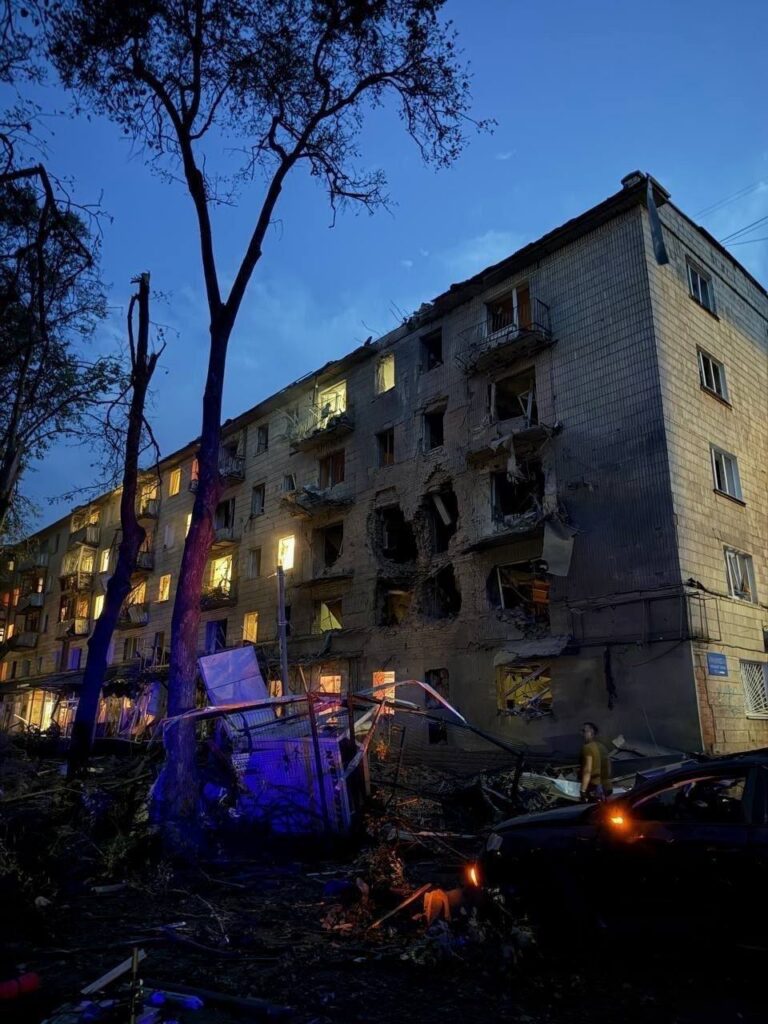
What is known about the Sumy strike
On the evening of July 3, Russian forces struck Sumy with guided aerial bombs. Local media reported that six KAB glide bombs were used against the city, with at least three impacts or detonations in the central area. Initial local reports said three people had been killed, including a child. Later Ukrainian reporting, citing local authorities, updated the toll to at least four dead.
The strike hit dense urban housing. Images from the scene show an apartment block with shattered windows, damaged balconies, broken facade sections, and debris near the entrances. This pattern points not only to a direct hit or near detonation, but also to a powerful blast wave moving through a residential quarter. For the city, that means an extended rescue operation, apartment-by-apartment checks, evacuation of unsafe sections, and structural inspections before residents can safely return.
FoxyShield assesses the episode as another example of Russia using air-delivered weapons against an urban center near the border. Even while exact coordinates and final casualty figures remain subject to official updates, the operational picture is already clear: the strike was heavy by city standards, part of the salvo hit the central zone, and the humanitarian impact fell on civilian housing.
Why guided bombs are a systemic threat to Sumy Oblast
Guided aerial bombs remain one of the hardest threats for Ukrainian frontline and border cities to counter. Unlike many missile attacks, a glide bomb can be released from a distance that complicates the direct engagement of the launch aircraft. Russian tactics often rely on keeping aircraft outside the most dangerous envelope of shorter-range Ukrainian air defenses while still delivering a large explosive payload.
For Sumy Oblast, geography makes the threat especially acute. Sumy city is relatively close to the Russian border, so the time between an air alert, detection, and impact may be short. In a KAB attack, civilians have little reaction time, while the blast radius and destructive power remain high even when the munition is aimed at an area rather than a single building.
The defense problem combines three factors: payload mass, launch distance, and relatively low cost for the attacker. One aircraft can release several bombs in a short period, creating pressure on warning systems, rescue units, hospitals, and local government. A report of six guided bombs against one city should therefore not be read as an isolated episode. It fits a wider campaign of pressure against Ukrainian border communities.
| Parameter | Known data | FoxyShield assessment |
|---|---|---|
| Location | Sumy, including the city center | Dense civilian urban area affected |
| Threat type | Guided aerial bombs | High destructive power and short warning time |
| Munitions reported | Local media reported six KAB bombs | Heavy strike by urban standards |
| Casualties | Initial reports said three killed; later updates said at least four, including a child | Figures may change after rescue work |
| Affected objects | Residential buildings and urban infrastructure | Civilian sector absorbed the main impact |
| Near-term risks | Repeat alerts, unstable structures, search operations | Access to damaged buildings should remain restricted |
Immediate consequences for the city and emergency services
After a strike of this scale, the first response usually runs on three parallel tracks: medical evacuation, search-and-rescue work, and technical inspection of damaged buildings. In a residential district, the danger is not limited to visible destruction. Hidden damage to floors, gas lines, electrical wiring, stairwells, and load-bearing elements can make sections unsafe even when individual apartments appear intact.
For local authorities, a strike on the city center also creates an information burden. Officials must confirm casualty lists, coordinate hospitals, organize aid points, reduce panic, and avoid publishing details that could help the attacker assess strike effectiveness. This is why casualty numbers often change in the first hours after attacks, especially while rescuers continue searching apartments and debris.
For civilians, the guidance remains strict: do not approach impact sites, do not enter damaged entrances without permission from rescuers, and do not publish exact real-time details of air defense activity or strike consequences. In Sumy, this matters because the city remains exposed to repeat attacks by guided bombs and drones.
Military significance of the attack
Militarily, the Sumy strike shows the continuation of Russia’s pressure campaign against Ukraine’s northern border belt. These attacks have tactical and psychological effects: they force cities to keep emergency resources on alert, overload medical and rescue systems, and create a persistent sense of danger far from the immediate ground contact line.
At the same time, guided bomb attacks against central urban districts do not deliver a rapid operational breakthrough. They are an instrument of attrition rather than maneuver. The likely purpose is to damage residential and municipal resilience, push civilians toward evacuation, and demonstrate the ability to hit city centers at relatively low aviation risk. Countering that threat requires not only local air defense, but also reducing the ability of launch aircraft to operate near the border.
In the coming days, the key indicators will be updated casualty figures, the scale of housing damage, the number of displaced residents, and whether guided bomb attacks continue across Sumy Oblast. If this tempo persists, it will signal an attempt to intensify pressure on border cities through civilian infrastructure rather than a classic battlefield axis.