Розділ 1
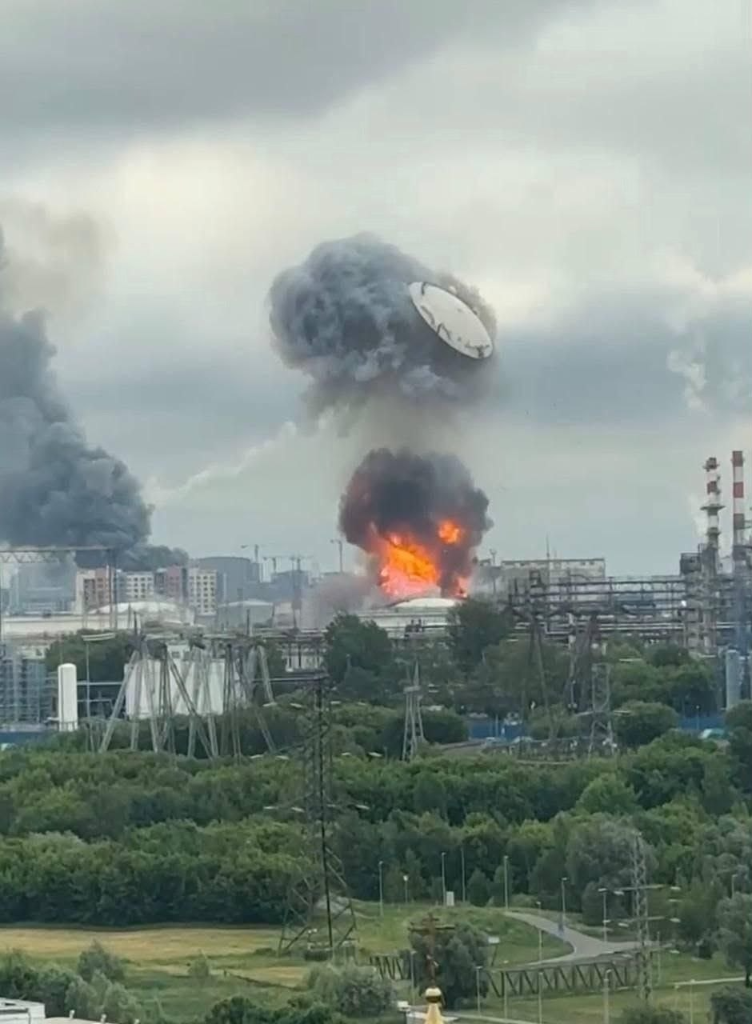
In the early hours of yesterday morning, the geopolitical landscape of Eastern Europe shifted once again as a massive, coordinated drone strike targeted a critical industrial facility deep within the Moscow region. This was not a random act of harassment, but rather a calculated and highly effective operation demonstrating a significant evolution in long-range strike capabilities. Eyewitnesses across the Russian capital reported being jolted awake by the sound of multiple, deafening explosions echoing through the city skyline. These initial detonations were swiftly followed by the sight of a massive, billowing plume of thick black smoke rising ominously over the targeted industrial zone. The sheer force of the impact was captured in dramatic video footage circulating widely on social media platforms; in one particularly striking clip, a massive detonation is seen tearing through an oil storage tank, violently blowing its heavy metal lid high into the morning air.
Beyond the immediate physical and logistical damage, the psychological impact of drone strikes on Moscow cannot be overstated. For over two years, the Kremlin has carefully cultivated a narrative for its domestic audience, portraying the “special military operation” as a distant, managed conflict that does not threaten the daily lives of ordinary Russians, particularly those living in the affluent capital. The sight of air raid sirens, anti-aircraft fire over the Kremlin, and burning industrial facilities in the suburbs fundamentally shatters this curated reality.
As the conflict grinds on, it is highly likely that strikes of this nature will not only continue but increase in frequency, scale, and sophistication. The destruction of the oil facility in Moscow is not an isolated incident; it is part of a broader, deliberate strategy of deep interdiction. The attacking forces have demonstrated both the will and the capability to consistently strike high-value targets across the breadth of the Russian Federation.
Розділ 2
This incident marks a profound escalation in the ongoing campaign designed to systematically degrade the logistical and energy infrastructure that sustains the Russian war machine from deep within its own rear areas. Historically, the Russian capital has enjoyed a sense of relative impunity, shielded by distance and layers of supposedly impenetrable air defense networks. However, this strike shatters that illusion of invulnerability. While local authorities were quick to issue statements claiming that their surface-to-air missile systems and electronic warfare units successfully intercepted the incoming Unmanned Aerial Vehicles (UAVs)—attributing the catastrophic damage merely to “falling debris”—the sheer scale of the explosion and the pinpoint accuracy of the strike strongly suggest a direct, unimpeded hit on a high-value target.
The destruction of such facilities brings the brutal reality of the war directly to the doorstep of the Russian political and economic elite. It demonstrates that the state can no longer guarantee the safety of its citizens or its critical assets, even in its most heavily defended regions. This erosion of confidence can have significant domestic political ramifications. It breeds anxiety among the populace, raises uncomfortable questions about the competence of the military leadership, and undermines the foundational promise of security upon which the current regime relies. The psychological shockwaves of a strike in Moscow often resonate far louder than the physical explosions themselves.
This reality establishes a “new normal” for the conflict. The Russian military must now operate under the constant assumption that its rear-area logistics, command centers, and energy infrastructure are under perpetual threat. This persistent vulnerability will continue to strain their resources, complicate their operational planning, and exert immense psychological pressure on both their leadership and the general public. The ability to reach out and strike Moscow is no longer a theoretical possibility; it is a proven, potent weapon in the ongoing war of attrition, signaling that the battlefield has truly expanded beyond the traditional frontlines.
Розділ 3
The choice of an oil storage and processing facility is highly strategic. Modern warfare is entirely dependent on a continuous and massive supply of hydrocarbons. Tanks, infantry fighting vehicles, fighter jets, and logistical transport convoys all require refined fuel to operate. By targeting these refineries and storage depots deep within Russian territory, the attacking forces are not merely destroying infrastructure; they are directly interdicting the supply chains required to sustain frontline military operations hundreds of kilometers away.
The success of this strike also highlights a remarkable technological and tactical evolution in asymmetric warfare. The ability to project power and strike deep into hostile territory was once the exclusive domain of superpowers possessing multi-billion-dollar fleets of strategic bombers and advanced cruise missiles. Today, a relatively inexpensive fleet of domestically produced, long-range kamikaze drones can achieve comparable strategic effects at a fraction of the cost.
Розділ 4
Furthermore, these industrial facilities are incredibly difficult and expensive to replace. A destroyed oil tank or a damaged refinement column cannot be quickly substituted with off-the-shelf components, especially under the weight of stringent international sanctions that restrict access to advanced Western engineering technologies. The cumulative effect of these strikes is a slow, methodical strangulation of the Russian military-industrial complex. Every gallon of aviation fuel that burns over Moscow is a gallon that cannot be used to power a bomber striking targets in Ukraine. This strategic calculus forces the Russian high command into a difficult dilemma: either they continue to suffer debilitating losses to their critical economic infrastructure, or they must pull vital air defense assets away from the frontlines to protect their rear, thereby weakening their forward positions.
These operations demonstrate an increasing mastery of complex flight path planning, terrain masking, and electronic warfare evasion. To reach Moscow, these drones must navigate hundreds of kilometers of hostile airspace, bypassing multiple layers of sophisticated Russian radar and air defense systems, including the S-400 Triumf and Pantsir-S1. The fact that they are consistently able to penetrate these defenses and strike their intended targets with precision speaks volumes about the ingenuity and technological adaptability of the attacking forces. It proves that in the modern battlespace, innovation and agility can successfully counter numerical superiority and legacy defense systems.
| Факти | Опис |
|---|---|
| The Strategic Shift: | The Strategic Shift: Bringing the War Home to Moscow In the early hours of yesterday morning, the geopolitical landscape of Eastern Europe shifted once again as a massive, coordinated drone strike targeted a critical industrial facility deep within the Moscow region |
| This was not | This was not a random act of harassment, but rather a calculated and highly effective operation demonstrating a significant evolution in long-range strike capabilities |
| Eyewitnesses across the | Eyewitnesses across the Russian capital reported being jolted awake by the sound of multiple, deafening explosions echoing through the city skyline |