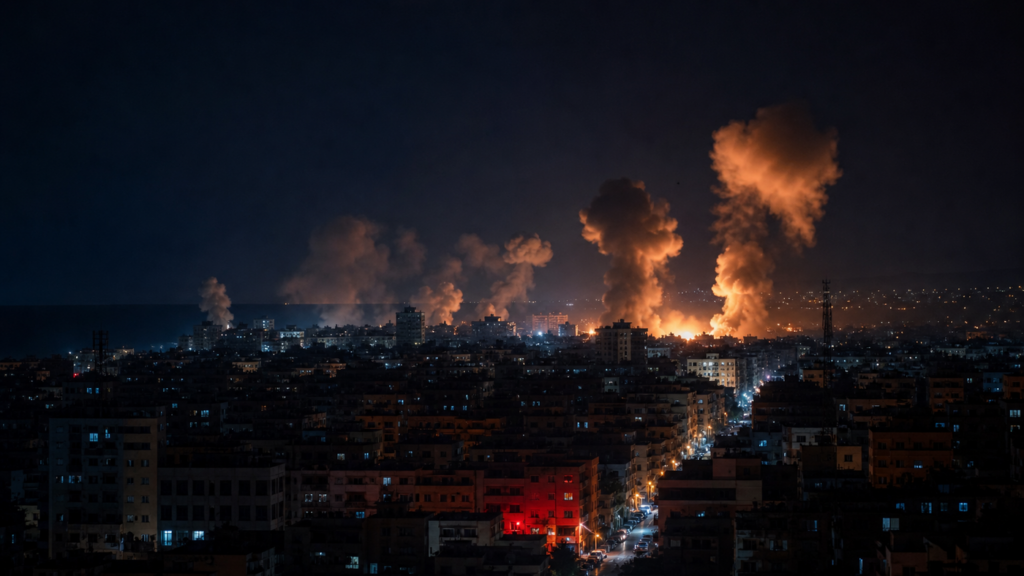
What Is Confirmed Tonight
Israel is again striking targets in Gaza, with reports from the enclave describing new bombing and recovery operations after recent attacks. This is a developing battlefield story: casualty figures can change quickly, and claims from officials, hospitals, armed groups and media outlets should be treated as provisional until independently corroborated.
Al Jazeera reported at least seven killed over 48 hours, while video from central Gaza showed the aftermath of recent Israeli strikes. AP’s running Israel-Hamas war hub remains a useful cross-check for updates.
The military significance is not only the number of strikes. It is the timing and distribution: Gaza is already under severe humanitarian pressure, negotiations over pauses or ceasefire formulas remain fragile, and every new strike wave can alter the bargaining space between Israel, Hamas, mediators and regional actors.
The operational picture is complicated by the information environment. Footage from Gaza can appear within minutes, while official military statements may arrive later and with narrower wording. FoxyShield therefore separates three layers: confirmed strike reporting, claims about intended targets, and the political effect of the images after publication. Mixing those layers is how fast news turns into bad analysis.
A second factor is geography. Strikes in dense urban districts create different military and political consequences than strikes on open launch areas or border corridors. Even when the target is military, the surrounding civilian environment can dominate the strategic effect. That is why location verification is as important as casualty counts.
Why the Strike Pattern Matters
The current pattern looks like pressure rather than a single isolated event. Israeli forces have used repeated air and ground strikes to disrupt command nodes, tunnels, weapons storage, launch crews and militant movement. Hamas and allied factions, meanwhile, benefit from dense urban terrain, concealment, damaged infrastructure and information ambiguity. That makes every strike both a tactical event and an information battle.
For FoxyShield readers, the key question is whether the strikes are preparatory, punitive, intelligence-driven or part of a wider sequencing of negotiations. A narrow intelligence-driven strike usually has limited follow-up. A pressure campaign often comes with repeated night attacks, warnings, raids and public messaging designed to shape ceasefire talks or hostage negotiations.
A second factor is geography. Strikes in dense urban districts create different military and political consequences than strikes on open launch areas or border corridors. Even when the target is military, the surrounding civilian environment can dominate the strategic effect. That is why location verification is as important as casualty counts.
Israel’s likely objective is to preserve freedom of action while keeping pressure on Hamas networks. Hamas’s likely objective is to survive the strike cycle, maintain command visibility, and convert civilian suffering into diplomatic pressure on Israel. Both sides are therefore fighting on the battlefield and inside the media cycle at the same time.
Operational Risks for the Next 72 Hours
The next 72 hours carry several risks. First, additional strikes may hit areas already damaged, raising the chance of mass-casualty reports and international pressure. Second, Hamas may answer with rocket launches, ambush claims or hostage-related messaging. Third, regional actors can use the Gaza escalation to justify attacks elsewhere, especially if images of civilian harm dominate the information space.
The diplomatic risk is also real. A strike wave during talks can be interpreted by one side as leverage and by the other as sabotage. Mediators may try to keep negotiations alive, but the political cost rises whenever the battlefield produces fresh casualty images. This is why casualty verification, location verification and timing matter more than viral clips alone.
Israel’s likely objective is to preserve freedom of action while keeping pressure on Hamas networks. Hamas’s likely objective is to survive the strike cycle, maintain command visibility, and convert civilian suffering into diplomatic pressure on Israel. Both sides are therefore fighting on the battlefield and inside the media cycle at the same time.
If the strike tempo continues, the next signal will be whether Israel pairs air activity with ground raids or public evacuation instructions. If the tempo drops, it may suggest a short punitive or intelligence cycle rather than a broader operation. If mediators speak publicly within hours, diplomacy is trying to contain the tactical shock.
What FoxyShield Is Watching
FoxyShield is watching four indicators: whether Israeli statements identify specific target categories; whether Hamas releases coordinated battlefield claims; whether casualty reports cluster around shelters, hospitals or evacuation zones; and whether mediators issue unusually urgent language. Those signals will show whether this is a limited strike cycle or the opening of a broader escalation.
Bottom line: the bombing wave keeps Gaza in a high-risk escalation window. The confirmed facts support a serious developing story, but not all battlefield claims should be treated as verified. The best reading tonight is cautious: Israel is applying renewed military pressure, Gaza’s humanitarian risk is rising, and the political space for a pause remains vulnerable.
If the strike tempo continues, the next signal will be whether Israel pairs air activity with ground raids or public evacuation instructions. If the tempo drops, it may suggest a short punitive or intelligence cycle rather than a broader operation. If mediators speak publicly within hours, diplomacy is trying to contain the tactical shock.
The operational picture is complicated by the information environment. Footage from Gaza can appear within minutes, while official military statements may arrive later and with narrower wording. FoxyShield therefore separates three layers: confirmed strike reporting, claims about intended targets, and the political effect of the images after publication. Mixing those layers is how fast news turns into bad analysis.
| Signal | Current read | Why it matters |
|---|---|---|
| Strike tempo | Renewed and repeated | May indicate pressure during negotiations |
| Civilian-risk environment | High | Dense terrain and damaged infrastructure raise verification and casualty risks |
| Regional spillover | Watch level | Gaza images can trigger action by aligned actors |
| Negotiation impact | Fragile | New strikes can harden positions or be used as leverage |