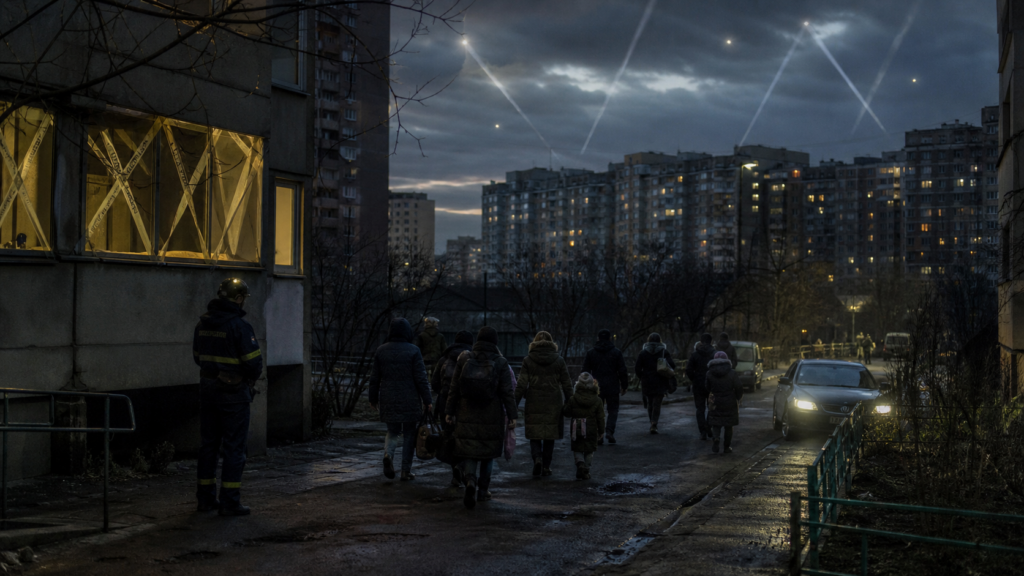
Warning as an urban system
A possible Russian strike is not only a local emergency for Ukraine. It is a test of how a modern city absorbs repeated long-range pressure while keeping power, transport, hospitals and public trust functioning. Ukrainian municipalities now prepare through layered warning: official alerts, shelter access, backup power, emergency medical routing and rapid damage assessment. The important point for a global audience is that the city itself has become part of the defense architecture.
Research from RUSI and daily operational tracking from ISW show that Russia has used missiles and one-way attack drones as a campaign tool, not as isolated events. The target set often mixes military, energy and civilian infrastructure pressure. That pattern makes preparation a standing civic routine rather than a rare wartime drill.
| Research anchor | What it adds | Why it matters |
|---|---|---|
| RUSI war lessons | Tactics, adaptation and force employment | Frames strikes as a campaign, not isolated news |
| NATO support for Ukraine | Air defense and allied assistance | Links Ukrainian defense to European security |
| ISW campaign updates | Operational context and daily pattern tracking | Helps interpret timing and target selection |
| CSIS Missile Threat | Missile system characteristics | Explains range, launch and warning challenges |
What preparation looks like
Practical preparation is less dramatic than the strike itself: batteries charged, stairwells cleared, shelters unlocked, buses and hospitals ready for disruption, and local officials coordinating with air-defense warnings. The lesson for Europe is direct. Civil defense is no longer a Cold War archive subject; it is an everyday resilience capability.
NATO support for Ukraine has increasingly focused on air defense, ammunition and energy resilience because the threat links the battlefield to the urban rear. Each night of warning asks whether the defensive network can keep enough interceptors, sensors and emergency crews in the right place.
The global signal
For readers outside Ukraine, the question is not whether one city can endure another night. The question is what a long strike campaign teaches other states about warning speed, shelter culture, backup energy, mobile repair teams and public communication. Ukraine is creating a hard-earned model of urban survival under precision and semi-precision attack.
That model is relevant from the Baltic region to the Indo-Pacific. Cities that depend on centralized electricity, digital payments and just-in-time logistics are vulnerable even without occupation. Ukraine’s experience shows that resilience must be designed before the sirens start.
Sources: https://www.rusi.org/explore-our-research/publications/special-resources/preliminary-lessons-conventional-warfighting-russias-invasion-ukraine-february-july-2022, https://www.rusi.org/explore-our-research/publications/special-resources/meatgrinder-russian-tactics-second-year-its-invasion-ukraine, https://www.nato.int/en/what-we-do/partnerships-and-cooperation/natos-support-for-ukraine, https://understandingwar.org/analysis/russia-ukraine/ukraine-russia-conflict/, https://missilethreat.csis.org/missile/kh-101-kh-102/
What to Watch Next
The indicators to watch are practical rather than theatrical: launch tempo, the mix of drones and missiles, timing against weather and repair cycles, and whether Russia concentrates on military logistics, energy nodes or symbolic political targets. A single alert does not prove a strategic shift, but repeated patterns can reveal stockpile management, adaptation to Ukrainian air defense and pressure points in allied support.
For global readers, that makes Ukraine a warning system for wider security planning. The same questions now matter to NATO members and partners: how many interceptors are available, how quickly damaged infrastructure can be restored, and whether public communication keeps trust during a prolonged campaign.