Why the warning matters beyond Ukraine
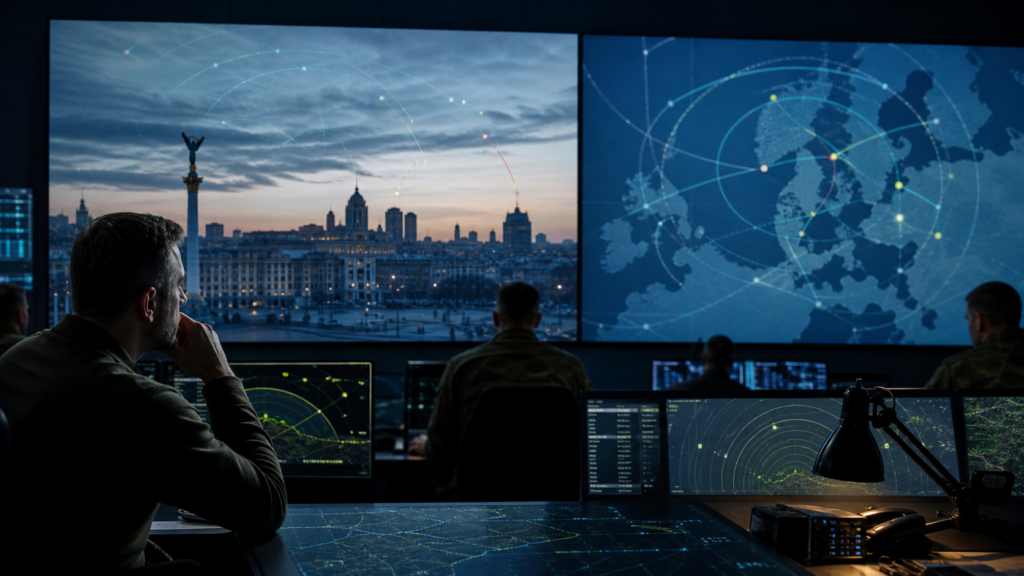
A threat warning over Ukraine now travels quickly into NATO planning rooms because the same strike patterns test European air defense depth, stockpiles and political stamina.
The global relevance comes from the interaction between mass, precision and endurance. RUSI’s lessons from the war emphasize adaptation under fire, while NATO’s Ukraine support page shows how air defense has become a central strategic requirement rather than a specialist niche. The conflict is forcing governments to compare the cost of warning, interception, repair and deterrence.
| Research anchor | What it adds | Why it matters |
|---|---|---|
| RUSI war lessons | Tactics, adaptation and force employment | Frames strikes as a campaign, not isolated news |
| NATO support for Ukraine | Air defense and allied assistance | Links Ukrainian defense to European security |
| ISW campaign updates | Operational context and daily pattern tracking | Helps interpret timing and target selection |
| CSIS Missile Threat | Missile system characteristics | Explains range, launch and warning challenges |
The military pattern to watch
The pattern to watch is sequencing: drones may map defenses, missiles may target infrastructure or command nodes, and follow-on waves may test exhausted crews. CSIS Missile Threat data on systems such as Kh-101 helps explain why speed, range and launch diversity complicate warning. ISW’s campaign tracking gives the daily operational frame for interpreting whether a strike is routine pressure or a signal of change.
What changes in the next phase
The next phase is likely to reward states that combine production scale, sensor fusion and civil resilience. High-end interceptors remain essential, but cheap drones and decoys make density just as important. The strongest lesson is that modern defense cannot separate military readiness from factories, power grids, rail repair, software, public alerts and allied stockpiles.
Sources: https://www.rusi.org/explore-our-research/publications/special-resources/preliminary-lessons-conventional-warfighting-russias-invasion-ukraine-february-july-2022, https://www.rusi.org/explore-our-research/publications/special-resources/meatgrinder-russian-tactics-second-year-its-invasion-ukraine, https://www.nato.int/en/what-we-do/partnerships-and-cooperation/natos-support-for-ukraine, https://understandingwar.org/analysis/russia-ukraine/ukraine-russia-conflict/, https://missilethreat.csis.org/missile/kh-101-kh-102/
What to Watch Next
The indicators to watch are practical rather than theatrical: launch tempo, the mix of drones and missiles, timing against weather and repair cycles, and whether Russia concentrates on military logistics, energy nodes or symbolic political targets. A single alert does not prove a strategic shift, but repeated patterns can reveal stockpile management, adaptation to Ukrainian air defense and pressure points in allied support.
For global readers, that makes Ukraine a warning system for wider security planning. The same questions now matter to NATO members and partners: how many interceptors are available, how quickly damaged infrastructure can be restored, and whether public communication keeps trust during a prolonged campaign.