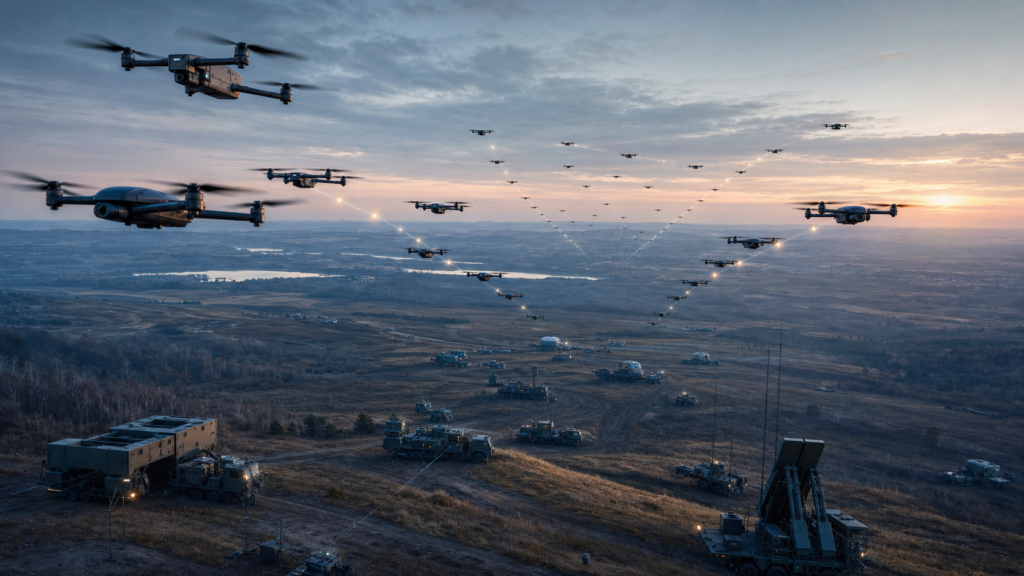
From Individual Drones to Coordinated Mass
The central drone trend of 2026 is not simply that armed forces possess more unmanned aircraft. The deeper change is the transition from individually piloted platforms to groups that can share observations, divide tasks and continue a mission when individual vehicles are lost. Reporting published on June 23, 2026 cited NATO transformation officials warning that AI-enabled swarms could combine mass with precision across air, land and maritime domains. That warning reflects a practical problem already visible in Ukraine: a defender may understand how to defeat one drone yet still fail when many inexpensive systems arrive from different directions and perform different roles.
A useful swarm does not require science-fiction autonomy. It can begin with common mission software, automated route planning, shared target coordinates and rules that let aircraft redistribute reconnaissance, relay and strike duties. Human operators may still authorize critical actions while software handles navigation and coordination. This reduces the number of operators needed per aircraft and compresses the time between detection and action.
The operational value comes from redundancy. A conventional formation can lose effectiveness when a key sensor or command platform is destroyed. A distributed unmanned formation can potentially route information around the loss. Some vehicles can act as decoys, others as sensors, communications relays or interceptors. The result is not an invulnerable cloud, but a force designed to absorb attrition while continuing to generate pressure.
Why Traditional Air Defense Faces a Saturation Problem
Most established air-defense architectures were optimized around a limited number of valuable threats: aircraft, helicopters, cruise missiles and ballistic missiles. Their sensors, command systems and interceptors remain essential, but their economics become uncomfortable when they are repeatedly assigned to small drones. The problem is not only the price of a missile compared with the target. It is also magazine depth, reload time, radar workload and the number of simultaneous tracks a command network can process reliably.
An AI-coordinated raid can exploit those constraints without every drone carrying a warhead. Decoys may stimulate radars and force defenders to reveal positions. Reconnaissance aircraft can observe which sectors engage. Relay drones can extend communications around terrain. Strike vehicles may approach only after the formation has identified a gap. Even imperfect coordination can make a raid more demanding than a simple wave following one route.
This changes the meaning of air superiority. A force may retain advanced fighters and long-range missile batteries yet still struggle to protect every headquarters, bridge, ammunition point and moving column from persistent low-cost observation. The defender therefore needs a layered response: passive sensors, electronic warfare, interceptor drones, guns, directed-energy systems where practical, and missiles reserved for targets that justify them. The objective is not to apply the most powerful weapon to every track. It is to assign the cheapest reliable effect while protecting scarce high-end capacity.
| Threat model | Primary advantage | Main vulnerability | Defensive implication |
|---|---|---|---|
| Single remotely piloted drone | Precise human control | Radio link and operator workload | Detect and disrupt the control chain |
| Coordinated drone salvo | Multiple axes and role specialization | Shared timing and communications dependencies | Layer sensors and preserve magazine depth |
| AI-assisted swarm | Rapid task redistribution and resilience | Software, data and identification errors | Attack the network while defeating individual vehicles |
The New Contest Is Software, Data and Production
Swarm warfare turns procurement speed into a combat variable. Aircraft designs will still matter, but software updates, data standards and access to components may decide which side adapts first. Ukraine’s wartime model has demonstrated the value of short feedback loops between operators, engineers and manufacturers. A system that is adequate today can become ineffective after the opponent changes frequencies, flight profiles, navigation logic or camouflage. Large acquisition programs measured in years are poorly suited to that tempo.
For NATO forces, interoperability is the difficult part. A swarm assembled from several manufacturers must exchange data without creating a cyber vulnerability or locking commanders into one vendor. Identification rules must prevent friendly drones from being mistaken for hostile ones. Communications should degrade gracefully under jamming rather than collapse. Autonomous functions also require clear boundaries, testing and accountability, particularly when software influences targeting decisions.
Production matters because attritable systems only make strategic sense when they can actually be replaced. A spectacular prototype does not create mass. Supply chains for motors, batteries, sensors, processors and secure communications must support continuous output, while training pipelines produce operators, mission planners and maintainers. The emerging competition is therefore less about finding one revolutionary drone than building an ecosystem that can update thousands of ordinary systems quickly.
What an Effective Counter-Swarm Architecture Requires
There is no single counter-swarm weapon. Jammers can be highly effective against exposed links but less useful against autonomous navigation, hardened communications or fiber-optic control. Guns and interceptor drones can provide favorable engagement economics, yet they require early warning and accurate cueing. High-power microwave and laser systems may eventually engage groups efficiently, but weather, range, power generation and line of sight remain operational constraints. Missiles still matter when a dangerous target must be stopped with high confidence.
The strongest architecture separates detection, identification and engagement while connecting them through a common command layer. Passive acoustic, radio-frequency and optical sensors can add tracks without continuously broadcasting. Radar supplies range and velocity. Software correlates weak observations into a usable picture. Commanders then apply engagement rules based on target behavior, location and risk. Mobile units need the same logic in compact form because a static defensive bubble cannot protect a force that must maneuver.
The strategic lesson is blunt: mass cannot be answered only with exquisite scarcity. Defenders need their own scalable sensors, effectors and software, plus the authority to update them rapidly. AI drone swarms are not replacing aircraft, artillery or air defense. They are changing how those systems find targets, consume ammunition and survive contact. Militaries that treat the swarm as merely another drone type will miss the larger shift toward distributed, adaptive combat networks.