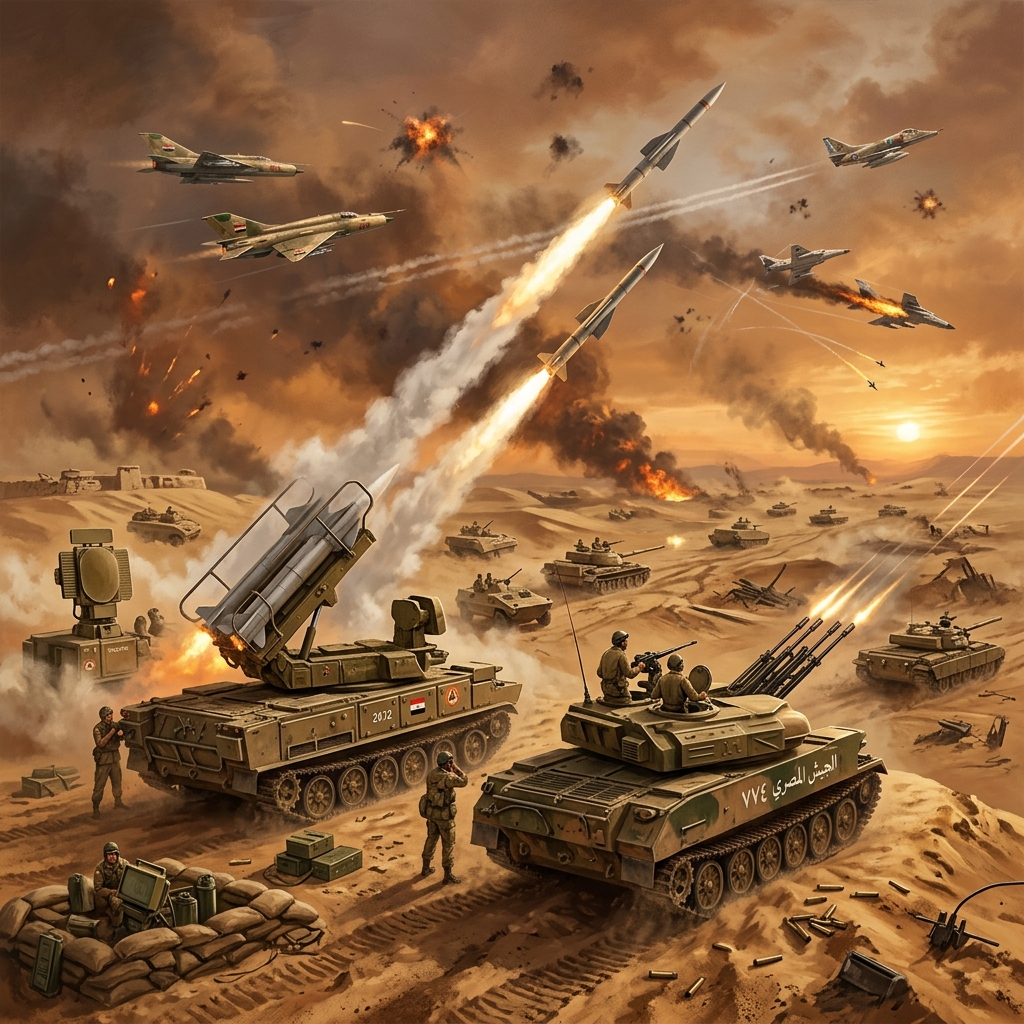
The Shock of October 1973
When the Yom Kippur War erupted on October 6, 1973, the Israeli Air Force (IAF) was widely considered the undisputed master of Middle Eastern skies. Following its stunning victory in the 1967 Six-Day War, where it destroyed the Arab air forces on the ground in a matter of hours, Israeli planners assumed that air superiority would be quickly established in any future conflict. This assumption proved dangerously incorrect. In the opening days of the war, as Egyptian forces surged across the Suez Canal and Syrian armor swept onto the Golan Heights, Israeli fighter jets rushing to support ground troops encountered a dense, integrated air defense network of unprecedented scale. The skies over the battlefields were closed by a thick wall of surface-to-air missiles, catching the IAF completely off guard.
The Egyptian and Syrian air defense networks were not merely collections of individual batteries, but fully integrated, overlapping shields designed by Soviet advisors. They combined strategic static missiles with highly mobile tactical systems, ensuring that any aircraft operating from low to high altitude was constantly under threat. The tactical doctrine was clear: deny the IAF the ability to intervene in the ground battle, allowing Arab armies to consolidate their positions and operate without fear of devastating air strikes. The shock of this defensive wall forced the Israeli command to confront a new reality where air superiority could no longer be taken for granted.
The Soviet-Designed Mobile Shield: SA-6 and Shilka
The core of the tactical air defense shock was the introduction of two modern Soviet-supplied systems: the 2K12 Kub (known to NATO as the SA-6 Gainful) surface-to-air missile system and the ZSU-23-4 Shilka self-propelled anti-aircraft gun. The 2K12 Kub was a mobile system mounted on tracked chassis, allowing it to keep pace with advancing tank and motorized infantry divisions. It utilized semi-active radar homing, which was a significant advancement over the command guidance systems of older SAMs. The Kub’s radar operated on frequencies that were unknown to Israeli intelligence, rendering the electronic countermeasures (ECM) pods carried by Israeli F-4 Phantoms and A-4 Skyhawks completely useless. The missiles flew fast and maneuvered aggressively, earning them the nickname ‘Three Fingers of Death’ among Israeli pilots.
Working in close coordination with the SA-6 was the ZSU-23-4 Shilka. Equipped with a liquid-cooled quad 23mm automatic cannon and an integrated gun-dish radar, the Shilka could project a devastating volume of fire at low-altitude targets. Its high rate of fire and rapid radar-guided tracking made it a nightmare for pilots attempting to fly low to evade the SAM batteries. The combination was lethal: if Israeli jets flew high, they were targeted by the SA-6, SA-2, and SA-3 missiles; if they dove low to escape, they were shredded by the rapid-fire cannons of the Shilka. This layered tactical shield created an almost impassable zone of denial.
Neutralizing IAF Air Superiority
During the first three days of the conflict, the integrated air defense shield inflicted catastrophic losses on the IAF. Attempting to repeat their close air support tactics of 1967, Israeli squadrons suffered heavy casualties. Over the Golan Heights and the Suez Canal, dozens of F-4 Phantoms and A-4 Skyhawks were shot down by the relentless barrage of missiles and artillery. The IAF was forced to temporarily suspend air operations within 15 miles of the Suez Canal, leaving Israeli ground forces to defend against the Egyptian advance without their customary air umbrella. The psychological impact on Israeli pilots was profound, as their radar warning receivers failed to detect the SA-6 locks, and missiles seemed to appear out of nowhere.
The tactical dilemma was exacerbated by the sheer density of the deployments. The Egyptians had lined the western bank of the Suez Canal with dozens of batteries, creating a wall of missile fire that covered the entire crossing zone. The Syrians had established a similar network on the Golan Heights. The IAF attempted various tactics to counter the shield, including terrain masking and chaff drops, but the lack of effective electronic jamming equipment meant that every mission was a high-risk operation. The loss of nearly a third of Israel’s combat aircraft in the first week demonstrated that the missile shield had successfully neutralized IAF air superiority, altering the strategic dynamics of the war’s initial phase.
Tactical Adaptation and the Shield's Collapse
To break the deadlock, the Israeli military recognized that the missile shield had to be defeated from the ground, not the air. On October 15, Israeli forces under Major General Ariel Sharon launched a counteroffensive, crossing the Suez Canal at Deversoir (Operation Stouthearted Men). Operating on the west bank of the canal, Israeli armored columns bypassed the Egyptian infantry and struck directly at the air defense batteries themselves. The lightly armored radar cabins and support vehicles of the SAM sites were highly vulnerable to tank fire. As Israeli tanks systematically overran and destroyed several SA-6 and SA-2 batteries, they tore a massive gap in the Egyptian air defense network, creating safe corridors for the IAF.
Through these newly opened corridors, the IAF flooded the airspace, hunting down the remaining batteries and providing vital close air support to the advancing ground troops. The destruction of the ground-based shield allowed the IAF to regain its freedom of maneuver, ultimately facilitating the encirclement of the Egyptian Third Army and forcing a ceasefire. The Yom Kippur War demonstrated both the immense power of integrated mobile air defenses and their vulnerability to ground maneuver. The lessons learned in 1973 reshaped global military doctrine, leading to the development of stealth technology, advanced electronic warfare, and suppression of enemy air defense (SEAD) tactics that would define subsequent air campaigns.
| System Name | NATO Designation | Type / Propulsion | Max Range (km) | Guidance / Target Altitude |
|---|---|---|---|---|
| 2K12 Kub | SA-6 Gainful | Mobile Tactical SAM | 24 | Semi-Active Radar Homing / Low-to-Med |
| S-75 Dvina | SA-2 Guideline | Static Strategic SAM | 45 | Radio Command Guidance / Med-to-High |
| S-125 Neva | SA-3 Goa | Static Strategic SAM | 15 | Radio Command Guidance / Low-to-Med |
| ZSU-23-4 Shilka | N/A | Mobile Quad 23mm AAA | 2.5 | Radar-Guided / Very Low-to-Low |