From military host to political order
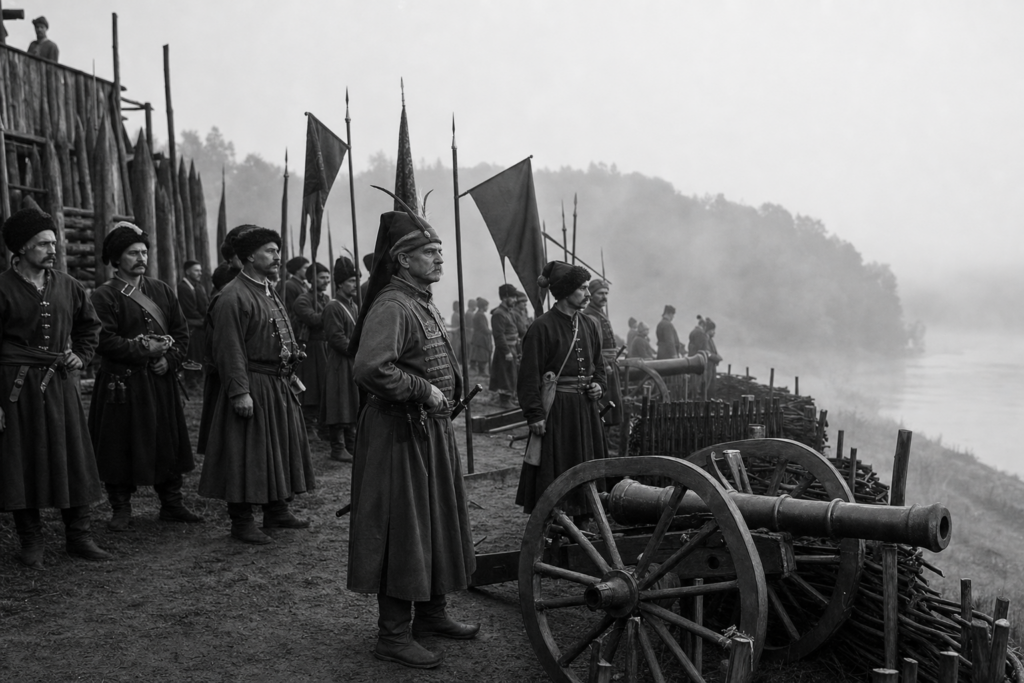
The Cossack Hetmanate was a political and military order that emerged from the mid-seventeenth-century upheavals in Ukrainian lands and operated within a contested frontier between the Polish-Lithuanian Commonwealth, the Crimean Khanate, the Ottoman world, Muscovy, and other regional powers. It cannot be reduced to a single battlefield tradition or a romantic image of independent warriors. The Hetmanate developed institutions of administration, taxation, diplomacy, military organization, and local self-government while confronting constant pressure from larger states. Its history is therefore useful for understanding how a frontier polity tries to turn military mobilization into durable governance. Cossack forces combined cavalry, infantry, artillery, riverine operations, fortifications, and flexible local knowledge, but their effectiveness depended on political alliances, supply, social cohesion, and the authority of the hetman and officer elite.
The Cossack uprising led by Bohdan Khmelnytsky in 1648 created conditions for a new political structure, but the transition from rebellion to governance was difficult. The Hetmanate organized regimental and company districts that combined territorial administration with military command. Officers known as starshyna played central roles in collecting revenue, administering justice, and mobilizing troops. Chancery work, diplomatic correspondence, and fiscal arrangements were as necessary as battlefield leadership. This institutional dimension matters because frontier states cannot survive on mobilization alone. They must decide who has authority, how resources are collected, how disputes are resolved, and how commitments to allies are enforced. The Hetmanate’s political life was contested, and its institutions changed over time, but their existence demonstrates that Cossack statecraft involved more than temporary war bands. It was an effort to create order under conditions of continual external pressure.
The Cossack Hetmanate was a political and military order that emerged from the mid-seventeenth-century upheavals in Ukrainian lands and operated within a contested frontier between the Polish-Lithuanian Commonwealth, the Crimean Khanate, the Ottoman world, Muscovy, and other regional powers. It cannot be reduced to a single battlefield tradition or a romantic image of independent warriors. The Hetmanate developed institutions of administration, taxation, diplomacy, military organization, and local self-government while confronting constant pressure from larger states. Its history is therefore useful for understanding how a frontier polity tries to turn military mobilization into durable governance. Cossack forces combined cavalry, infantry, artillery, riverine operations, fortifications, and flexible local knowledge, but their effectiveness depended on political alliances, supply, social cohesion, and the authority of the hetman and officer elite.
The Cossack uprising led by Bohdan Khmelnytsky in 1648 created conditions for a new political structure, but the transition from rebellion to governance was difficult. The Hetmanate organized regimental and company districts that combined territorial administration with military command. Officers known as starshyna played central roles in collecting revenue, administering justice, and mobilizing troops. Chancery work, diplomatic correspondence, and fiscal arrangements were as necessary as battlefield leadership. This institutional dimension matters because frontier states cannot survive on mobilization alone. They must decide who has authority, how resources are collected, how disputes are resolved, and how commitments to allies are enforced. The Hetmanate’s political life was contested, and its institutions changed over time, but their existence demonstrates that Cossack statecraft involved more than temporary war bands. It was an effort to create order under conditions of continual external pressure.
The Cossack Hetmanate was a political and military order that emerged from the mid-seventeenth-century upheavals in Ukrainian lands and operated within a contested frontier between the Polish-Lithuanian Commonwealth, the Crimean Khanate, the Ottoman world, Muscovy, and other regional powers. It cannot be reduced to a single battlefield tradition or a romantic image of independent warriors. The Hetmanate developed institutions of administration, taxation, diplomacy, military organization, and local self-government while confronting constant pressure from larger states. Its history is therefore useful for understanding how a frontier polity tries to turn military mobilization into durable governance. Cossack forces combined cavalry, infantry, artillery, riverine operations, fortifications, and flexible local knowledge, but their effectiveness depended on political alliances, supply, social cohesion, and the authority of the hetman and officer elite.
The Cossack uprising led by Bohdan Khmelnytsky in 1648 created conditions for a new political structure, but the transition from rebellion to governance was difficult. The Hetmanate organized regimental and company districts that combined territorial administration with military command. Officers known as starshyna played central roles in collecting revenue, administering justice, and mobilizing troops. Chancery work, diplomatic correspondence, and fiscal arrangements were as necessary as battlefield leadership. This institutional dimension matters because frontier states cannot survive on mobilization alone. They must decide who has authority, how resources are collected, how disputes are resolved, and how commitments to allies are enforced. The Hetmanate’s political life was contested, and its institutions changed over time, but their existence demonstrates that Cossack statecraft involved more than temporary war bands. It was an effort to create order under conditions of continual external pressure.
| Element | Function | Strategic significance |
|---|---|---|
| Regimental districts | Administration and mobilization | Links territory to military authority |
| Starshyna | Officer and administrative elite | Manages revenue, justice, and command |
| Fortified towns and Sich | Defense and communication nodes | Protects communities and routes |
| Cavalry, infantry, artillery | Combined military capabilities | Supports flexible frontier operations |
| Diplomacy and treaties | Manage powerful neighbors | Creates options but risks dependence |
Frontier warfare, mobility, and fortified landscapes
The Cossack Hetmanate was a political and military order that emerged from the mid-seventeenth-century upheavals in Ukrainian lands and operated within a contested frontier between the Polish-Lithuanian Commonwealth, the Crimean Khanate, the Ottoman world, Muscovy, and other regional powers. It cannot be reduced to a single battlefield tradition or a romantic image of independent warriors. The Hetmanate developed institutions of administration, taxation, diplomacy, military organization, and local self-government while confronting constant pressure from larger states. Its history is therefore useful for understanding how a frontier polity tries to turn military mobilization into durable governance. Cossack forces combined cavalry, infantry, artillery, riverine operations, fortifications, and flexible local knowledge, but their effectiveness depended on political alliances, supply, social cohesion, and the authority of the hetman and officer elite.
Military operations in the Hetmanate took place across rivers, steppe, forests, towns, and fortified lines. Cossack forces valued mobility, reconnaissance, and the ability to combine mounted troops with infantry and artillery. Wagon formations, field fortifications, and river crossings could help compensate for numerical disadvantages. At the same time, mobility depended on horses, forage, roads, boats, local guides, and secure supply. Fortified towns and the Zaporizhian Sich were not merely symbols; they were nodes of defense, administration, and communication. Warfare along this frontier also involved civilian communities, trade routes, and seasonal rhythms. A commander had to consider not only where to fight, but how to keep forces supplied, how to protect settlements, and how to communicate across distance. This makes the Hetmanate a valuable case for studying the relationship between local knowledge and larger operational systems.
The Cossack Hetmanate was a political and military order that emerged from the mid-seventeenth-century upheavals in Ukrainian lands and operated within a contested frontier between the Polish-Lithuanian Commonwealth, the Crimean Khanate, the Ottoman world, Muscovy, and other regional powers. It cannot be reduced to a single battlefield tradition or a romantic image of independent warriors. The Hetmanate developed institutions of administration, taxation, diplomacy, military organization, and local self-government while confronting constant pressure from larger states. Its history is therefore useful for understanding how a frontier polity tries to turn military mobilization into durable governance. Cossack forces combined cavalry, infantry, artillery, riverine operations, fortifications, and flexible local knowledge, but their effectiveness depended on political alliances, supply, social cohesion, and the authority of the hetman and officer elite.
Military operations in the Hetmanate took place across rivers, steppe, forests, towns, and fortified lines. Cossack forces valued mobility, reconnaissance, and the ability to combine mounted troops with infantry and artillery. Wagon formations, field fortifications, and river crossings could help compensate for numerical disadvantages. At the same time, mobility depended on horses, forage, roads, boats, local guides, and secure supply. Fortified towns and the Zaporizhian Sich were not merely symbols; they were nodes of defense, administration, and communication. Warfare along this frontier also involved civilian communities, trade routes, and seasonal rhythms. A commander had to consider not only where to fight, but how to keep forces supplied, how to protect settlements, and how to communicate across distance. This makes the Hetmanate a valuable case for studying the relationship between local knowledge and larger operational systems.
The Cossack Hetmanate was a political and military order that emerged from the mid-seventeenth-century upheavals in Ukrainian lands and operated within a contested frontier between the Polish-Lithuanian Commonwealth, the Crimean Khanate, the Ottoman world, Muscovy, and other regional powers. It cannot be reduced to a single battlefield tradition or a romantic image of independent warriors. The Hetmanate developed institutions of administration, taxation, diplomacy, military organization, and local self-government while confronting constant pressure from larger states. Its history is therefore useful for understanding how a frontier polity tries to turn military mobilization into durable governance. Cossack forces combined cavalry, infantry, artillery, riverine operations, fortifications, and flexible local knowledge, but their effectiveness depended on political alliances, supply, social cohesion, and the authority of the hetman and officer elite.
Military operations in the Hetmanate took place across rivers, steppe, forests, towns, and fortified lines. Cossack forces valued mobility, reconnaissance, and the ability to combine mounted troops with infantry and artillery. Wagon formations, field fortifications, and river crossings could help compensate for numerical disadvantages. At the same time, mobility depended on horses, forage, roads, boats, local guides, and secure supply. Fortified towns and the Zaporizhian Sich were not merely symbols; they were nodes of defense, administration, and communication. Warfare along this frontier also involved civilian communities, trade routes, and seasonal rhythms. A commander had to consider not only where to fight, but how to keep forces supplied, how to protect settlements, and how to communicate across distance. This makes the Hetmanate a valuable case for studying the relationship between local knowledge and larger operational systems.
Alliances and the risks of strategic dependence
The Cossack Hetmanate was a political and military order that emerged from the mid-seventeenth-century upheavals in Ukrainian lands and operated within a contested frontier between the Polish-Lithuanian Commonwealth, the Crimean Khanate, the Ottoman world, Muscovy, and other regional powers. It cannot be reduced to a single battlefield tradition or a romantic image of independent warriors. The Hetmanate developed institutions of administration, taxation, diplomacy, military organization, and local self-government while confronting constant pressure from larger states. Its history is therefore useful for understanding how a frontier polity tries to turn military mobilization into durable governance. Cossack forces combined cavalry, infantry, artillery, riverine operations, fortifications, and flexible local knowledge, but their effectiveness depended on political alliances, supply, social cohesion, and the authority of the hetman and officer elite.
The Hetmanate operated amid powers stronger in population and resources, making alliances unavoidable and dangerous. Relations with the Crimean Khanate were important in the early stages of the uprising but could be unstable. The 1654 Pereiaslav agreement and subsequent relationship with Muscovy opened military and political possibilities while also creating new constraints on autonomy. Treaties, oaths, and military support could change the balance against one adversary while increasing dependence on another. Internal divisions among Cossack elites, competing visions of autonomy, and the interests of neighboring states contributed to the period sometimes called the Ruin. This history cautions against simple narratives of alliance as either rescue or betrayal. Small and medium polities often make choices under severe pressure, where every available partner imposes costs. Strategic agency exists, but it is constrained by geography, resources, social divisions, and the changing aims of powerful neighbors.
The Cossack Hetmanate was a political and military order that emerged from the mid-seventeenth-century upheavals in Ukrainian lands and operated within a contested frontier between the Polish-Lithuanian Commonwealth, the Crimean Khanate, the Ottoman world, Muscovy, and other regional powers. It cannot be reduced to a single battlefield tradition or a romantic image of independent warriors. The Hetmanate developed institutions of administration, taxation, diplomacy, military organization, and local self-government while confronting constant pressure from larger states. Its history is therefore useful for understanding how a frontier polity tries to turn military mobilization into durable governance. Cossack forces combined cavalry, infantry, artillery, riverine operations, fortifications, and flexible local knowledge, but their effectiveness depended on political alliances, supply, social cohesion, and the authority of the hetman and officer elite.
The Hetmanate operated amid powers stronger in population and resources, making alliances unavoidable and dangerous. Relations with the Crimean Khanate were important in the early stages of the uprising but could be unstable. The 1654 Pereiaslav agreement and subsequent relationship with Muscovy opened military and political possibilities while also creating new constraints on autonomy. Treaties, oaths, and military support could change the balance against one adversary while increasing dependence on another. Internal divisions among Cossack elites, competing visions of autonomy, and the interests of neighboring states contributed to the period sometimes called the Ruin. This history cautions against simple narratives of alliance as either rescue or betrayal. Small and medium polities often make choices under severe pressure, where every available partner imposes costs. Strategic agency exists, but it is constrained by geography, resources, social divisions, and the changing aims of powerful neighbors.
The Cossack Hetmanate was a political and military order that emerged from the mid-seventeenth-century upheavals in Ukrainian lands and operated within a contested frontier between the Polish-Lithuanian Commonwealth, the Crimean Khanate, the Ottoman world, Muscovy, and other regional powers. It cannot be reduced to a single battlefield tradition or a romantic image of independent warriors. The Hetmanate developed institutions of administration, taxation, diplomacy, military organization, and local self-government while confronting constant pressure from larger states. Its history is therefore useful for understanding how a frontier polity tries to turn military mobilization into durable governance. Cossack forces combined cavalry, infantry, artillery, riverine operations, fortifications, and flexible local knowledge, but their effectiveness depended on political alliances, supply, social cohesion, and the authority of the hetman and officer elite.
The Hetmanate operated amid powers stronger in population and resources, making alliances unavoidable and dangerous. Relations with the Crimean Khanate were important in the early stages of the uprising but could be unstable. The 1654 Pereiaslav agreement and subsequent relationship with Muscovy opened military and political possibilities while also creating new constraints on autonomy. Treaties, oaths, and military support could change the balance against one adversary while increasing dependence on another. Internal divisions among Cossack elites, competing visions of autonomy, and the interests of neighboring states contributed to the period sometimes called the Ruin. This history cautions against simple narratives of alliance as either rescue or betrayal. Small and medium polities often make choices under severe pressure, where every available partner imposes costs. Strategic agency exists, but it is constrained by geography, resources, social divisions, and the changing aims of powerful neighbors.
Legacy: Ukrainian statecraft and historical complexity
The Cossack Hetmanate was a political and military order that emerged from the mid-seventeenth-century upheavals in Ukrainian lands and operated within a contested frontier between the Polish-Lithuanian Commonwealth, the Crimean Khanate, the Ottoman world, Muscovy, and other regional powers. It cannot be reduced to a single battlefield tradition or a romantic image of independent warriors. The Hetmanate developed institutions of administration, taxation, diplomacy, military organization, and local self-government while confronting constant pressure from larger states. Its history is therefore useful for understanding how a frontier polity tries to turn military mobilization into durable governance. Cossack forces combined cavalry, infantry, artillery, riverine operations, fortifications, and flexible local knowledge, but their effectiveness depended on political alliances, supply, social cohesion, and the authority of the hetman and officer elite.
The Cossack Hetmanate remains central to Ukrainian historical memory because it represents both a tradition of political self-organization and the difficulties of maintaining autonomy in a contested region. Its legacy includes military culture, administrative practices, legal traditions, diplomatic experience, and debates about sovereignty. A responsible account avoids treating the Hetmanate as a static national symbol. It was diverse, socially stratified, and shaped by changing relations with neighbors and internal actors. Yet that complexity is precisely why it matters. The Hetmanate shows how institutions emerge from conflict, how military authority seeks civilian legitimacy, and how diplomacy becomes essential for survival. Studying it connects local communities and frontier warfare to wider European and Eurasian politics. It also reminds readers that state-building is not a single declaration; it is a continuing effort to organize resources, trust, defense, and political authority under uncertain conditions.
The Cossack Hetmanate was a political and military order that emerged from the mid-seventeenth-century upheavals in Ukrainian lands and operated within a contested frontier between the Polish-Lithuanian Commonwealth, the Crimean Khanate, the Ottoman world, Muscovy, and other regional powers. It cannot be reduced to a single battlefield tradition or a romantic image of independent warriors. The Hetmanate developed institutions of administration, taxation, diplomacy, military organization, and local self-government while confronting constant pressure from larger states. Its history is therefore useful for understanding how a frontier polity tries to turn military mobilization into durable governance. Cossack forces combined cavalry, infantry, artillery, riverine operations, fortifications, and flexible local knowledge, but their effectiveness depended on political alliances, supply, social cohesion, and the authority of the hetman and officer elite.
The Cossack Hetmanate remains central to Ukrainian historical memory because it represents both a tradition of political self-organization and the difficulties of maintaining autonomy in a contested region. Its legacy includes military culture, administrative practices, legal traditions, diplomatic experience, and debates about sovereignty. A responsible account avoids treating the Hetmanate as a static national symbol. It was diverse, socially stratified, and shaped by changing relations with neighbors and internal actors. Yet that complexity is precisely why it matters. The Hetmanate shows how institutions emerge from conflict, how military authority seeks civilian legitimacy, and how diplomacy becomes essential for survival. Studying it connects local communities and frontier warfare to wider European and Eurasian politics. It also reminds readers that state-building is not a single declaration; it is a continuing effort to organize resources, trust, defense, and political authority under uncertain conditions.
The Cossack Hetmanate was a political and military order that emerged from the mid-seventeenth-century upheavals in Ukrainian lands and operated within a contested frontier between the Polish-Lithuanian Commonwealth, the Crimean Khanate, the Ottoman world, Muscovy, and other regional powers. It cannot be reduced to a single battlefield tradition or a romantic image of independent warriors. The Hetmanate developed institutions of administration, taxation, diplomacy, military organization, and local self-government while confronting constant pressure from larger states. Its history is therefore useful for understanding how a frontier polity tries to turn military mobilization into durable governance. Cossack forces combined cavalry, infantry, artillery, riverine operations, fortifications, and flexible local knowledge, but their effectiveness depended on political alliances, supply, social cohesion, and the authority of the hetman and officer elite.
The Cossack Hetmanate remains central to Ukrainian historical memory because it represents both a tradition of political self-organization and the difficulties of maintaining autonomy in a contested region. Its legacy includes military culture, administrative practices, legal traditions, diplomatic experience, and debates about sovereignty. A responsible account avoids treating the Hetmanate as a static national symbol. It was diverse, socially stratified, and shaped by changing relations with neighbors and internal actors. Yet that complexity is precisely why it matters. The Hetmanate shows how institutions emerge from conflict, how military authority seeks civilian legitimacy, and how diplomacy becomes essential for survival. Studying it connects local communities and frontier warfare to wider European and Eurasian politics. It also reminds readers that state-building is not a single declaration; it is a continuing effort to organize resources, trust, defense, and political authority under uncertain conditions.