Engineering, maintenance, and state capacity
Roman roads are often treated as a simple symbol of imperial engineering, but their military importance lay in the wider system they supported: surveying, labor, bridges, milestones, waystations, depots, river crossings, local administration, and the routines of marching armies. A paved road by itself does not create strategic mobility. Soldiers still need food, water, animals, equipment, medical care, intelligence, and secure routes through territory. The Roman state invested in networks that connected cities, forts, ports, frontiers, and provincial centers, enabling officials and forces to move information and resources more predictably than on unimproved routes. These networks varied in quality and purpose across the empire, and Roman armies often marched beyond formal roads. Yet the road system provides a useful historical case for understanding infrastructure as a form of military capacity: it reduces friction, shortens response time, and creates options for commanders and administrators.
Roman roads were built through different methods depending on terrain, local materials, traffic needs, and resources. Some major routes had carefully prepared layers, drainage, bridges, and paving; others were less monumental but still maintained as strategic connections. Building and repairing them required labor from soldiers, communities, contractors, and provincial authorities. This is important because infrastructure is never only an initial project. Its value depends on maintenance, inspections, legal authority, and the ability to mobilize labor after floods, warfare, or wear. Roman milestones and itineraries helped standardize distance and movement, while bridges and ferries connected routes across rivers. Such systems made it easier to plan marches, move messengers, and calculate supply. The road network was therefore an expression of state capacity: the ability to organize people and materials repeatedly across a large territory, not merely the ability to construct impressive stone surfaces once.
Roman roads are often treated as a simple symbol of imperial engineering, but their military importance lay in the wider system they supported: surveying, labor, bridges, milestones, waystations, depots, river crossings, local administration, and the routines of marching armies. A paved road by itself does not create strategic mobility. Soldiers still need food, water, animals, equipment, medical care, intelligence, and secure routes through territory. The Roman state invested in networks that connected cities, forts, ports, frontiers, and provincial centers, enabling officials and forces to move information and resources more predictably than on unimproved routes. These networks varied in quality and purpose across the empire, and Roman armies often marched beyond formal roads. Yet the road system provides a useful historical case for understanding infrastructure as a form of military capacity: it reduces friction, shortens response time, and creates options for commanders and administrators.
Roman roads were built through different methods depending on terrain, local materials, traffic needs, and resources. Some major routes had carefully prepared layers, drainage, bridges, and paving; others were less monumental but still maintained as strategic connections. Building and repairing them required labor from soldiers, communities, contractors, and provincial authorities. This is important because infrastructure is never only an initial project. Its value depends on maintenance, inspections, legal authority, and the ability to mobilize labor after floods, warfare, or wear. Roman milestones and itineraries helped standardize distance and movement, while bridges and ferries connected routes across rivers. Such systems made it easier to plan marches, move messengers, and calculate supply. The road network was therefore an expression of state capacity: the ability to organize people and materials repeatedly across a large territory, not merely the ability to construct impressive stone surfaces once.
Roman roads are often treated as a simple symbol of imperial engineering, but their military importance lay in the wider system they supported: surveying, labor, bridges, milestones, waystations, depots, river crossings, local administration, and the routines of marching armies. A paved road by itself does not create strategic mobility. Soldiers still need food, water, animals, equipment, medical care, intelligence, and secure routes through territory. The Roman state invested in networks that connected cities, forts, ports, frontiers, and provincial centers, enabling officials and forces to move information and resources more predictably than on unimproved routes. These networks varied in quality and purpose across the empire, and Roman armies often marched beyond formal roads. Yet the road system provides a useful historical case for understanding infrastructure as a form of military capacity: it reduces friction, shortens response time, and creates options for commanders and administrators.
Roman roads were built through different methods depending on terrain, local materials, traffic needs, and resources. Some major routes had carefully prepared layers, drainage, bridges, and paving; others were less monumental but still maintained as strategic connections. Building and repairing them required labor from soldiers, communities, contractors, and provincial authorities. This is important because infrastructure is never only an initial project. Its value depends on maintenance, inspections, legal authority, and the ability to mobilize labor after floods, warfare, or wear. Roman milestones and itineraries helped standardize distance and movement, while bridges and ferries connected routes across rivers. Such systems made it easier to plan marches, move messengers, and calculate supply. The road network was therefore an expression of state capacity: the ability to organize people and materials repeatedly across a large territory, not merely the ability to construct impressive stone surfaces once.
| Component | Function | Strategic effect |
|---|---|---|
| Road surfaces and drainage | Support regular travel | Reduces weather-related friction |
| Bridges and ferries | Cross rivers and obstacles | Maintains network continuity |
| Milestones and itineraries | Standardize distance | Improves planning and dispatch |
| Forts and waystations | Support troops and couriers | Connects frontier to administration |
| Maintenance and labor | Repair routes over time | Sustains capacity beyond initial construction |
Marching armies and the logistics of movement
Roman roads are often treated as a simple symbol of imperial engineering, but their military importance lay in the wider system they supported: surveying, labor, bridges, milestones, waystations, depots, river crossings, local administration, and the routines of marching armies. A paved road by itself does not create strategic mobility. Soldiers still need food, water, animals, equipment, medical care, intelligence, and secure routes through territory. The Roman state invested in networks that connected cities, forts, ports, frontiers, and provincial centers, enabling officials and forces to move information and resources more predictably than on unimproved routes. These networks varied in quality and purpose across the empire, and Roman armies often marched beyond formal roads. Yet the road system provides a useful historical case for understanding infrastructure as a form of military capacity: it reduces friction, shortens response time, and creates options for commanders and administrators.
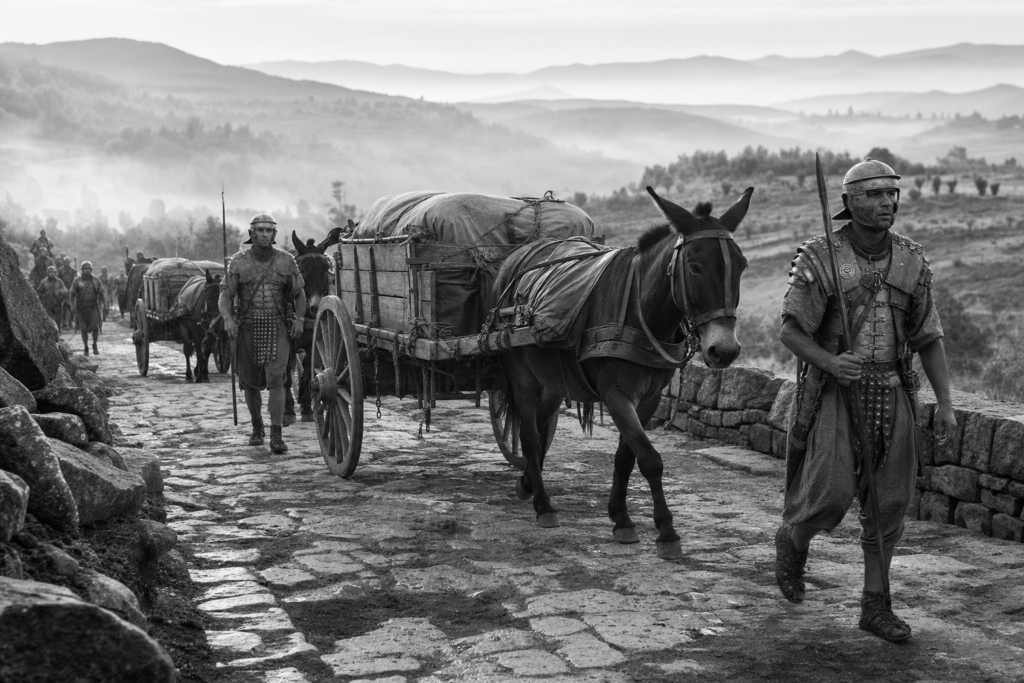
A Roman legion on the move was not simply a column of infantry. It included officers, specialists, baggage, animals, carts, engineers, and often accompanying civilians or allied troops. The daily march had to account for water sources, camp sites, weather, security, and the capacity of roads and bridges. A reliable route could accelerate movement, but it could also become predictable and vulnerable if an enemy understood its use. Commanders therefore balanced speed with reconnaissance and protection. Roads enabled rapid concentration of forces between provincial centers and frontier zones, yet supply still depended on local procurement, river transport, sea routes, and stored resources. The historical lesson is that mobility has layers. Roads improve the movement of people and wheeled transport, but a campaign succeeds only when food, animals, communication, and security are managed along the route. Infrastructure creates potential; organization converts it into operational effect.
Roman roads are often treated as a simple symbol of imperial engineering, but their military importance lay in the wider system they supported: surveying, labor, bridges, milestones, waystations, depots, river crossings, local administration, and the routines of marching armies. A paved road by itself does not create strategic mobility. Soldiers still need food, water, animals, equipment, medical care, intelligence, and secure routes through territory. The Roman state invested in networks that connected cities, forts, ports, frontiers, and provincial centers, enabling officials and forces to move information and resources more predictably than on unimproved routes. These networks varied in quality and purpose across the empire, and Roman armies often marched beyond formal roads. Yet the road system provides a useful historical case for understanding infrastructure as a form of military capacity: it reduces friction, shortens response time, and creates options for commanders and administrators.
A Roman legion on the move was not simply a column of infantry. It included officers, specialists, baggage, animals, carts, engineers, and often accompanying civilians or allied troops. The daily march had to account for water sources, camp sites, weather, security, and the capacity of roads and bridges. A reliable route could accelerate movement, but it could also become predictable and vulnerable if an enemy understood its use. Commanders therefore balanced speed with reconnaissance and protection. Roads enabled rapid concentration of forces between provincial centers and frontier zones, yet supply still depended on local procurement, river transport, sea routes, and stored resources. The historical lesson is that mobility has layers. Roads improve the movement of people and wheeled transport, but a campaign succeeds only when food, animals, communication, and security are managed along the route. Infrastructure creates potential; organization converts it into operational effect.
Roman roads are often treated as a simple symbol of imperial engineering, but their military importance lay in the wider system they supported: surveying, labor, bridges, milestones, waystations, depots, river crossings, local administration, and the routines of marching armies. A paved road by itself does not create strategic mobility. Soldiers still need food, water, animals, equipment, medical care, intelligence, and secure routes through territory. The Roman state invested in networks that connected cities, forts, ports, frontiers, and provincial centers, enabling officials and forces to move information and resources more predictably than on unimproved routes. These networks varied in quality and purpose across the empire, and Roman armies often marched beyond formal roads. Yet the road system provides a useful historical case for understanding infrastructure as a form of military capacity: it reduces friction, shortens response time, and creates options for commanders and administrators.
A Roman legion on the move was not simply a column of infantry. It included officers, specialists, baggage, animals, carts, engineers, and often accompanying civilians or allied troops. The daily march had to account for water sources, camp sites, weather, security, and the capacity of roads and bridges. A reliable route could accelerate movement, but it could also become predictable and vulnerable if an enemy understood its use. Commanders therefore balanced speed with reconnaissance and protection. Roads enabled rapid concentration of forces between provincial centers and frontier zones, yet supply still depended on local procurement, river transport, sea routes, and stored resources. The historical lesson is that mobility has layers. Roads improve the movement of people and wheeled transport, but a campaign succeeds only when food, animals, communication, and security are managed along the route. Infrastructure creates potential; organization converts it into operational effect.
Frontiers, communication, and strategic choice
Roman roads are often treated as a simple symbol of imperial engineering, but their military importance lay in the wider system they supported: surveying, labor, bridges, milestones, waystations, depots, river crossings, local administration, and the routines of marching armies. A paved road by itself does not create strategic mobility. Soldiers still need food, water, animals, equipment, medical care, intelligence, and secure routes through territory. The Roman state invested in networks that connected cities, forts, ports, frontiers, and provincial centers, enabling officials and forces to move information and resources more predictably than on unimproved routes. These networks varied in quality and purpose across the empire, and Roman armies often marched beyond formal roads. Yet the road system provides a useful historical case for understanding infrastructure as a form of military capacity: it reduces friction, shortens response time, and creates options for commanders and administrators.
Roman roads connected more than armies. They linked governors, tax officials, merchants, couriers, and communities, making them part of a political as well as military system. On frontiers such as Britain, the Rhine, and the Danube, roads tied forts to supply bases and ports, allowing units to shift and information to travel. This did not make borders invulnerable. Distance, weather, local resistance, and competing priorities could still slow response. But networks gave Rome greater flexibility in deciding where to concentrate force and how to reinforce threatened points. Communication was especially important: reports could move through official and informal channels, enabling authorities to assess events and issue orders. The road system therefore shaped strategic choice by changing the time required to learn, decide, and act. In a large empire, reducing that time could be as important as the number of soldiers stationed in any one place.
Roman roads are often treated as a simple symbol of imperial engineering, but their military importance lay in the wider system they supported: surveying, labor, bridges, milestones, waystations, depots, river crossings, local administration, and the routines of marching armies. A paved road by itself does not create strategic mobility. Soldiers still need food, water, animals, equipment, medical care, intelligence, and secure routes through territory. The Roman state invested in networks that connected cities, forts, ports, frontiers, and provincial centers, enabling officials and forces to move information and resources more predictably than on unimproved routes. These networks varied in quality and purpose across the empire, and Roman armies often marched beyond formal roads. Yet the road system provides a useful historical case for understanding infrastructure as a form of military capacity: it reduces friction, shortens response time, and creates options for commanders and administrators.
Roman roads connected more than armies. They linked governors, tax officials, merchants, couriers, and communities, making them part of a political as well as military system. On frontiers such as Britain, the Rhine, and the Danube, roads tied forts to supply bases and ports, allowing units to shift and information to travel. This did not make borders invulnerable. Distance, weather, local resistance, and competing priorities could still slow response. But networks gave Rome greater flexibility in deciding where to concentrate force and how to reinforce threatened points. Communication was especially important: reports could move through official and informal channels, enabling authorities to assess events and issue orders. The road system therefore shaped strategic choice by changing the time required to learn, decide, and act. In a large empire, reducing that time could be as important as the number of soldiers stationed in any one place.
Roman roads are often treated as a simple symbol of imperial engineering, but their military importance lay in the wider system they supported: surveying, labor, bridges, milestones, waystations, depots, river crossings, local administration, and the routines of marching armies. A paved road by itself does not create strategic mobility. Soldiers still need food, water, animals, equipment, medical care, intelligence, and secure routes through territory. The Roman state invested in networks that connected cities, forts, ports, frontiers, and provincial centers, enabling officials and forces to move information and resources more predictably than on unimproved routes. These networks varied in quality and purpose across the empire, and Roman armies often marched beyond formal roads. Yet the road system provides a useful historical case for understanding infrastructure as a form of military capacity: it reduces friction, shortens response time, and creates options for commanders and administrators.
Roman roads connected more than armies. They linked governors, tax officials, merchants, couriers, and communities, making them part of a political as well as military system. On frontiers such as Britain, the Rhine, and the Danube, roads tied forts to supply bases and ports, allowing units to shift and information to travel. This did not make borders invulnerable. Distance, weather, local resistance, and competing priorities could still slow response. But networks gave Rome greater flexibility in deciding where to concentrate force and how to reinforce threatened points. Communication was especially important: reports could move through official and informal channels, enabling authorities to assess events and issue orders. The road system therefore shaped strategic choice by changing the time required to learn, decide, and act. In a large empire, reducing that time could be as important as the number of soldiers stationed in any one place.
Legacy: infrastructure as a military system
Roman roads are often treated as a simple symbol of imperial engineering, but their military importance lay in the wider system they supported: surveying, labor, bridges, milestones, waystations, depots, river crossings, local administration, and the routines of marching armies. A paved road by itself does not create strategic mobility. Soldiers still need food, water, animals, equipment, medical care, intelligence, and secure routes through territory. The Roman state invested in networks that connected cities, forts, ports, frontiers, and provincial centers, enabling officials and forces to move information and resources more predictably than on unimproved routes. These networks varied in quality and purpose across the empire, and Roman armies often marched beyond formal roads. Yet the road system provides a useful historical case for understanding infrastructure as a form of military capacity: it reduces friction, shortens response time, and creates options for commanders and administrators.
The legacy of Roman roads is often visible in later landscapes, but their deeper lesson concerns systems thinking. Military power is not only weapons and formations; it also includes the physical and administrative networks that allow those formations to exist, move, and be supplied. Roman infrastructure worked because it was connected to law, taxation, labor, local governance, and military practice. It was neither uniform nor magically efficient, and it could be neglected or damaged. Nevertheless, it helped sustain an empire across diverse regions for centuries. Modern readers should avoid direct analogies between ancient roads and contemporary technology, but the underlying question remains relevant: which networks reduce friction for a state, and who maintains them when crises occur? Studying Roman mobility highlights how engineering, institutions, and logistics combine to create strategic endurance.
Roman roads are often treated as a simple symbol of imperial engineering, but their military importance lay in the wider system they supported: surveying, labor, bridges, milestones, waystations, depots, river crossings, local administration, and the routines of marching armies. A paved road by itself does not create strategic mobility. Soldiers still need food, water, animals, equipment, medical care, intelligence, and secure routes through territory. The Roman state invested in networks that connected cities, forts, ports, frontiers, and provincial centers, enabling officials and forces to move information and resources more predictably than on unimproved routes. These networks varied in quality and purpose across the empire, and Roman armies often marched beyond formal roads. Yet the road system provides a useful historical case for understanding infrastructure as a form of military capacity: it reduces friction, shortens response time, and creates options for commanders and administrators.
The legacy of Roman roads is often visible in later landscapes, but their deeper lesson concerns systems thinking. Military power is not only weapons and formations; it also includes the physical and administrative networks that allow those formations to exist, move, and be supplied. Roman infrastructure worked because it was connected to law, taxation, labor, local governance, and military practice. It was neither uniform nor magically efficient, and it could be neglected or damaged. Nevertheless, it helped sustain an empire across diverse regions for centuries. Modern readers should avoid direct analogies between ancient roads and contemporary technology, but the underlying question remains relevant: which networks reduce friction for a state, and who maintains them when crises occur? Studying Roman mobility highlights how engineering, institutions, and logistics combine to create strategic endurance.
Roman roads are often treated as a simple symbol of imperial engineering, but their military importance lay in the wider system they supported: surveying, labor, bridges, milestones, waystations, depots, river crossings, local administration, and the routines of marching armies. A paved road by itself does not create strategic mobility. Soldiers still need food, water, animals, equipment, medical care, intelligence, and secure routes through territory. The Roman state invested in networks that connected cities, forts, ports, frontiers, and provincial centers, enabling officials and forces to move information and resources more predictably than on unimproved routes. These networks varied in quality and purpose across the empire, and Roman armies often marched beyond formal roads. Yet the road system provides a useful historical case for understanding infrastructure as a form of military capacity: it reduces friction, shortens response time, and creates options for commanders and administrators.
The legacy of Roman roads is often visible in later landscapes, but their deeper lesson concerns systems thinking. Military power is not only weapons and formations; it also includes the physical and administrative networks that allow those formations to exist, move, and be supplied. Roman infrastructure worked because it was connected to law, taxation, labor, local governance, and military practice. It was neither uniform nor magically efficient, and it could be neglected or damaged. Nevertheless, it helped sustain an empire across diverse regions for centuries. Modern readers should avoid direct analogies between ancient roads and contemporary technology, but the underlying question remains relevant: which networks reduce friction for a state, and who maintains them when crises occur? Studying Roman mobility highlights how engineering, institutions, and logistics combine to create strategic endurance.