The Strategic Crux of the Mediterranean
During the Second World War, a tiny archipelago in the center of the Mediterranean Sea became the target of one of the most sustained and brutal aerial sieges in military history. The island of Malta, a British crown colony, sat directly astride the Axis supply routes running from Italy to Field Marshal Erwin Rommel’s Panzer Army Africa in Libya. For the Allies, Malta was an unsinkable aircraft carrier, submarine base, and radar outpost from which they could harass and disrupt Axis logistics. For Axis commanders, particularly the Italian Regia Aeronautica and the German Luftwaffe, the elimination of Malta was a strategic necessity. If Malta fell, the Mediterranean would become an Axis lake, securing Rommel’s supply lines and opening the road to the Suez Canal and the oil fields of the Middle East.
The siege began on June 11, 1940, the day after Italy declared war on the Allies. With the French fleet out of the war and the British Mediterranean Fleet forced to withdraw to Alexandria, Malta was left isolated and undefended. The island possessed no modern fighter aircraft, no anti-aircraft searchlights, and only a tiny garrison of soldiers. Yet, over the next two and a half years, the island’s defenders would endure over 3,000 air raids, making Malta the most bombed place on Earth during the war. The battle for Malta was not just a battle for territory; it was a battle of logistical endurance and air defense innovation.
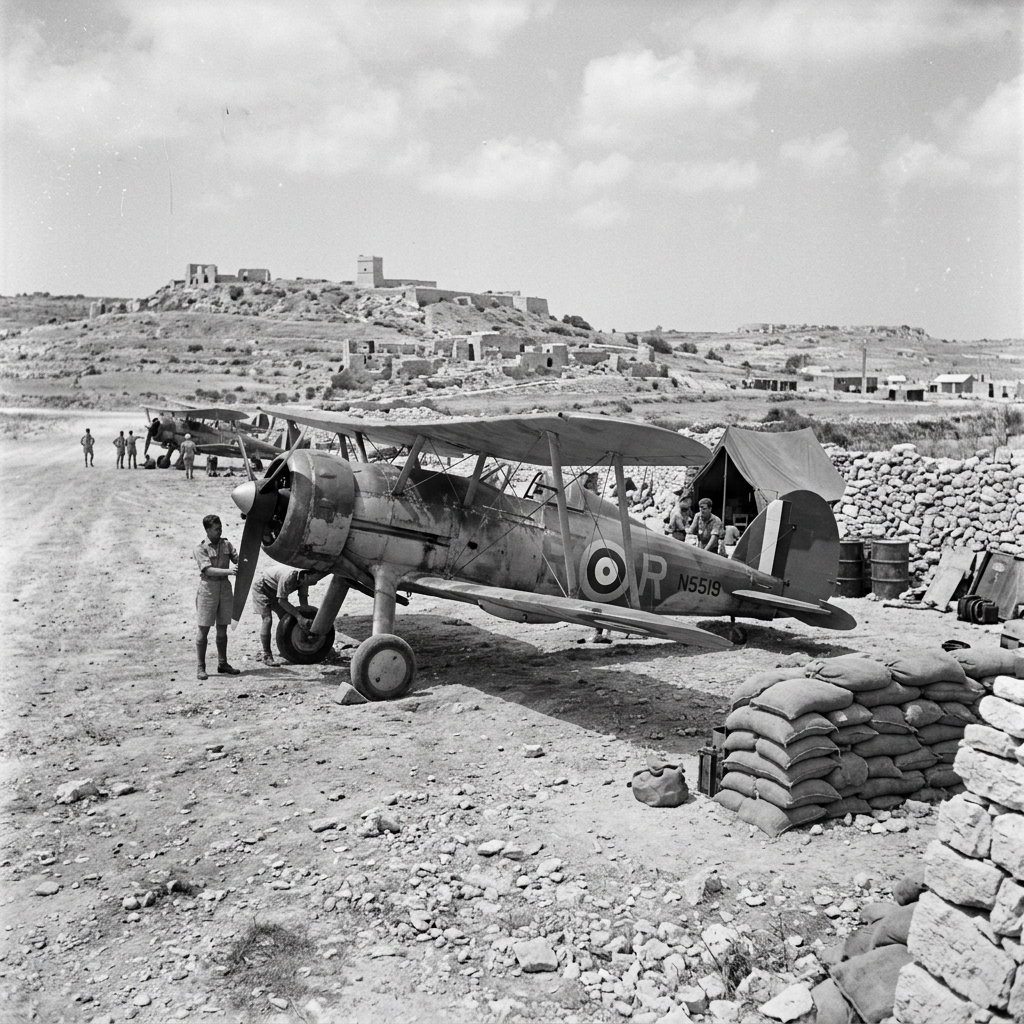
Faith, Hope, and Charity: The Legendary Gladiator Defense
In the opening weeks of the siege, the air defense of Malta fell to a handful of obsolete biplanes. Legend has it that only three Gloster Sea Gladiators, famously named Faith, Hope, and Charity, defended the island against hundreds of Italian bombers. While the reality was slightly more complex—there were initially six crated Gladiators, with a few kept in reserve for spare parts—the psychological impact of these biplanes was immense. Flown by a small group of volunteer pilots who had never flown fighters before, the Gladiators scrambled day after day to intercept incoming formations, successfully disrupting attacks and proving that the island would not surrender without a fight.
By late 1940, the arrival of Hawker Hurricanes via aircraft carriers (a dangerous logistical operation known as “Club Runs”) provided the island with its first modern interceptors. However, the true test came in early 1941 when the German Luftwaffe’s Fliegerkorps X was transferred to Sicily. The Germans brought the deadly Messerschmitt Bf 109 and the Junkers Ju 87 Stuka dive-bomber, unleashing a campaign of devastation. The RAF pilots on Malta were severely outnumbered and plagued by shortages of aviation fuel, spare parts, and ammunition. Pilots flew multiple sorties a day, collapsing from exhaustion, while ground crews worked in bombed-out pens to keep the aircraft flying under continuous bombardment.
Under Ground and in the Air: The Civil and Military Synergy
The survival of Malta depended on a unique synergy between the military defenders and the civilian population. The island’s geography provided a natural advantage: its core was composed of soft globigerina limestone. As the bombs fell, Maltese civilians and military engineers carved out a vast network of underground shelters, hospitals, and command centers. Entire communities moved underground, living in conditions of extreme crowding and poor sanitation, but safe from the high-explosive payloads dropped from above. The Lascaris War Rooms, located deep beneath the fortifications of Valletta, served as the nerve center of the defense, where operators plotted radar tracks and directed fighter interceptions.
Malta’s military engineers also demonstrated incredible resilience. Airfield runways at Hal Far, Luqa, and Ta’ Qali were repeatedly cratered by bombs. In response, thousands of Maltese civilians and soldiers stood ready with shovels and rollers. Within minutes of a raid ending, they would swarm onto the runways, filling craters and smoothing the surface so that incoming fighters could land safely. The island’s early warning capability was also enhanced by the installation of AMES Type 242 radar stations. Perched on the island’s high cliffs, these radars detected Axis aircraft as they took off from Sicilian airfields just 60 miles away, giving Malta’s defenders a vital 15-minute warning to scramble their fighters.
Operation Pedestal and the Turning of the Tide
By mid-1942, Malta was on the brink of starvation. Axis blockades had cut off almost all supply ships, and the island’s stocks of food, fuel, and ammunition were down to a few weeks. The British government launched Operation Pedestal, a massive convoy of 14 merchant ships escorted by an unprecedented force of battleships, aircraft carriers, and cruisers. The convoy was subjected to a relentless four-day gauntlet of Axis submarines, torpedo boats, and bombers. Only five merchant ships, including the heavily damaged American-built oil tanker SS Ohio, made it to Valletta’s Grand Harbour. The arrival of the Ohio, carrying vital fuel, saved the island from surrender at the final hour.
With fuel restored and reinforced with Spitfire Mk V fighters, Malta’s air shield became impenetrable. The island went on the offensive. British bombers and submarines operating from Malta destroyed up to 60% of Axis supply convoys heading to North Africa, leaving Rommel’s Panzer Army without fuel and ammunition. This directly enabled the Allied victory at El Alamein and the subsequent collapse of the Axis front in North Africa. The defense of Malta proved that a coordinated air shield, combined with civilian resilience and radar technology, could withstand the most intense siege in history, transforming a vulnerable outpost into the springboard for the liberation of Southern Europe.
| Fighter Aircraft Type | Role in Defense | Maximum Speed | Armament | Service Period in Malta |
|---|---|---|---|---|
| Gloster Sea Gladiator | Initial Biplane Interception | 253 mph (407 km/h) | 4x .303 Browning machine guns | June – August 1940 |
| Hawker Hurricane Mk I/II | Main Defense Workhorse | 340 mph (547 km/h) | 8x or 12x .303 machine guns | August 1940 – March 1942 |
| Supermarine Spitfire Mk V | Air Superiority Interceptor | 374 mph (602 km/h) | 2x 20mm cannons, 4x .303 guns | March 1942 – End of Siege |