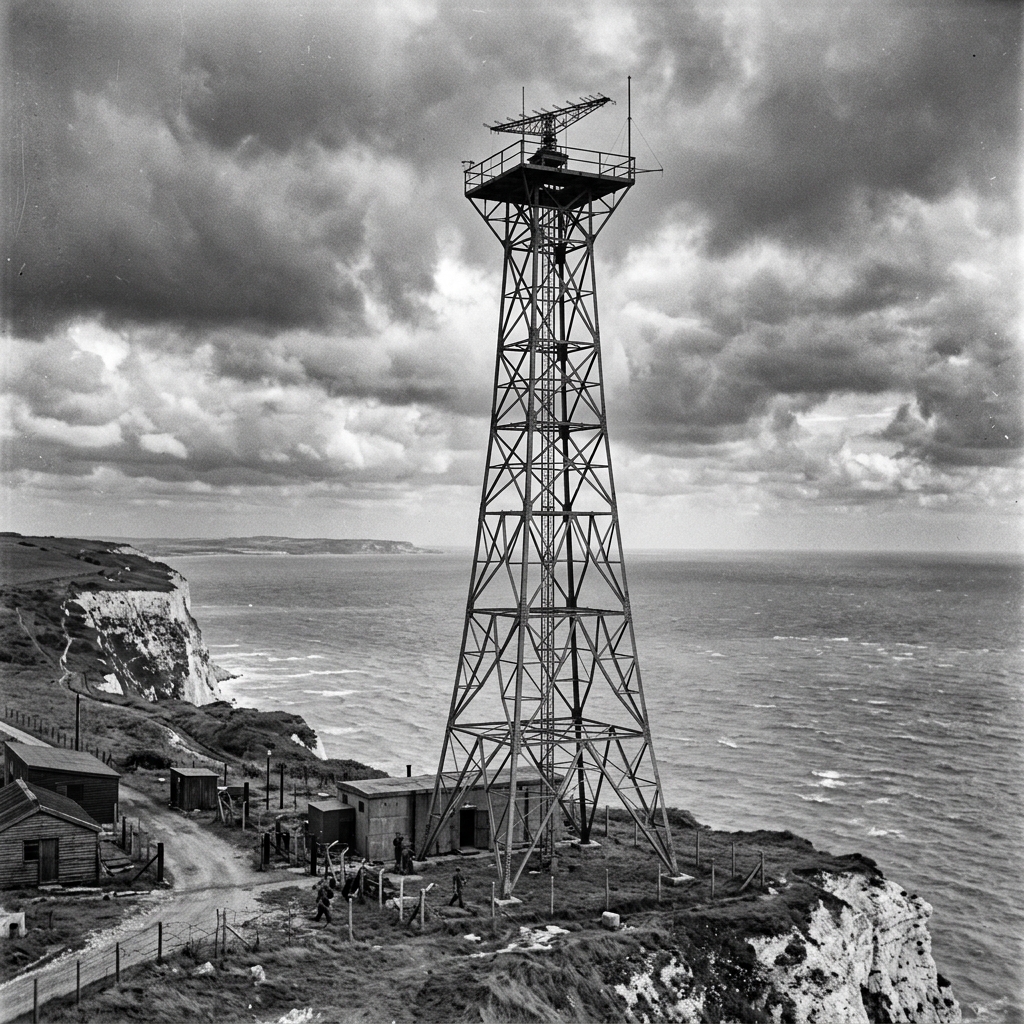
The Technological Race Against the Luftwaffe
In the summer of 1940, the fate of Western Europe hung on a thread. Following the fall of France, Great Britain stood isolated against the seemingly unstoppable might of the German Luftwaffe. Under the command of Reichsmarschall Hermann Göring, the Luftwaffe launched a massive aerial offensive aimed at destroying the Royal Air Force (RAF) as a prerequisite for Operation Sea Lion—the planned amphibious invasion of the British Isles. The German air fleet possessed a massive numerical advantage, fielding over 2,500 combat aircraft against the RAF’s hard-pressed Fighter Command, which could muster fewer than 700 operational Hurricanes and Spitfires. To survive, the British military needed more than bravery; they needed a technological miracle.
That miracle was a highly classified network of radio towers code-named Chain Home. Developed in the mid-1930s by a team of visionary British scientists led by Sir Robert Watson-Watt, the system utilized electromagnetic waves to detect incoming aircraft long before they could reach the British coastline. Unlike traditional methods of air defense, which relied on acoustic mirrors and visual observers to spot enemy bombers after they had already crossed the coast, radar provided early warning of incoming raids up to 100 miles away. This critical window of time stripped the Luftwaffe of the element of surprise, transforming the Battle of Britain from an unequal battle of attrition into a tactical contest where the defenders could anticipate every move.
The Architecture of the Chain Home Network
The physical manifestation of this electromagnetic shield was a series of imposing steel and wooden towers erected along the southern and eastern coasts of England. Known officially as Air Ministry Experimental Station (AMES) Type 1, the Chain Home stations operated on high-frequency radio bands between 20 and 30 megahertz (wavelengths of 10 to 15 meters). Unlike modern radar systems that utilize rotating directional antennas, Chain Home stations used stationary floodlight transmitters to illuminate vast sectors of the sky with radio energy. The reflected signals were then captured by separate, highly sensitive receiver towers located nearby.
These stations were massive engineering feats. The transmitter masts, constructed of steel, rose to a height of 350 feet, while the wooden receiver towers stood at 240 feet. Operating at such low frequencies, the radar beams were wide, requiring skilled operators—predominantly members of the Women’s Auxiliary Air Force (WAAF)—to determine the range, bearing, and altitude of the incoming formations. Using a cathode-ray tube oscilloscope, operators measured the tiny “blips” of reflected energy, applying complex mathematical corrections to estimate the size of the enemy raid. Despite its primitive appearance, Chain Home was a robust and resilient network that could operate continuously in all weather conditions, providing a constant watch over the English Channel.
The Dowding System: The World's First Integrated Air Defense
Radar alone, however, was not enough to win the battle. The true genius of British air defense lay in how this electronic data was processed and translated into tactical decisions. This revolutionary command-and-control framework, devised by Air Chief Marshal Sir Hugh Dowding, became known as the Dowding System. It was the world’s first integrated air defense network, linking radar stations, ground observers, fighter squadrons, and anti-aircraft artillery into a single, cohesive command structure through a secure network of dedicated telephone lines.
When a Chain Home station detected an incoming formation, the details were immediately telephoned to the Filter Room at Fighter Command Headquarters in Bentley Priory. There, trained officers cross-referenced the radar plots with visual reports from the Observer Corps to filter out errors and establish a clear track of the raid. Once verified, the track was sent to the Operations Rooms of individual Fighter Groups, such as Group 11, which defended London and the southeast. On giant map tables, using wooden croupier-style rakes, plotters moved color-coded markers representing enemy and friendly formations. This real-time visualization allowed commanders to vector Spitfires and Hurricanes to the exact altitude and location of the enemy bombers, conserving precious fuel and pilot strength.
Strategic Impact and Legacy of the Electromagnetic Shield
The integration of radar and the Dowding System fundamentally altered the economics of aerial warfare. Because British commanders did not have to run continuous patrol flights in search of the enemy, they could keep their fighters on the ground until a raid was detected, launching them at the precise moment to intercept the attackers. This multiplier effect effectively doubled the strength of Fighter Command. German pilots, expecting to find the RAF destroyed, were repeatedly shocked to find British interceptors waiting for them in the clouds, regardless of the route they took.
By October 1940, having suffered unsustainable losses in bombers and crews, Adolf Hitler was forced to postpone Operation Sea Lion indefinitely. The electromagnetic shield of Chain Home had saved Britain from invasion and handed Nazi Germany its first major strategic defeat of World War II. Beyond its immediate military victory, the development of British radar laid the foundation for the postwar electronic age, leading directly to advancements in microwave technology, television, and radio astronomy. The towers of Chain Home stood as silent sentinels, demonstrating for the first time in history that the invisible spectrum of radio waves could decide the fate of nations.
| Technical Parameter | Chain Home Specification (1940) |
|---|---|
| Operating Frequency | 20 – 30 MHz (High Frequency / HF) |
| Wavelength | 10 – 15 meters |
| Peak Power Output | 350 kW (later upgraded to 750 kW) |
| Detection Range (Bombers) | Up to 80 – 100 miles (130 – 160 km) |
| Detection Range (Fighters) | Up to 50 – 60 miles (80 – 95 km) |
| Transmitter Mast Height | 350 feet (106 meters) – Steel |
| Receiver Mast Height | 240 feet (73 meters) – Wood |
| Sector Coverage | Approx. 120-degree floodlight arc |