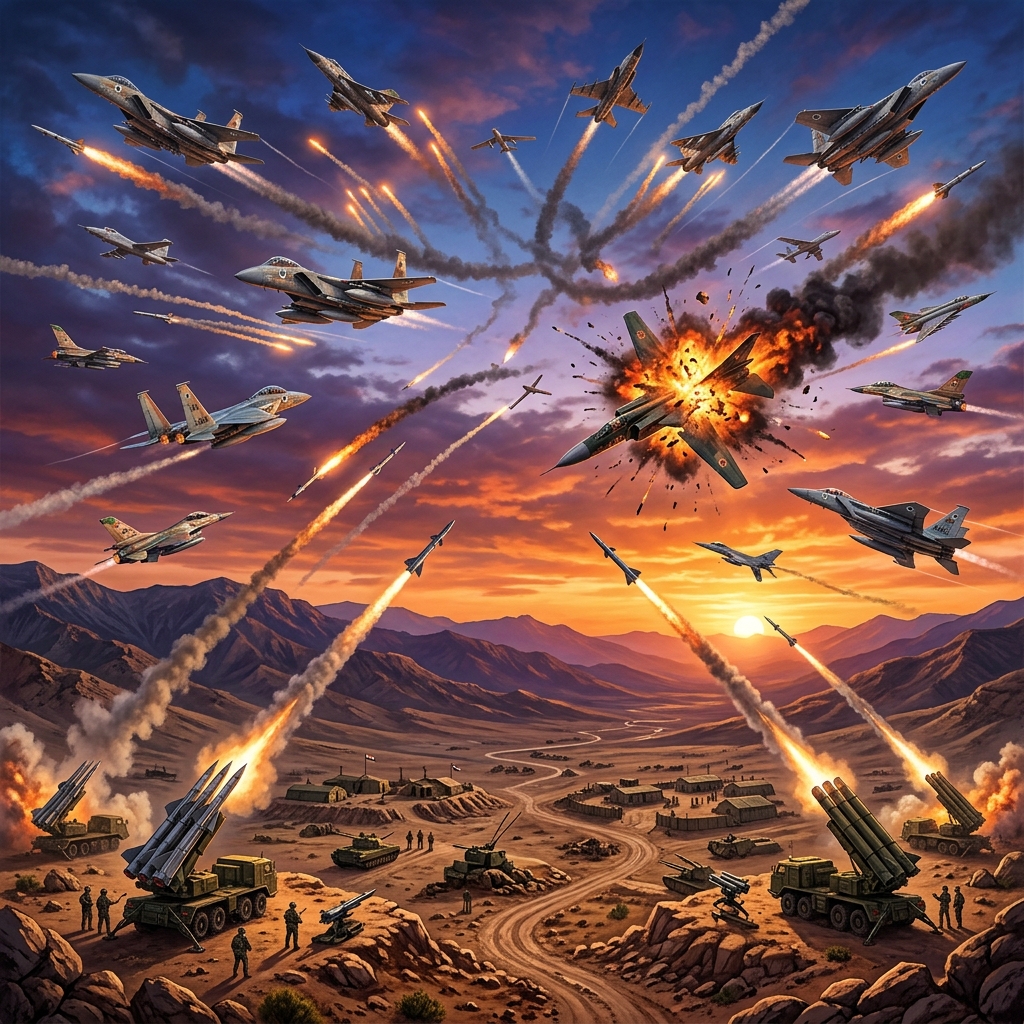
The Bekaa Valley Missile Threat
In the spring of 1982, the Bekaa Valley in Lebanon was home to one of the densest and most modern air defense networks in the world. Following the outbreak of the Lebanese Civil War and the subsequent Syrian intervention, Syria deployed a massive network of Soviet-supplied surface-to-air missile (SAM) batteries into the valley. This network was composed primarily of SA-6 “Gainful” mobile missile systems, supplemented by older SA-2 “Guideline” and SA-3 “Goa” systems. Operating under a unified command structure and backed by early warning radars and anti-aircraft artillery, this “SAM umbrella” effectively closed Lebanese airspace to Israeli aviation, posing a severe strategic threat to the Israeli Air Force (IAF).
For Israel, the presence of these missiles was unacceptable. They not only restricted the IAF’s ability to support ground operations but also threatened northern Israel. However, attacking a modern, integrated air defense network was considered a high-risk operation. During the 1973 Yom Kippur War, similar Soviet-supplied SAM networks had inflicted catastrophic losses on the IAF, shooting down over 100 Israeli jets in the opening days of the conflict. To avoid a repeat of that disaster, Israeli military planners realized they could not rely on brute force; they needed a revolutionary approach that combined electronic warfare, unmanned aircraft, and precision-guided munitions.
The Intel Revolution: Drones and Decoys
The key to defeating the Syrian SAM network lay in the innovative use of unmanned aerial vehicles (UAVs)—a technology in which Israel was a global pioneer. Prior to the attack, the IAF deployed small, remote-controlled Scout and Mastiff UAVs to loiter over the Bekaa Valley. These drones, made of fiberglass and possessing tiny radar cross-sections, were virtually invisible to Syrian radar. Equipped with real-time video cameras, they transmitted live footage of the Syrian missile sites, revealing their exact locations, movements, and operational readiness without risking a single pilot’s life.
When the operation launched on the afternoon of June 9, 1982, the IAF did not send manned fighters first. Instead, they launched decoy drones, including Samson and Delilah air-launched decoys and ground-launched targets. These decoys were designed to mimic the radar signatures of Israeli fighter jets. The Syrian radar operators, believing they were under massive attack, turned on their target-tracking radars and opened fire, launching their missiles at empty decoys. This accomplished two critical goals: it exhausted the Syrian missile supply and, more importantly, forced the Syrian radars to emit electromagnetic signals, revealing their exact operating frequencies to hovering Israeli electronic intelligence (ELINT) aircraft.
The SEAD Blitz: Electronic Suppression and Precision Strike
With the Syrian radar frequencies identified and recorded, the IAF launched a coordinated Suppression of Enemy Air Defenses (SEAD) blitz. Ground-launched Katiusza rockets and artillery fired anti-radiation warheads, while IAF F-4 Phantom fighters launched AGM-45 Shrike and AGM-78 Standard ARM anti-radiation missiles. These missiles locked onto the active electromagnetic emissions of the Syrian radars, riding the beams directly to their sources and destroying the radar cabins with pinpoint accuracy. Without their tracking radars, the remaining Syrian missile launchers were blinded and helpless.
Simultaneously, Israeli Boeing 707 jamming aircraft cloaked the airspace in electromagnetic noise, disrupting Syrian communication links with their ground control intercept (GCI) stations. As the SAM batteries were systematically destroyed, the Syrian Air Force scrambled dozens of MiG-21 and MiG-23 fighters to intercept the attackers. However, the Syrian pilots, cut off from their ground controllers by jamming and facing Israeli F-15 and F-16 fighters armed with all-aspect AIM-9L Sidewinder and Python 3 missiles, were slaughtered in the skies. The ensuing air battle became one of the largest and most one-sided dogfights of the jet age.
Strategic Impact and the Death of the Soviet Air Defense Doctrine
By the evening of June 9, 1982, Operation Mole Cricket 19 had achieved a decisive victory. In less than two hours, the IAF had destroyed 17 of the 19 Syrian SAM batteries in the Bekaa Valley (with the remaining two destroyed the following day). In the air battle, Israeli fighters shot down 86 Syrian aircraft over two days with zero combat losses of their own. The “SAM umbrella” that had dominated the airspace was completely dismantled, allowing the IAF to operate with total air superiority over Lebanon.
The strategic shock of Operation Mole Cricket 19 reverberated worldwide, particularly in Moscow. The complete failure of the Soviet Union’s most modern export air defense systems and fighters against Western technology and tactics forced a major re-evaluation of Soviet military doctrine. The battle demonstrated that an integrated air defense network could be systematically dismantled using electronic warfare, drones, and precision strikes. Today, the tactics pioneered during Operation Mole Cricket 19 remain the foundation of modern SEAD operations, proving that control of the electromagnetic spectrum is the primary prerequisite for air superiority.
| Metric / Asset | Syrian Air Defense Forces | Israeli Air Force / Defense Forces |
|---|---|---|
| Initial SAM Batteries | 19 batteries (SA-6, SA-2, SA-3) | N/A (Attackers) |
| SAM Batteries Destroyed | 19 batteries (17 on June 9, 2 on June 10) | 0 |
| Combat Aircraft Downed | 86 jets (MiG-21, MiG-23, MiG-25) | 0 combat losses |
| Key Technology Used | Early Warning Radar, Static/Mobile launchers | Scout/Mastiff UAVs, Samson decoys, ELINT, Jamming |
| Primary Armament | SA-6 missiles, MiG cannons/air-to-air missiles | AGM-78 Standard ARM, AGM-45 Shrike, AIM-9L, Python 3 |