A Frozen Conflict Returns to War
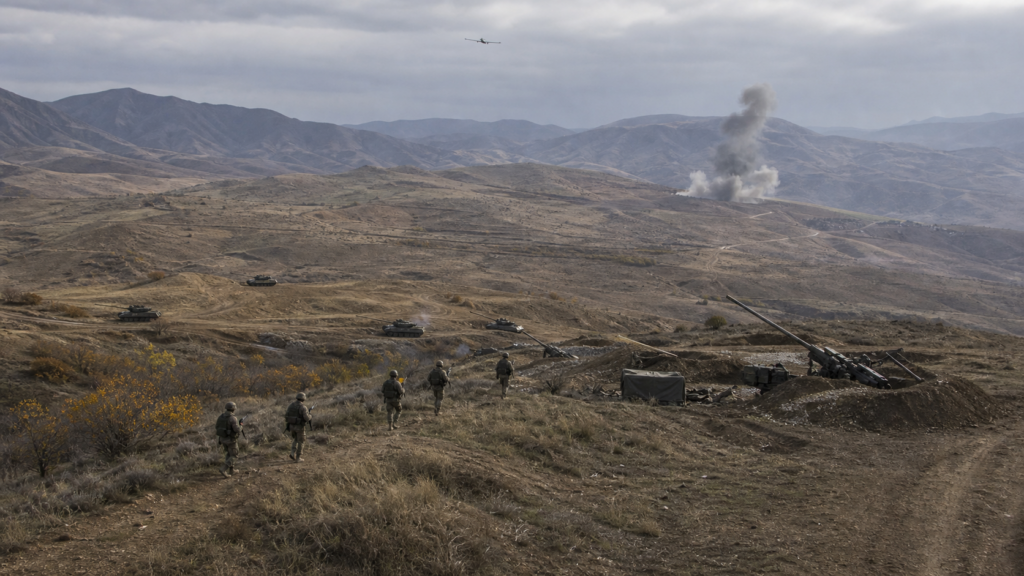
On 27 September 2020, large-scale fighting resumed around Nagorno-Karabakh. Armenia and Azerbaijan had spent decades preparing around a fortified line created after the first war. Azerbaijan entered the conflict with greater financial resources, modernized forces and strong Turkish support. Armenia and the de facto Nagorno-Karabakh authorities relied heavily on trenches, minefields, artillery positions and terrain that had previously favored the defender.
The war lasted forty-four days and ended with a Russian-brokered statement on 9–10 November. Azerbaijan recovered extensive territory around Nagorno-Karabakh and captured Shusha, a strategically and symbolically important city overlooking Stepanakert. The speed of the reversal encouraged a simple story that drones alone had transformed war. In reality, unmanned systems were part of a larger reconnaissance, deception, artillery, missile and ground-maneuver architecture.
How the Sensor-to-Shooter Network Worked
Azerbaijan used reconnaissance UAVs, armed drones and loitering munitions to find, identify and strike targets. Video feeds supported battle-damage assessment and public information operations. Converted aircraft and other decoys helped stimulate air defenses, exposing radar activity and positions. Once sensors located artillery, vehicles or command sites, several effectors could be used: drone weapons, loitering munitions, tube artillery, rockets or missiles.
The tactical problem for the defender was persistent observation. Camouflage designed for human eyes was less effective against electro-optical and thermal sensors. Vehicles concentrated near revetments or moving on predictable roads became vulnerable. Air-defense systems could destroy some drones but were themselves targeted when they emitted. No single technology made defense impossible; the imbalance came from one side connecting sensors, command and precision fires faster than the other could disperse and adapt.
| Capability | Operational use | Defensive lesson |
|---|---|---|
| Reconnaissance UAVs | Persistent detection and correction of fire | Movement, camouflage and emission discipline must be continuous |
| Loitering munitions | Attack exposed air defense and high-value vehicles | Decoys and short exposure times are essential |
| Artillery and rockets | Deliver volume after drone cueing | Sensors and shooters must be treated as one network |
| Special operations and infantry | Exploit terrain and seize key settlements | Technology cannot replace forces that occupy ground |
Terrain, Ground Forces and the Capture of Shusha
Southern terrain allowed Azerbaijan to advance across flatter ground near the Iranian border, stretching defensive lines and opening routes westward. Ground forces then converted remote strikes into territorial control. Special operations and light infantry used difficult approaches toward Shusha, where close combat reduced some advantages of heavy vehicles. The city’s fall threatened the main route and made the remaining Armenian position increasingly difficult.
This phase is essential to understanding the result. Drones degraded and isolated defensive positions, but soldiers still had to clear terrain, maintain logistics and hold captured ground. Azerbaijan also benefited from years of procurement, training and operational planning. Armenia’s problems included static posture, vulnerable logistics, insufficient integration of air defense and electronic warfare, and slow adaptation under constant observation.
The Lessons—and Their Limits
The war demonstrated that static forces without layered short-range air defense, electronic warfare, decoys and disciplined concealment can be dismantled. It accelerated global interest in loitering munitions and low-cost unmanned reconnaissance. Yet its lessons should not be copied mechanically. The air-defense density, external support, geography and force quality of every theater differ.
The political result was also temporary rather than final. Russian peacekeepers entered under the ceasefire arrangement, while the underlying status and security dispute persisted; later events again transformed control and displaced populations. The durable military lesson is broader than “buy drones.” Armed forces need a resilient cycle linking reconnaissance, decisions, fires, maneuver and logistics, while retaining the ability to operate when that network is jammed, deceived or attacked.