Intelligence as an advantage, not a guarantee
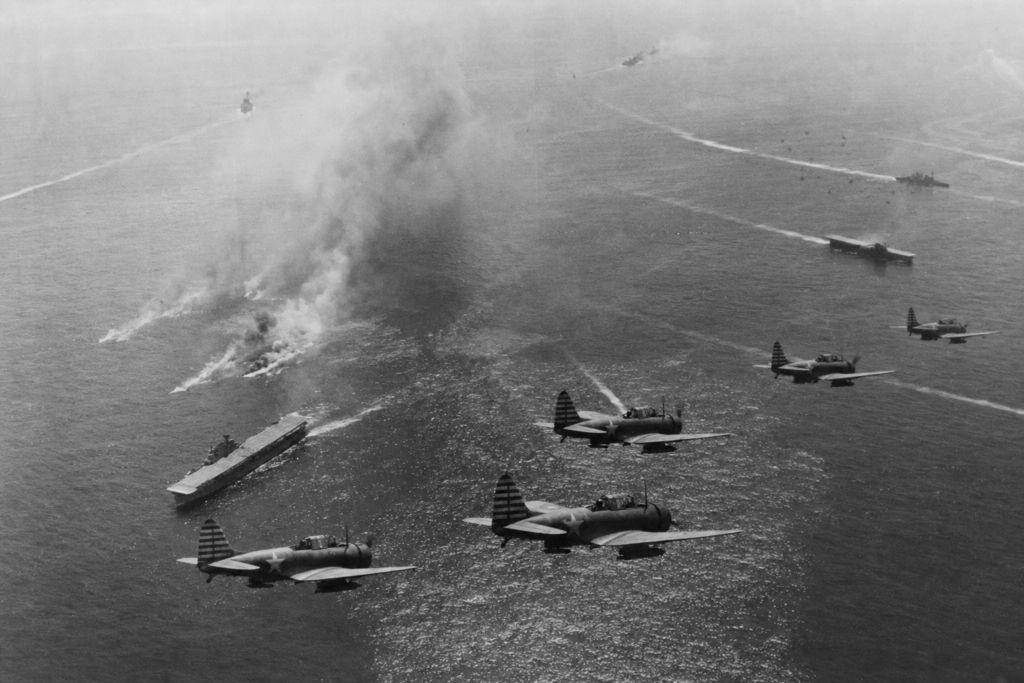
The Battle of Midway in June 1942 was a decisive Pacific War battle in which intelligence, command judgment, carrier aviation, and chance converged within a few hours. Six months after Pearl Harbor, Japan sought to draw out and destroy the remaining American carriers while taking Midway Atoll. U.S. naval cryptanalysts had partially broken the Japanese naval code JN-25 and concluded that the target identified as AF was Midway. By sending an unencrypted message that Midway’s water-distillation plant had failed, American planners helped confirm the interpretation when Japanese traffic reported that AF lacked water. This intelligence did not make the outcome automatic. It gave Admiral Chester Nimitz a chance to place limited forces in an advantageous position, but aircraft, fuel, reconnaissance, communications, tactical choices, and timing still determined how that opportunity unfolded.
The Midway intelligence success is often told as if codebreaking revealed every Japanese move with perfect certainty. The reality was more complicated. Analysts worked with partial decrypts, traffic patterns, known Japanese procedures, and estimates about force composition and timing. Their assessment gave Nimitz enough confidence to deploy the carriers Enterprise, Hornet, and the hurriedly repaired Yorktown north-east of Midway. Yet commanders still faced uncertainty about exact positions, weather, search plans, and whether other Japanese forces might be nearby. This distinction matters. Intelligence is valuable when it changes a decision under uncertainty; it rarely removes uncertainty. At Midway, the American command accepted risk based on a better, but not complete, understanding of Japanese intentions. The battle demonstrates why analysis, decision-making, and operations must be connected. A correct assessment that reaches no commander in time has little value; a bold decision without an assessment can become a costly gamble.
The Battle of Midway in June 1942 was a decisive Pacific War battle in which intelligence, command judgment, carrier aviation, and chance converged within a few hours. Six months after Pearl Harbor, Japan sought to draw out and destroy the remaining American carriers while taking Midway Atoll. U.S. naval cryptanalysts had partially broken the Japanese naval code JN-25 and concluded that the target identified as AF was Midway. By sending an unencrypted message that Midway’s water-distillation plant had failed, American planners helped confirm the interpretation when Japanese traffic reported that AF lacked water. This intelligence did not make the outcome automatic. It gave Admiral Chester Nimitz a chance to place limited forces in an advantageous position, but aircraft, fuel, reconnaissance, communications, tactical choices, and timing still determined how that opportunity unfolded.
The Midway intelligence success is often told as if codebreaking revealed every Japanese move with perfect certainty. The reality was more complicated. Analysts worked with partial decrypts, traffic patterns, known Japanese procedures, and estimates about force composition and timing. Their assessment gave Nimitz enough confidence to deploy the carriers Enterprise, Hornet, and the hurriedly repaired Yorktown north-east of Midway. Yet commanders still faced uncertainty about exact positions, weather, search plans, and whether other Japanese forces might be nearby. This distinction matters. Intelligence is valuable when it changes a decision under uncertainty; it rarely removes uncertainty. At Midway, the American command accepted risk based on a better, but not complete, understanding of Japanese intentions. The battle demonstrates why analysis, decision-making, and operations must be connected. A correct assessment that reaches no commander in time has little value; a bold decision without an assessment can become a costly gamble.
The Battle of Midway in June 1942 was a decisive Pacific War battle in which intelligence, command judgment, carrier aviation, and chance converged within a few hours. Six months after Pearl Harbor, Japan sought to draw out and destroy the remaining American carriers while taking Midway Atoll. U.S. naval cryptanalysts had partially broken the Japanese naval code JN-25 and concluded that the target identified as AF was Midway. By sending an unencrypted message that Midway’s water-distillation plant had failed, American planners helped confirm the interpretation when Japanese traffic reported that AF lacked water. This intelligence did not make the outcome automatic. It gave Admiral Chester Nimitz a chance to place limited forces in an advantageous position, but aircraft, fuel, reconnaissance, communications, tactical choices, and timing still determined how that opportunity unfolded.
The Midway intelligence success is often told as if codebreaking revealed every Japanese move with perfect certainty. The reality was more complicated. Analysts worked with partial decrypts, traffic patterns, known Japanese procedures, and estimates about force composition and timing. Their assessment gave Nimitz enough confidence to deploy the carriers Enterprise, Hornet, and the hurriedly repaired Yorktown north-east of Midway. Yet commanders still faced uncertainty about exact positions, weather, search plans, and whether other Japanese forces might be nearby. This distinction matters. Intelligence is valuable when it changes a decision under uncertainty; it rarely removes uncertainty. At Midway, the American command accepted risk based on a better, but not complete, understanding of Japanese intentions. The battle demonstrates why analysis, decision-making, and operations must be connected. A correct assessment that reaches no commander in time has little value; a bold decision without an assessment can become a costly gamble.
| Factor | Role | Operational consequence |
|---|---|---|
| JN-25 analysis | Identifies likely target and timing | Allows U.S. carriers to prepare an ambush |
| Reconnaissance | Locates carrier forces | Creates opportunities and uncertainty |
| Carrier deck cycle | Rearming and refueling aircraft | Makes carriers vulnerable at a critical moment |
| Dive-bomber attacks | Strike Japanese carriers | Destroys three carriers within minutes |
| Hiryū counterattacks | Damages Yorktown | Shows the battle remained contested |
Carrier aviation and the problem of timing
The Battle of Midway in June 1942 was a decisive Pacific War battle in which intelligence, command judgment, carrier aviation, and chance converged within a few hours. Six months after Pearl Harbor, Japan sought to draw out and destroy the remaining American carriers while taking Midway Atoll. U.S. naval cryptanalysts had partially broken the Japanese naval code JN-25 and concluded that the target identified as AF was Midway. By sending an unencrypted message that Midway’s water-distillation plant had failed, American planners helped confirm the interpretation when Japanese traffic reported that AF lacked water. This intelligence did not make the outcome automatic. It gave Admiral Chester Nimitz a chance to place limited forces in an advantageous position, but aircraft, fuel, reconnaissance, communications, tactical choices, and timing still determined how that opportunity unfolded.
Naval carrier warfare was highly sensitive to timing because aircraft could be vulnerable on decks, fuel and armament took time to handle, and search reports could force abrupt changes. Japanese doctrine emphasized a coordinated strike, but during the battle Vice Admiral Chūichi Nagumo faced conflicting demands: strike Midway again, respond to reports of American ships, and protect his own carriers. Aircraft were being rearmed and refueled when American dive bombers arrived. U.S. attacks were not neatly coordinated. Torpedo squadrons suffered catastrophic losses, while dive bombers became separated and arrived through different routes. Yet this disorder also contributed to surprise. In a short period on the morning of 4 June, bombs set Akagi, Kaga, and Sōryū ablaze. The event illustrates a harsh feature of carrier combat: systems built around speed and concentration can become extremely vulnerable when reconnaissance, command, and deck cycles collide at the wrong moment.
The Battle of Midway in June 1942 was a decisive Pacific War battle in which intelligence, command judgment, carrier aviation, and chance converged within a few hours. Six months after Pearl Harbor, Japan sought to draw out and destroy the remaining American carriers while taking Midway Atoll. U.S. naval cryptanalysts had partially broken the Japanese naval code JN-25 and concluded that the target identified as AF was Midway. By sending an unencrypted message that Midway’s water-distillation plant had failed, American planners helped confirm the interpretation when Japanese traffic reported that AF lacked water. This intelligence did not make the outcome automatic. It gave Admiral Chester Nimitz a chance to place limited forces in an advantageous position, but aircraft, fuel, reconnaissance, communications, tactical choices, and timing still determined how that opportunity unfolded.
Naval carrier warfare was highly sensitive to timing because aircraft could be vulnerable on decks, fuel and armament took time to handle, and search reports could force abrupt changes. Japanese doctrine emphasized a coordinated strike, but during the battle Vice Admiral Chūichi Nagumo faced conflicting demands: strike Midway again, respond to reports of American ships, and protect his own carriers. Aircraft were being rearmed and refueled when American dive bombers arrived. U.S. attacks were not neatly coordinated. Torpedo squadrons suffered catastrophic losses, while dive bombers became separated and arrived through different routes. Yet this disorder also contributed to surprise. In a short period on the morning of 4 June, bombs set Akagi, Kaga, and Sōryū ablaze. The event illustrates a harsh feature of carrier combat: systems built around speed and concentration can become extremely vulnerable when reconnaissance, command, and deck cycles collide at the wrong moment.
The Battle of Midway in June 1942 was a decisive Pacific War battle in which intelligence, command judgment, carrier aviation, and chance converged within a few hours. Six months after Pearl Harbor, Japan sought to draw out and destroy the remaining American carriers while taking Midway Atoll. U.S. naval cryptanalysts had partially broken the Japanese naval code JN-25 and concluded that the target identified as AF was Midway. By sending an unencrypted message that Midway’s water-distillation plant had failed, American planners helped confirm the interpretation when Japanese traffic reported that AF lacked water. This intelligence did not make the outcome automatic. It gave Admiral Chester Nimitz a chance to place limited forces in an advantageous position, but aircraft, fuel, reconnaissance, communications, tactical choices, and timing still determined how that opportunity unfolded.
Naval carrier warfare was highly sensitive to timing because aircraft could be vulnerable on decks, fuel and armament took time to handle, and search reports could force abrupt changes. Japanese doctrine emphasized a coordinated strike, but during the battle Vice Admiral Chūichi Nagumo faced conflicting demands: strike Midway again, respond to reports of American ships, and protect his own carriers. Aircraft were being rearmed and refueled when American dive bombers arrived. U.S. attacks were not neatly coordinated. Torpedo squadrons suffered catastrophic losses, while dive bombers became separated and arrived through different routes. Yet this disorder also contributed to surprise. In a short period on the morning of 4 June, bombs set Akagi, Kaga, and Sōryū ablaze. The event illustrates a harsh feature of carrier combat: systems built around speed and concentration can become extremely vulnerable when reconnaissance, command, and deck cycles collide at the wrong moment.
Losses, decisions, and the broader operational picture
The Battle of Midway in June 1942 was a decisive Pacific War battle in which intelligence, command judgment, carrier aviation, and chance converged within a few hours. Six months after Pearl Harbor, Japan sought to draw out and destroy the remaining American carriers while taking Midway Atoll. U.S. naval cryptanalysts had partially broken the Japanese naval code JN-25 and concluded that the target identified as AF was Midway. By sending an unencrypted message that Midway’s water-distillation plant had failed, American planners helped confirm the interpretation when Japanese traffic reported that AF lacked water. This intelligence did not make the outcome automatic. It gave Admiral Chester Nimitz a chance to place limited forces in an advantageous position, but aircraft, fuel, reconnaissance, communications, tactical choices, and timing still determined how that opportunity unfolded.
Midway was not only an American success. It was a battle of costly decisions and losses on both sides. Yorktown was damaged in the initial exchange and later sunk after attacks by the Japanese carrier Hiryū and a submarine. American aviators faced long searches, fuel shortages, and heavy casualties. Japanese crews fought fires and tried to preserve damaged ships under conditions where aviation fuel and munitions made carriers dangerous. The U.S. decision to pursue the battle, the Japanese decision to continue operations after the first losses, and the limits of communications all shaped the result. The destruction of four Japanese fleet carriers deprived Japan of experienced aircrews and deck-operations capacity that could not be quickly replaced. Still, Midway did not end the Pacific War. It shifted the strategic initiative and created conditions for later Allied operations, including Guadalcanal, rather than producing an immediate final victory.
The Battle of Midway in June 1942 was a decisive Pacific War battle in which intelligence, command judgment, carrier aviation, and chance converged within a few hours. Six months after Pearl Harbor, Japan sought to draw out and destroy the remaining American carriers while taking Midway Atoll. U.S. naval cryptanalysts had partially broken the Japanese naval code JN-25 and concluded that the target identified as AF was Midway. By sending an unencrypted message that Midway’s water-distillation plant had failed, American planners helped confirm the interpretation when Japanese traffic reported that AF lacked water. This intelligence did not make the outcome automatic. It gave Admiral Chester Nimitz a chance to place limited forces in an advantageous position, but aircraft, fuel, reconnaissance, communications, tactical choices, and timing still determined how that opportunity unfolded.
Midway was not only an American success. It was a battle of costly decisions and losses on both sides. Yorktown was damaged in the initial exchange and later sunk after attacks by the Japanese carrier Hiryū and a submarine. American aviators faced long searches, fuel shortages, and heavy casualties. Japanese crews fought fires and tried to preserve damaged ships under conditions where aviation fuel and munitions made carriers dangerous. The U.S. decision to pursue the battle, the Japanese decision to continue operations after the first losses, and the limits of communications all shaped the result. The destruction of four Japanese fleet carriers deprived Japan of experienced aircrews and deck-operations capacity that could not be quickly replaced. Still, Midway did not end the Pacific War. It shifted the strategic initiative and created conditions for later Allied operations, including Guadalcanal, rather than producing an immediate final victory.
The Battle of Midway in June 1942 was a decisive Pacific War battle in which intelligence, command judgment, carrier aviation, and chance converged within a few hours. Six months after Pearl Harbor, Japan sought to draw out and destroy the remaining American carriers while taking Midway Atoll. U.S. naval cryptanalysts had partially broken the Japanese naval code JN-25 and concluded that the target identified as AF was Midway. By sending an unencrypted message that Midway’s water-distillation plant had failed, American planners helped confirm the interpretation when Japanese traffic reported that AF lacked water. This intelligence did not make the outcome automatic. It gave Admiral Chester Nimitz a chance to place limited forces in an advantageous position, but aircraft, fuel, reconnaissance, communications, tactical choices, and timing still determined how that opportunity unfolded.
Midway was not only an American success. It was a battle of costly decisions and losses on both sides. Yorktown was damaged in the initial exchange and later sunk after attacks by the Japanese carrier Hiryū and a submarine. American aviators faced long searches, fuel shortages, and heavy casualties. Japanese crews fought fires and tried to preserve damaged ships under conditions where aviation fuel and munitions made carriers dangerous. The U.S. decision to pursue the battle, the Japanese decision to continue operations after the first losses, and the limits of communications all shaped the result. The destruction of four Japanese fleet carriers deprived Japan of experienced aircrews and deck-operations capacity that could not be quickly replaced. Still, Midway did not end the Pacific War. It shifted the strategic initiative and created conditions for later Allied operations, including Guadalcanal, rather than producing an immediate final victory.
Legacy: learning, resilience, and the limits of hindsight
The Battle of Midway in June 1942 was a decisive Pacific War battle in which intelligence, command judgment, carrier aviation, and chance converged within a few hours. Six months after Pearl Harbor, Japan sought to draw out and destroy the remaining American carriers while taking Midway Atoll. U.S. naval cryptanalysts had partially broken the Japanese naval code JN-25 and concluded that the target identified as AF was Midway. By sending an unencrypted message that Midway’s water-distillation plant had failed, American planners helped confirm the interpretation when Japanese traffic reported that AF lacked water. This intelligence did not make the outcome automatic. It gave Admiral Chester Nimitz a chance to place limited forces in an advantageous position, but aircraft, fuel, reconnaissance, communications, tactical choices, and timing still determined how that opportunity unfolded.
The battle is often used to teach that intelligence wins wars. A better lesson is that intelligence can create an opportunity which organizations must still exploit through preparation, training, maintenance, command discipline, and resilience. U.S. Navy codebreakers, reconnaissance crews, carrier aviators, submarine forces, and repair teams all contributed. The rapid repair of Yorktown before the battle is a reminder that logistics and industrial skill matter as much as dramatic combat. Midway also cautions against hindsight. The outcome appears inevitable only after the fact; participants faced incomplete reports, confusing sightings, and decisions made in minutes. Japanese plans contained real strengths, and U.S. success depended on several contingencies. Studying the battle responsibly means recognizing both the importance of preparation and the uncertainty that remains in combat even when one side has a significant informational advantage.
The Battle of Midway in June 1942 was a decisive Pacific War battle in which intelligence, command judgment, carrier aviation, and chance converged within a few hours. Six months after Pearl Harbor, Japan sought to draw out and destroy the remaining American carriers while taking Midway Atoll. U.S. naval cryptanalysts had partially broken the Japanese naval code JN-25 and concluded that the target identified as AF was Midway. By sending an unencrypted message that Midway’s water-distillation plant had failed, American planners helped confirm the interpretation when Japanese traffic reported that AF lacked water. This intelligence did not make the outcome automatic. It gave Admiral Chester Nimitz a chance to place limited forces in an advantageous position, but aircraft, fuel, reconnaissance, communications, tactical choices, and timing still determined how that opportunity unfolded.
The battle is often used to teach that intelligence wins wars. A better lesson is that intelligence can create an opportunity which organizations must still exploit through preparation, training, maintenance, command discipline, and resilience. U.S. Navy codebreakers, reconnaissance crews, carrier aviators, submarine forces, and repair teams all contributed. The rapid repair of Yorktown before the battle is a reminder that logistics and industrial skill matter as much as dramatic combat. Midway also cautions against hindsight. The outcome appears inevitable only after the fact; participants faced incomplete reports, confusing sightings, and decisions made in minutes. Japanese plans contained real strengths, and U.S. success depended on several contingencies. Studying the battle responsibly means recognizing both the importance of preparation and the uncertainty that remains in combat even when one side has a significant informational advantage.
The Battle of Midway in June 1942 was a decisive Pacific War battle in which intelligence, command judgment, carrier aviation, and chance converged within a few hours. Six months after Pearl Harbor, Japan sought to draw out and destroy the remaining American carriers while taking Midway Atoll. U.S. naval cryptanalysts had partially broken the Japanese naval code JN-25 and concluded that the target identified as AF was Midway. By sending an unencrypted message that Midway’s water-distillation plant had failed, American planners helped confirm the interpretation when Japanese traffic reported that AF lacked water. This intelligence did not make the outcome automatic. It gave Admiral Chester Nimitz a chance to place limited forces in an advantageous position, but aircraft, fuel, reconnaissance, communications, tactical choices, and timing still determined how that opportunity unfolded.
The battle is often used to teach that intelligence wins wars. A better lesson is that intelligence can create an opportunity which organizations must still exploit through preparation, training, maintenance, command discipline, and resilience. U.S. Navy codebreakers, reconnaissance crews, carrier aviators, submarine forces, and repair teams all contributed. The rapid repair of Yorktown before the battle is a reminder that logistics and industrial skill matter as much as dramatic combat. Midway also cautions against hindsight. The outcome appears inevitable only after the fact; participants faced incomplete reports, confusing sightings, and decisions made in minutes. Japanese plans contained real strengths, and U.S. success depended on several contingencies. Studying the battle responsibly means recognizing both the importance of preparation and the uncertainty that remains in combat even when one side has a significant informational advantage.