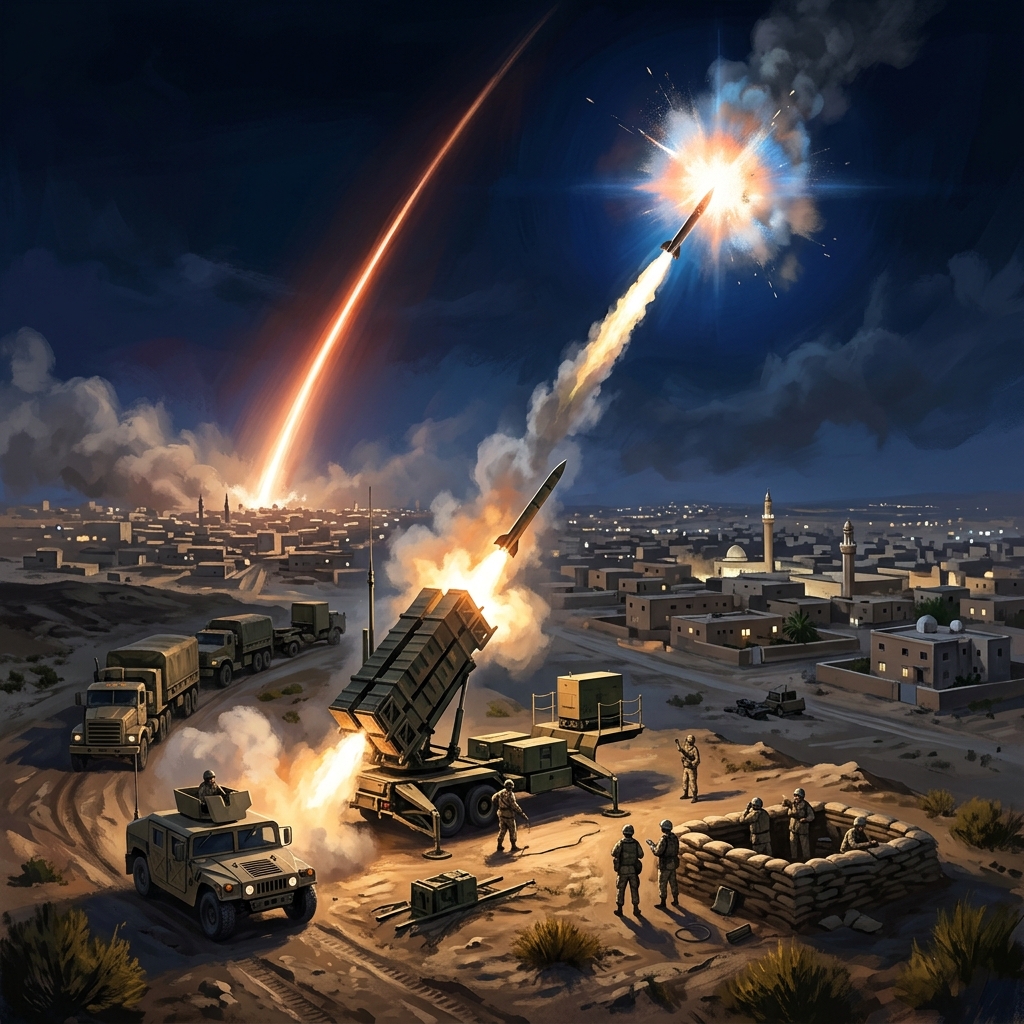
The Scud Threat and Coalition Strategy
During the 1991 Gulf War, the coalition forces led by the United States faced an asymmetric threat that transcended the conventional battlefield. Desperate to fracture the coalition, Iraqi dictator Saddam Hussein launched dozens of Al-Hussein tactical ballistic missiles—locally modified Soviet Scud-B missiles—against civilian targets in Israel and Saudi Arabia. The strategic goal was political rather than military: by striking Israel, Iraq hoped to provoke an Israeli military retaliation, which would make it politically impossible for Arab nations like Egypt, Syria, and Saudi Arabia to remain in the US-led coalition. The Scud strikes created terror in cities like Tel Aviv and Riyadh, forcing millions of civilians to wear gas masks in fear of chemical warheads, and threatening to derail the coalition’s strategic plans.
To counter this threat, the coalition had to act quickly. Finding and destroying the highly mobile, truck-mounted Iraqi Scud launchers (Transporter-Erector-Launchers, or TELs) in the vast western Iraqi desert proved to be extremely difficult. Despite intensive search-and-destroy missions by coalition aircraft and special forces, the missile launches continued. The primary line of defense shifted from offensive airstrikes to defensive ground-based interception, placing a massive burden on a system that had never before been tested in combat against ballistic missiles. The stage was set for the first operational duel between ballistic missiles and guided missile defense systems in history.
The MIM-104 Patriot: From Anti-Aircraft to Anti-Missile
The weapon chosen to protect coalition forces and civilian populations from the Scud attacks was the MIM-104 Patriot air defense system. Originally designed by Raytheon in the late 1960s and 1970s, the Patriot was built to defend military forces against high-performance tactical aircraft. However, recognizing the growing threat of tactical ballistic missiles, the US Army had initiated a series of upgrades in the 1980s. This led to the development of the PAC-2 (Patriot Advanced Capability-2) system, which featured modified software and a new warhead with larger fragments and a proximity fuse designed specifically to destroy fast-moving ballistic missile warheads rather than merely damaging aircraft airframes.
The Patriot system was highly complex, consisting of the AN/MPQ-53 phased-array radar, an engagement control station, power generators, and launcher stations carrying four missiles each. The radar was capable of tracking up to 100 targets and guiding multiple missiles simultaneously. Unlike older systems, the Patriot used Track-Via-Missile (TVM) guidance, where the missile itself tracked the target and transmitted the guidance data back to the ground control station, which calculated the steering corrections. The deployment of PAC-2 batteries to Israel and Saudi Arabia in early 1991 represented a major technological milestone, testing the viability of the American strategic concept of tactical missile defense.
Interceptions Over Riyadh and Tel Aviv
The combat debut of the MIM-104 Patriot PAC-2 occurred on January 18, 1991, when a battery in Saudi Arabia engaged an incoming Iraqi Scud. Over the next six weeks, Patriot batteries in Israel and Saudi Arabia fought intense, dramatic night duels against Scud missiles. Television networks broadcasted these engagements live to a global audience, showing bright streaks of rising Patriot missiles intercepting descending Scuds over major metropolitan areas. The loud explosions and flashing lights became iconic images of the war. To the public and military planners, the Patriot appeared to be a triumph of technology, successfully neutralizing the Iraqi missile threat and preventing Israel from entering the war, thereby preserving the integrity of the coalition.
However, subsequent detailed analyses revealed that the interceptions were highly complex and not always completely successful. The Al-Hussein missiles, modified in Iraq to extend their range, were structurally unstable. During re-entry into the atmosphere, they frequently broke apart into several pieces, including the warhead, booster, and fuselage. The Patriot’s radar had difficulty distinguishing the lethal warhead from the debris. In several cases, Patriot missiles intercepted the booster or fuselage, leaving the warhead to crash and detonate on the ground. Despite these limitations, the Patriot system performed a critical role in providing psychological reassurance to the populations of Israel and Saudi Arabia, preventing panic and maintaining the geopolitical balance of the conflict.
A New Era of Missile Defense
The Scud-Patriot duels of 1991 marked the beginning of the modern era of ballistic missile defense. The operational experience gained during the Gulf War validated the feasibility of intercepting ballistic missiles, but it also exposed critical areas for improvement. It became clear that detonating a warhead near a ballistic missile was insufficient; the interceptor had to achieve a direct, high-speed collision to physically destroy the incoming warhead’s payload. This lesson led directly to the development of the PAC-3 system, which utilizes a hit-to-kill vehicle that contains no explosive warhead, instead relying on pure kinetic energy to obliterate targets. The PAC-3 became the backbone of US tactical missile defense in the subsequent decades.
Beyond the Patriot upgrades, the Gulf War accelerated global investment in layered missile defense architectures. Israel, having experienced the Scud attacks firsthand, partnerered with the United States to develop the Arrow missile defense system for high-altitude interception, which later formed the outer tier of a network that includes David’s Sling and the Iron Dome. Similarly, the United States developed the Terminal High Altitude Area Defense (THAAD) system to intercept longer-range threats. Today, as ballistic and cruise missile technologies proliferate worldwide, the legacy of the 1991 duels remains central to modern military planning, proving that ground-based shields are essential for national defense and geopolitical stability in times of crisis.
| Feature / Specification | Al-Hussein (Modified Scud-B) | MIM-104 Patriot (PAC-2) |
|---|---|---|
| Origin / Manufacturer | Soviet Union / Iraqi Modification | United States / Raytheon |
| Maximum Speed | Mach 4.5 | Mach 5.0 |
| Maximum Range (km) | 650 | 70 (Tactical Range) |
| Warhead / Payload | 500 kg High Explosive (HE) | 90 kg HE Fragmentation (M248) |
| Guidance System | Inertial (No mid-flight updates) | Track-Via-Missile (TVM) Radio Command |