The Limits of Anti-Aircraft Artillery in World War II
During the opening years of World War II, air defense relied almost exclusively on unguided anti-aircraft artillery, commonly referred to as flak. Batteries of guns ranging from light, rapid-fire automatic cannons like the 20mm and 40mm Bofors to heavy ordnance such as the legendary German 88mm and the British 3.7-inch guns attempted to fill the skies with shrapnel. The tactical concept was simple: project a volume of metal into the airspace ahead of incoming bomber formations, forcing them to disperse or drop their payloads inaccurately. However, as aviation technology progressed, aircraft flew faster, higher, and with greater armor protection, exposing the severe physical limitations of unguided gun-based systems. At high altitudes, the time-of-flight of a shell could exceed fifteen or twenty seconds, during which a bomber could easily change its heading, rendering calculated fire-control solutions completely obsolete.
To counter these limitations, mid-war innovations introduced advanced radar-directed gun-laying systems, such as the American SCR-584 radar, which tracked targets automatically and transmitted fire-control data directly to the gun mounts. Combined with the revolutionary VT radio proximity fuse, which detonated the shell when it detected an aircraft nearby rather than relying on preset mechanical timers, gun-based air defense achieved a massive leap in lethality. During the V-1 flying bomb campaign over Britain and the defense of Antwerp, these systems proved highly effective. Yet, despite these technological triumphs, military planners recognized that artillery had reached its absolute physical limits. The speed of early jet fighters and the altitude capability of strategic bombers meant that guns could no longer guarantee intercepts. A new weapon was required—one that could adjust its trajectory in mid-flight to pursue a maneuvering target.
The Cold War Dawn of Guided Missiles
The transition from unguided artillery to guided surface-to-air missiles (SAMs) began in earnest during the late 1940s and early 1950s, driven by the threat of nuclear-armed strategic bombers. The United States and the Soviet Union, utilizing research and scientists captured from wartime Germany, launched intensive development programs. The results of these efforts materialized as the first operational, heavy strategic SAM systems. In the West, the United States deployed the MIM-3 Nike Ajax in 1953. This system utilized command guidance, where one ground radar tracked the target bomber, another tracked the interceptor missile, and a computer calculated steering corrections that were transmitted to the missile via radio link. The Nike Ajax was quickly deployed in defensive rings around major American cities and military installations, establishing a permanent shield against high-altitude threats.
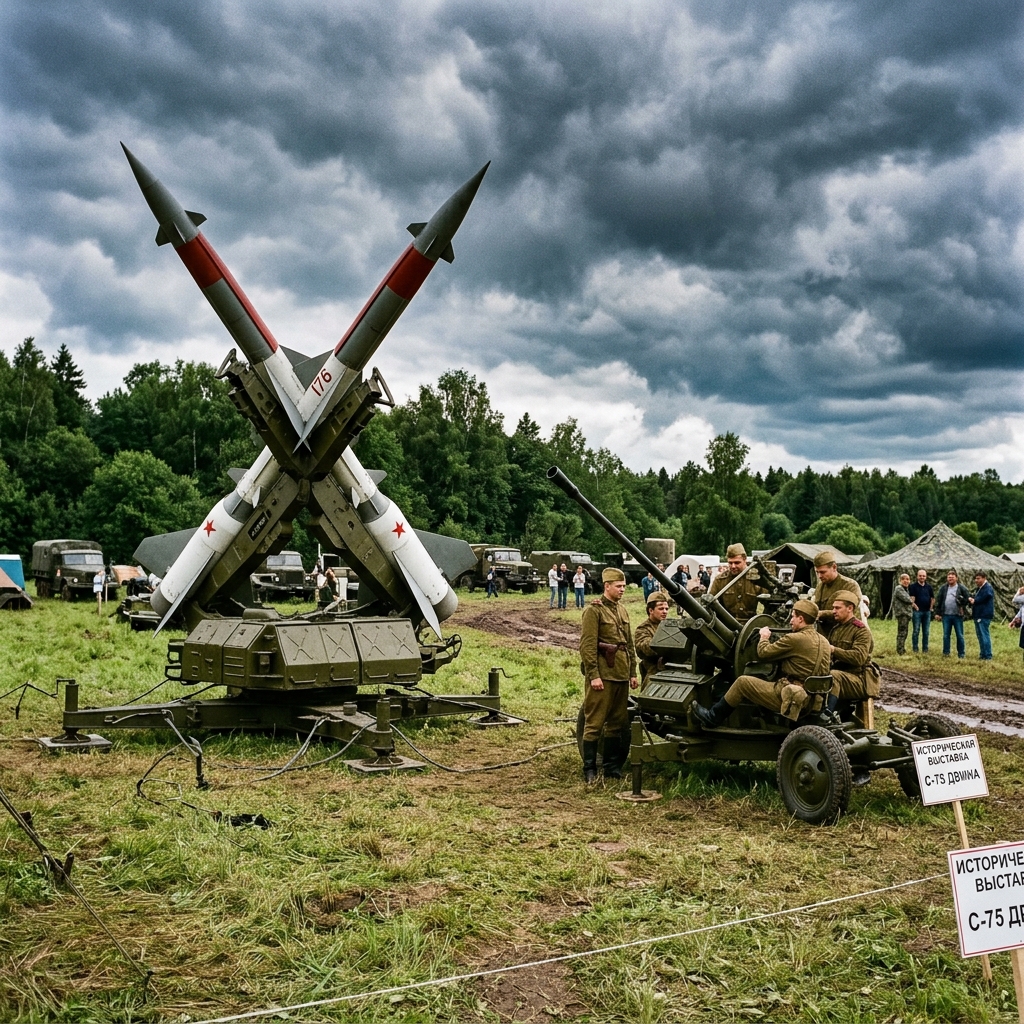
Simultaneously, the Soviet Union developed and deployed the S-75 Dvina (known to NATO as the SA-2 Guideline) in 1957. The S-75 was a two-stage missile designed to intercept targets at altitudes up to 25 kilometers, far beyond the reach of conventional anti-aircraft artillery. The system relied on the Fan Song radar, which tracked targets and guided the missile using a radio command system. The S-75 Dvina would become the most widely deployed air defense system in history, demonstrating its capability in several high-profile Cold War incidents, including the downing of an American U-2 spy plane in 1960. These early strategic SAM systems redefined the relationship between air power and ground defense, proving that high-altitude airspace was no longer a safe haven for reconnaissance or bombing missions. The guided missile had officially replaced the gun as the primary guardian of the sky.
Integrating Tactical SAMs into Ground Operations
While early systems like the Nike Ajax and S-75 Dvina were highly effective, they were strategic weapons designed for fixed installations. They required massive concrete launch pads, extensive radar complexes, and hours of setup time, making them entirely unsuited for mobile ground operations. As armies prepared for potential high-speed maneuvers on European battlefields, the need arose for tactical SAM systems that could move alongside armored divisions and protect them from tactical strike aircraft. This led to the development of transportable, medium-range systems in the late 1950s and 1960s. The United States developed the MIM-23 Hawk, a semi-active radar homing system that was significantly more mobile than the Nike series and could target low-flying aircraft. The Hawk utilized continuous-wave radar to track targets in the clutter of ground reflections, filling a critical gap in low-altitude defense.
On the Soviet side, the drive for mobility led to the creation of the 2K12 Kub (SA-6 Gainful) system, which entered service in the late 1960s. Unlike its strategic predecessors, the 2K12 Kub was mounted on tracked armored vehicles, allowing it to accompany motorized infantry and tank units directly into combat. The system utilized semi-active radar homing, with a mobile radar vehicle providing target illumination while the launchers followed behind. The tactical effectiveness of this mobile shield was demonstrated during the 1973 Yom Kippur War, where Egyptian and Syrian Kub batteries inflicted heavy losses on the Israeli Air Force, proving that mobile ground forces could carry their own effective air defense umbrella. This integration of mobility and guidance established the modern concept of tactical air defense, ensuring that army maneuvers were protected from air strikes without depending on static bases.
The Modern Tactical Air Defense Paradigm
Today, tactical air defense has evolved into a highly integrated, layered, and networked paradigm. No single system is expected to counter every threat; instead, modern air defense operations rely on the coordinated interaction of short, medium, and long-range systems. At the short-range level (SHORAD), forces utilize mobile gun systems like the German Gepard and infantry-portable missiles (MANPADS) such as the Stinger or Starstreak to counter low-flying helicopters, close-support jets, and tactical drones. These systems are supported by medium-range systems like NASAMS or IRIS-T, which utilize active radar homing missiles to engage targets at longer distances and higher altitudes. Long-range systems, such as the MIM-104 Patriot and the S-300/S-400 series, provide the outer layer of protection, capable of intercepting high-altitude aircraft and tactical ballistic missiles.
The key to modern tactical air defense lies in networking and sensor fusion. Advanced command and control systems link disparate radars, electro-optical sensors, and missile batteries into a single, unified picture. This allows a radar from one system to detect a target and pass the tracking data to a missile launcher from another system, maximizing engagement envelopes and minimizing reaction times. In the modern combat environment, air defense must counter not only high-performance jets but also asymmetric threats, including low-cost loitering munitions, cruise missiles, and massed drone swarms. The historical transition from unguided WWII flak to early strategic SAMs laid the foundation for these complex networks, demonstrating that as long as the threat from the air continues to adapt, ground-based shields must evolve with equal speed and sophistication.
| System Name | Year Introduced | Guidance Type | Max Range (km) | Max Altitude (m) |
|---|---|---|---|---|
| Nike Ajax (US) | 1953 | Radio Command Guidance | 48 | 21,300 |
| S-75 Dvina (USSR) | 1957 | Radio Command Guidance | 45 | 25,000 |
| MIM-23 Hawk (US) | 1960 | Semi-Active Radar Homing | 40 | 18,000 |
| 2K12 Kub (USSR) | 1967 | Semi-Active Radar Homing | 24 | 14,000 |