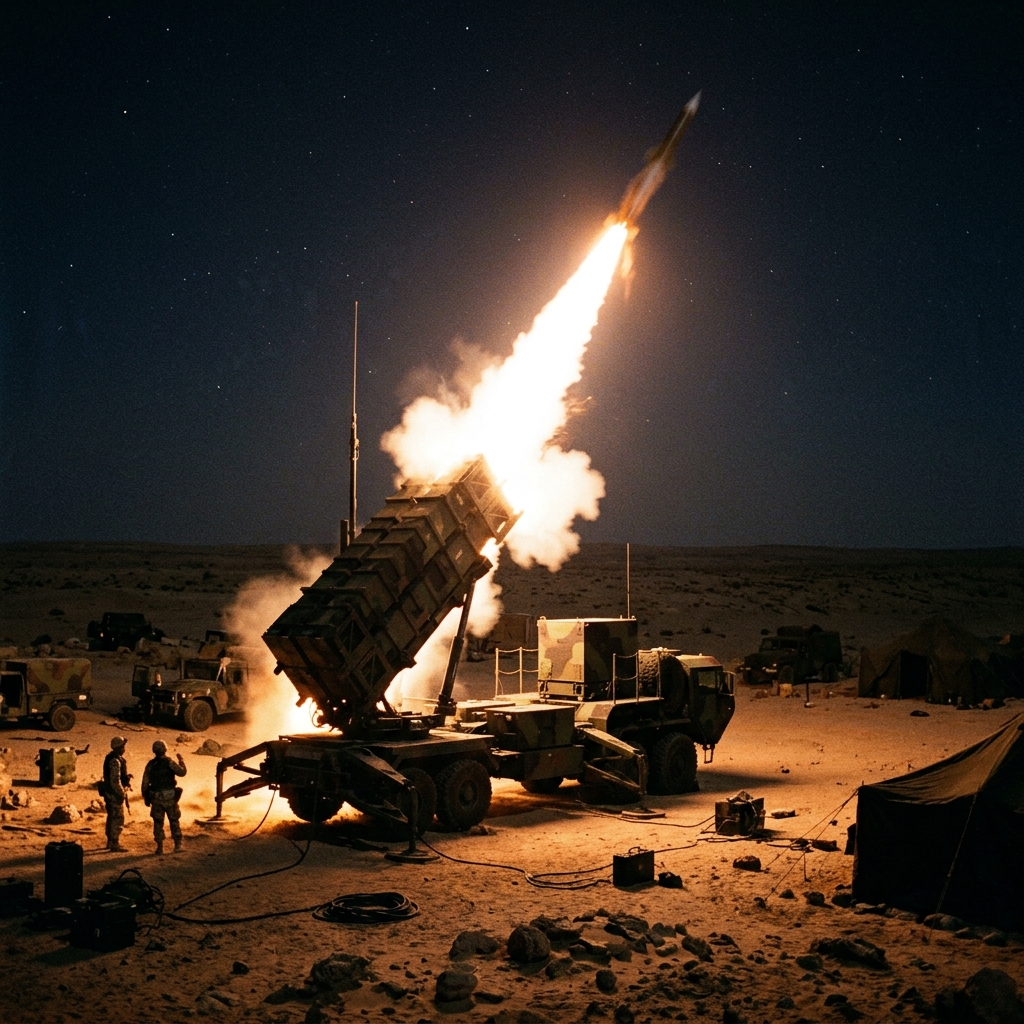
Origins of the SAM-D Project
In the mid-1960s, the United States Army recognized the need for a next-generation surface-to-air missile (SAM) system to replace its aging Nike Hercules and HAWK systems. The project, initially designated Surface-to-Air Missile Development (SAM-D), was aimed at defeating fast, low-flying aircraft and massed aerial attacks. Unlike older systems that relied on multiple, single-function radars for target acquisition, tracking, and missile guidance, SAM-D sought to consolidate these functions into a single, highly advanced multi-function phased-array radar. This design not only reduced the system’s logistical footprint but also made it far more capable of operating in dense electronic countermeasures (ECM) environments.
Renamed the Patriot (Phased Array Tracking Radar to Intercept on Target) in 1976, the system represented a major technological leap. Its AN/MPQ-53 radar utilized electronic scanning to track up to 100 targets simultaneously and guide up to nine missiles. However, the system’s development was slow and costly, facing technical challenges and political skepticism throughout the late 1970s. It was not until 1984 that the MIM-104A Patriot officially entered service, initially configured purely as a high-altitude air defense system designed to counter Soviet aircraft in a European theater of operations.
Track-via-Missile (TVM) Guidance
The core technological innovation that set the Patriot apart from its contemporaries was its Track-via-Missile (TVM) guidance system. In traditional semi-active radar homing systems, a missile tracks the reflected radar energy from a target and calculates its own steering corrections. In contrast, the TVM system divided the guidance workload between the missile and the ground-based Engagement Control Station (ECS). During the terminal phase of flight, the missile’s seeker received the reflected radar signals from the target and transmitted this raw tracking data back to the ground radar via a high-speed telemetry downlink.
The ECS’s powerful computers, which possessed far more processing power than could be crammed into a mobile missile, calculated the optimal intercept trajectory and transmitted steering commands back to the missile. This closed-loop guidance system had several critical advantages. It allowed the ground station to filter out clutter and chaff, made the missile highly resistant to electronic jamming, and enabled the system to perform evasive target maneuvers in real-time. TVM made the Patriot one of the most accurate and lethal air defense systems of its era.
Gulf War Baptism: The PAC-2 Upgrade
As the Soviet threat evolved to include tactical ballistic missiles, the Patriot underwent its first major modifications. The Patriot Advanced Capability 1 (PAC-1) upgrade introduced software modifications to allow the radar to track high-angle ballistic trajectories. This was followed by the PAC-2 (MIM-104C) upgrade, which introduced a redesigned warhead and fuse. The original aircraft-optimized warhead was replaced with a heavier blast-fragmentation warhead containing larger fragments, designed to destroy the faster, sturdier warheads of incoming ballistic missiles rather than just damaging their airframes.
The Patriot PAC-2 faced its baptism of fire during the 1991 Gulf War, where it was deployed to defend cities in Israel and Saudi Arabia against Iraqi Scud missile attacks. This was the first time in military history that a air defense system engaged tactical ballistic missiles in combat. While initial reports claimed near-perfect interception rates, subsequent military and academic audits revealed that the PAC-2 struggled to completely destroy the incoming Scud warheads due to the Scuds breaking apart during re-entry. Nevertheless, the Gulf War demonstrated the vital strategic value of anti-tactical ballistic missile (ATBM) defenses, paving the way for the next phase of the system’s evolution.
PAC-3 and Hit-to-Kill Technology
The limitations of the PAC-2 led to a complete redesign of the interceptor, resulting in the PAC-3 (MIM-104F) system. Developed by Lockheed Martin, the PAC-3 missile departed from the MIM-104 airframe, featuring a smaller, highly agile design. Because of its smaller size, a single Patriot launcher station could hold 16 PAC-3 missiles compared to only four PAC-2 missiles, dramatically increasing the battery’s firepower. The PAC-3 radar was also upgraded to the AN/MPQ-65, which provided enhanced detection and tracking range.
Most importantly, the PAC-3 introduced “Hit-to-Kill” technology. Instead of relying on a blast-fragmentation warhead to detonate near a target, the PAC-3 missile uses kinetic energy to collide directly with the incoming warhead, ensuring its complete destruction. To achieve this extreme precision, the PAC-3 is equipped with an active Ka-band millimeter-wave radar seeker in the nose for terminal guidance, as well as 180 solid-propellant attitude control motors (ACM) that allow the missile to make instantaneous maneuver adjustments in the final seconds of flight. Today, the Patriot PAC-3 remains one of the world’s premier air defense systems, protecting Allied airspace against advanced cruise missiles, aircraft, and ballistic threats.
| System / Interceptor | Year Introduced | Guidance Type | Warhead Type | Missiles per Launcher | Primary Target Threat |
|---|---|---|---|---|---|
| MIM-104A (SAM-D / Standard) | 1984 | Track-via-Missile (TVM) | Blast-Fragmentation (74 kg) | 4 | High-altitude aircraft & cruise missiles |
| MIM-104C (PAC-2) | 1990 | Track-via-Missile (TVM) | Heavy Blast-Frag (90 kg) | 4 | Tactical ballistic missiles & aircraft |
| MIM-104F (PAC-3) | 2001 | Active Ka-band Radar + TVM | Kinetic Hit-to-Kill (Lethality Enhancer) | 16 | Advanced ballistic, cruise missiles & UAVs |