Розділ 1
The history of military aviation in the twentieth century is largely defined by the fierce rivalry between the Soviet Union and the United States. At the heart of this confrontation was the Mikoyan-Gurevich (MiG) design bureau, which produced some of the most iconic jet fighters in history. Facing them were legendary American aerospace giants, creating a continuous cycle of technological leapfrogging. From the skies of Korea to the valleys of Vietnam and the desert sands of the Middle East, the duel between MiG and US fighters shaped modern aerial warfare tactics, aerodynamics, and radar technology.
The primary American adversary was the McDonnell Douglas F-4 Phantom II, a massive, twin-engine beast. Unlike the agile MiG-21, the Phantom was designed under the assumption that dogfights were obsolete, relying entirely on radar and medium-range missiles. However, the early Sparrow and Sidewinder missiles suffered from low reliability, forcing the US to retrofit the F-4 with an internal cannon (F-4E) and establish the TOPGUN school to retrain pilots in dogfighting. This clash proved that maneuverability and gun systems remained critical in tactical air combat.
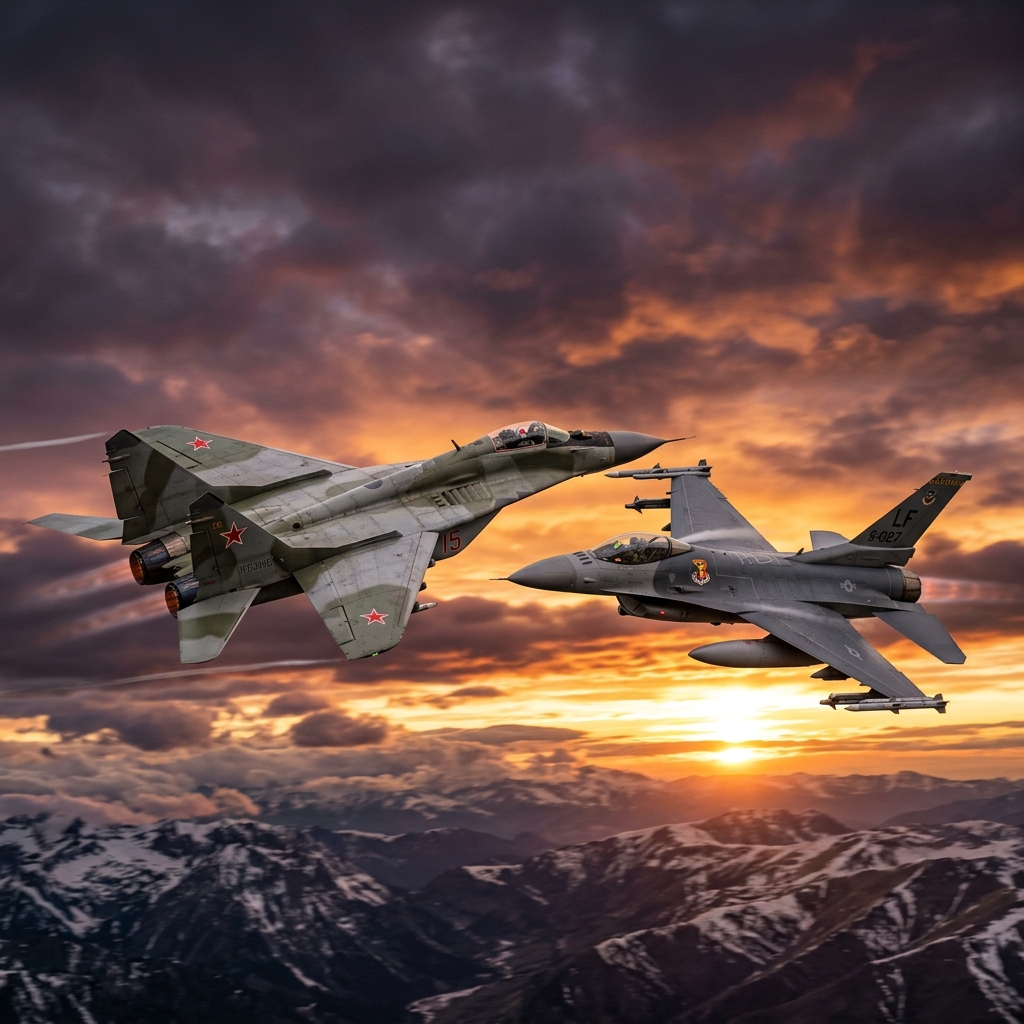
In response to the need for a lightweight, cost-effective multirole fighter, the US developed the General Dynamics F-16 Fighting Falcon. The F-16 introduced fly-by-wire controls, a bubble canopy for unmatched visibility, and a highly versatile airframe that evolved from a daytime dogfighter into a true multirole workhorse. While the MiG-29 was a formidable threat in close-in combat, the F-16 excelled in range, avionics integration, engine reliability, and life-cycle costs.
Розділ 2
The Korean War (1950–1953) marked the debut of swept-wing jet fighters. The appearance of the Soviet MiG-15 in “MiG Alley” came as a shock to United Nations forces. Powered by a reverse-engineered British Rolls-Royce Nene engine, the MiG-15 was light, climbed exceptionally fast, and possessed devastating firepower with its 37mm and 23mm cannons. It was designed primarily to intercept heavy American bombers, a task it performed with lethal efficiency.
In 1964, the Soviet Union introduced the MiG-25 “Foxbat”, a massive steel interceptor capable of reaching Mach 3.2. Its sole purpose was to intercept the projected American supersonic bombers and the SR-71 Blackbird. When Western radars tracked the MiG-25, they feared its massive wing area indicated extreme maneuverability, which prompted the US to design the McDonnell Douglas F-15 Eagle, the most successful air superiority fighter in history.
Розділ 3
To counter this threat, the United States rushed the North American F-86 Sabre into theater. While the Sabre lacked the climb rate and altitude performance of the MiG-15, it had superior high-speed handling, a more stable gun platform, and a radar-ranging gunsight that allowed pilots to score hits from greater distances. The tactical comparison between the two came down to pilot training and system capabilities: the MiG was a superior vertical fighter, while the Sabre dominated in horizontal maneuvers and pilot ergonomics.
While the MiG-25 was fast, it lacked agility. The Soviets addressed this by developing the MiG-31 “Foxhound”, which featured a strengthened airframe, turbofan engines, and the revolutionary Zaslon phased-array radar, allowing it to track and engage multiple low-flying targets simultaneously. The F-15 Eagle, however, became the gold standard of US airpower, boasting an undefeated combat record of 104 victories to 0 losses, combining high maneuverability, advanced avionics, and long-range missiles.
Розділ 4
By the late 1950s, the race to Mach 2 was on. The MiG-21 “Fishbed” emerged as a lightweight, delta-wing interceptor designed for simple, high-speed dashes. It became the most-produced supersonic jet in history, valued for its low cost, ease of maintenance, and agility. During the Vietnam War, North Vietnamese pilots utilized the MiG-21’s small visual signature and high thrust-to-weight ratio to execute deadly hit-and-run tactics against American strike packages.
The late Cold War saw the birth of highly maneuverable fourth-generation fighters. The Mikoyan bureau designed the MiG-29 “Fulcrum” as a theater-level dogfighter. Equipped with the R-73 infrared-guided missile and a helmet-mounted sight, the MiG-29 allowed pilots to target enemy aircraft simply by looking at them, a capability that stunned Western pilots after the reunification of Germany. The MiG-29’s aerodynamics allowed it to perform extreme cobra maneuvers.
| Факти | Опис |
|---|---|
| The history of | The history of military aviation in the twentieth century is largely defined by the fierce rivalry between the Soviet Union and the United States |
| At the heart | At the heart of this confrontation was the Mikoyan-Gurevich (MiG) design bureau, which produced some of the most iconic jet fighters in history |
| Facing them were | Facing them were legendary American aerospace giants, creating a continuous cycle of technological leapfrogging |