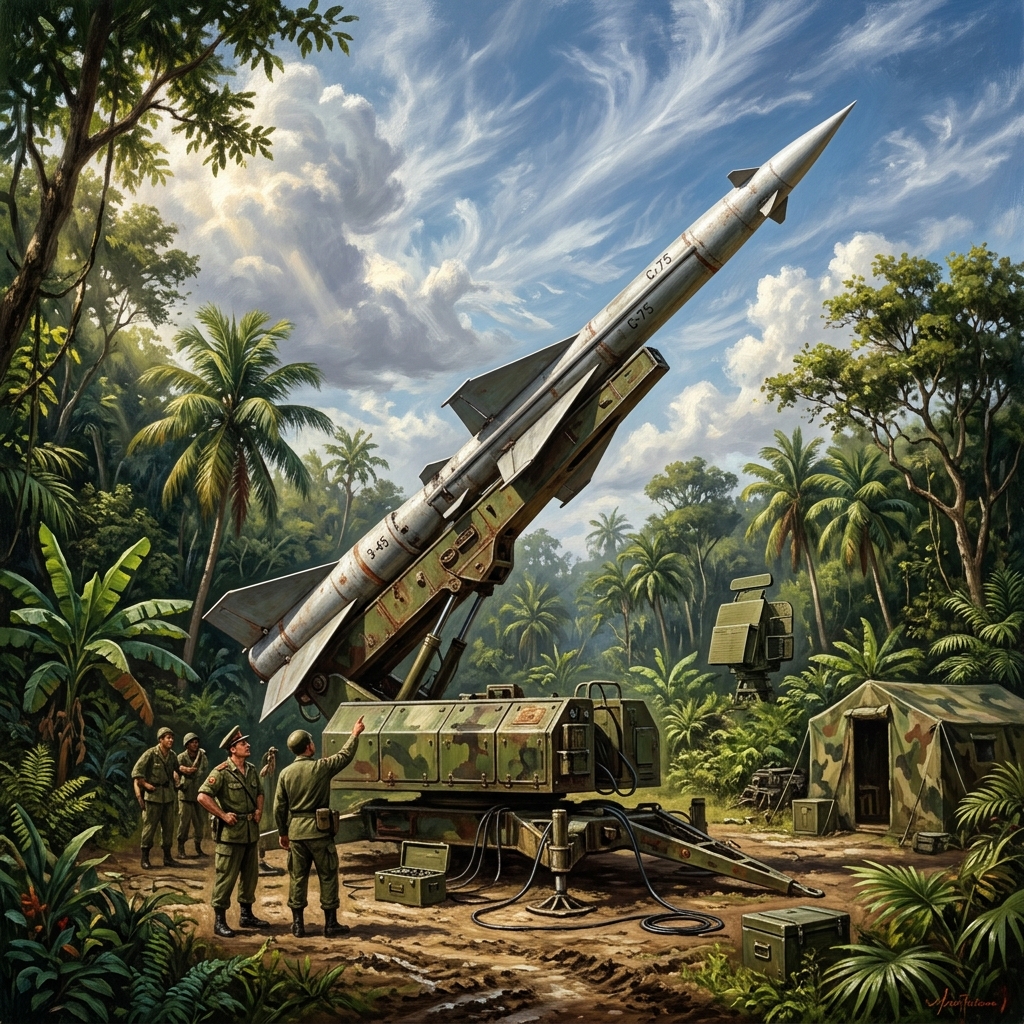
The High-Altitude Espionage Challenge
In the autumn of 1962, the world stood on the precipice of thermonuclear war. The United States discovered that the Soviet Union was secretly deploying medium- and intermediate-range ballistic missiles in Cuba, just 90 miles from the Florida coast. This clandestine operation, codenamed Anadyr by the Soviets, aimed to redress the strategic imbalance caused by American Jupiter missiles in Turkey. To confirm the presence of these offensive weapons, the US Air Force and CIA relied on high-altitude reconnaissance flights using the Lockheed U-2 spy plane. Flying at altitudes above 70,000 feet (21,300 meters), the U-2 was thought to be invulnerable to conventional interceptors and anti-aircraft artillery, providing the vital photographic evidence that President John F. Kennedy used to confront Moscow and establish a naval quarantine around the island.
However, the airspace over Cuba was far from undefended. Unknown to Washington, the Soviet deployment included a comprehensive air defense network designed specifically to protect the nuclear missile sites. As the crisis intensified during late October, U-2 flights became increasingly risky. The Soviet military personnel on the ground were operating under high stress, fully aware that a US invasion of Cuba could begin at any moment. The high-altitude spy flights, which had initially operated with impunity, were about to encounter a weapon designed specifically to sweep them from the skies, transforming a tense standoff into an active combat zone.
The S-75 Dvina: The Red Army's Shield in Cuba
The core of the Soviet air defense shield in Cuba was the S-75 Dvina (known to NATO as the SA-2 Guideline) surface-to-air missile system. Developed in the mid-1950s to counter the threat of American strategic bombers, the S-75 was a technological marvel of its era. It consisted of a two-stage missile, with a solid-fuel booster for initial acceleration and a liquid-fuel second stage for cruise. Guided by the Fan Song tracking and guidance radar, the system could engage targets flying at speeds of up to Mach 3 and at altitudes reaching 25 kilometers (82,000 feet). A single S-75 battery typically deployed six semi-fixed launchers arranged around a central radar guidance cabin, creating a highly lethal defense zone against high-altitude reconnaissance aircraft.
By October 1962, the Soviet Union had deployed 24 S-75 batteries across Cuba, divided into two air defense divisions. These batteries were strategically positioned to cover the entire island, ensuring that any aircraft attempting to photograph the ballistic missile sites would have to fly through overlapping engagement zones. The S-75 had already proved its lethality in May 1960, when it shot down CIA pilot Francis Gary Powers over Sverdlovsk, ending the era of unhindered U-2 flights over Soviet territory. In Cuba, the Soviet air defense crews stood ready to replicate this success if their commanders gave the order to fire.
October 27, 1962: The Downing of Major Anderson
The climax of the air defense confrontation occurred on Saturday, October 27, 1962, a day later remembered as Black Saturday. Major Rudolf Anderson Jr., an experienced U-2 pilot, took off from McCoy Air Force Base in Florida on a routine reconnaissance mission over Cuba. As his U-2F spy plane crossed the Cuban coastline, it was immediately detected by Soviet radar networks. Anderson’s route took him directly over several medium-range ballistic missile sites near Banes. Recognizing the threat Anderson’s photos posed if they revealed the missiles were becoming operational, the Soviet commander in Cuba, General Igor Statsenko, faced a critical decision. With communication lines to Moscow slow and no direct orders from Nikita Khrushchev, the local command decided to act on their own authority to prevent further espionage.
A Soviet S-75 battery near Banes, commanded by Major Ivan Gerchenov, was ordered to engage the intruder. Gerchenov’s crew locked their Fan Song radar onto the high-flying U-2 and fired two missiles. The first missile detonated close to Anderson’s aircraft, spraying it with shrapnel. The shrapnel punctured the pressurized cockpit and Anderson’s flight suit, causing instant decompression and killing the pilot. The U-2 crashed in the Cuban jungle, and Major Anderson became the only operational casualty of the Cuban Missile Crisis. The shootdown sent shockwaves through both Washington and Moscow, suddenly raising the stakes of the confrontation to an extreme level.
Political Fallout and the Path to De-escalation
The destruction of Major Anderson’s U-2 threatened to derail the delicate diplomatic negotiations between President Kennedy and Soviet Premier Nikita Khrushchev. Under standing orders, the US military was prepared to launch retaliatory air strikes against any Cuban SAM battery that fired on American aircraft. However, President Kennedy realized that striking the Soviet-operated batteries would inevitably kill Soviet personnel, triggering a direct military response in Europe and potentially leading to a global nuclear war. Kennedy chose to hold back the air strikes, opting instead to intensify secret diplomatic channels. He sent his brother, Attorney General Robert Kennedy, to meet with Soviet Ambassador Anatoly Dobrynin, offering a compromise: the US would publicly pledge never to invade Cuba, and secretly withdraw its Jupiter missiles from Turkey, in exchange for the removal of Soviet missiles from Cuba.
In Moscow, Khrushchev was equally alarmed by the shootdown. The action had been taken by local commanders without his explicit authorization, demonstrating that the crisis was spinning out of control. Fearing that another incident could trigger an unstoppable slide toward nuclear war, Khrushchev accepted the American proposal on October 28. The Soviet missiles were dismantled and shipped back to the USSR, and the S-75 batteries were eventually returned or transferred to Cuban control. The S-75 Dvina’s action on Black Saturday had demonstrated the lethal power of guided air defense systems, proving that high-altitude airspace was no longer a safe sanctuary, while simultaneously acting as the catalyst that forced both superpowers to step back from the brink of destruction.
| Specification | Lockheed U-2F Spy Plane | S-75 Dvina (SA-2) Missile |
|---|---|---|
| Maximum Speed | Mach 0.71 (760 km/h) | Mach 3.5 (4,300 km/h) |
| Maximum Altitude | 21,300 meters (70,000 ft) | 25,000 meters (82,000 ft) |
| Propulsion | Pratt & Whitney J75 Turbojet | Solid Booster + Liquid Cruise Rocket |
| Role / Function | High-Altitude Reconnaissance | High-Altitude Air Defense Interceptor |
| Guidance / Payload | High-Resolution Optical Cameras | Radio Command Guidance / 196 kg HE Warhead |