Reconnaissance, uncertainty, and the problem of interpretation
The Cuban Missile Crisis of October 1962 is often remembered as thirteen dramatic days at the edge of nuclear war. Its deeper historical value lies in the way intelligence, decision-making, alliance politics, and restraint were forced into one compressed timeline. American U-2 reconnaissance photographs showed Soviet medium- and intermediate-range missile sites under construction in Cuba. The discovery confronted President John F. Kennedy and his advisers with a problem that had no risk-free answer. An air strike might destroy some sites but could kill Soviet personnel and trigger escalation; an invasion risked a wider war; inaction would alter the strategic and political balance in the Caribbean. The crisis therefore became a test of how governments use incomplete information while trying to preserve room for negotiation. It reminds readers that intelligence is not a solution by itself: it is an input that must be interpreted, communicated, and connected to decisions whose consequences can extend far beyond the original evidence.
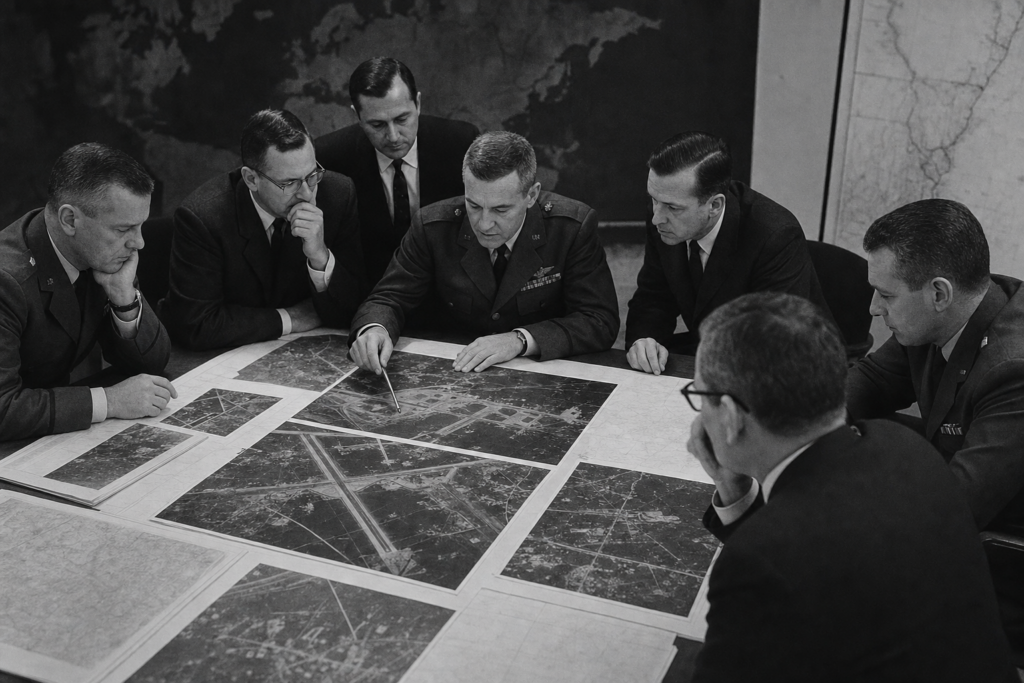
Photographic intelligence gave the United States unusually concrete evidence, but it did not answer every question. Analysts could identify launchers, missile transporters, support facilities, and construction patterns; they could not reliably know every timetable, every operational status, or every Soviet and Cuban intention. The Executive Committee of the National Security Council, known as ExComm, had to turn images into policy under intense time pressure. Different advisers drew different conclusions from the same material. Some emphasized the danger of delay; others warned that a first strike could fail to remove all weapons and might create irreversible escalation. This debate is central to the history of the crisis. Good intelligence reduced uncertainty, but it did not eliminate uncertainty. The responsible task was to distinguish what was observed, what was inferred, and what remained unknown before acting on a conclusion that could affect millions of lives.
The Cuban Missile Crisis of October 1962 is often remembered as thirteen dramatic days at the edge of nuclear war. Its deeper historical value lies in the way intelligence, decision-making, alliance politics, and restraint were forced into one compressed timeline. American U-2 reconnaissance photographs showed Soviet medium- and intermediate-range missile sites under construction in Cuba. The discovery confronted President John F. Kennedy and his advisers with a problem that had no risk-free answer. An air strike might destroy some sites but could kill Soviet personnel and trigger escalation; an invasion risked a wider war; inaction would alter the strategic and political balance in the Caribbean. The crisis therefore became a test of how governments use incomplete information while trying to preserve room for negotiation. It reminds readers that intelligence is not a solution by itself: it is an input that must be interpreted, communicated, and connected to decisions whose consequences can extend far beyond the original evidence.
Photographic intelligence gave the United States unusually concrete evidence, but it did not answer every question. Analysts could identify launchers, missile transporters, support facilities, and construction patterns; they could not reliably know every timetable, every operational status, or every Soviet and Cuban intention. The Executive Committee of the National Security Council, known as ExComm, had to turn images into policy under intense time pressure. Different advisers drew different conclusions from the same material. Some emphasized the danger of delay; others warned that a first strike could fail to remove all weapons and might create irreversible escalation. This debate is central to the history of the crisis. Good intelligence reduced uncertainty, but it did not eliminate uncertainty. The responsible task was to distinguish what was observed, what was inferred, and what remained unknown before acting on a conclusion that could affect millions of lives.
This historical case remains essential for understanding how disciplined analysis and political restraint can protect civilians when military options appear urgent.
| Date | Development | Why it mattered |
|---|---|---|
| 14 October 1962 | U-2 photographs missile sites | The United States gains evidence of Soviet deployment |
| 22 October | Kennedy announces quarantine | Pressure is applied without an immediate strike |
| 24 October | Soviet ships approach the quarantine | The risk of a direct naval confrontation peaks |
| 27 October | U-2 is shot down over Cuba | Escalation danger increases sharply |
| 28 October | Khrushchev accepts removal | The immediate crisis is de-escalated |
The quarantine and a deliberately limited use of force
The Cuban Missile Crisis of October 1962 is often remembered as thirteen dramatic days at the edge of nuclear war. Its deeper historical value lies in the way intelligence, decision-making, alliance politics, and restraint were forced into one compressed timeline. American U-2 reconnaissance photographs showed Soviet medium- and intermediate-range missile sites under construction in Cuba. The discovery confronted President John F. Kennedy and his advisers with a problem that had no risk-free answer. An air strike might destroy some sites but could kill Soviet personnel and trigger escalation; an invasion risked a wider war; inaction would alter the strategic and political balance in the Caribbean. The crisis therefore became a test of how governments use incomplete information while trying to preserve room for negotiation. It reminds readers that intelligence is not a solution by itself: it is an input that must be interpreted, communicated, and connected to decisions whose consequences can extend far beyond the original evidence.
Kennedy chose a naval quarantine rather than the immediate air strike urged by some advisers. The term quarantine was selected partly because a formal blockade had specific legal implications, but the practical purpose was clear: stop additional offensive military equipment from reaching Cuba while demanding removal of the missiles already identified. The measure created pressure without instantly attacking Soviet forces on the island. It also gave Moscow time to respond, allowed Washington to build support through the Organization of American States, and made the dispute visible to international audiences. The quarantine was not a harmless middle path. Naval encounters could have gone wrong, and the Soviet Union could have treated it as an act of war. Its importance was that it preserved a ladder of choices. By avoiding an irreversible first blow, it kept diplomacy alive while still demonstrating that the discovery had consequences.
The Cuban Missile Crisis of October 1962 is often remembered as thirteen dramatic days at the edge of nuclear war. Its deeper historical value lies in the way intelligence, decision-making, alliance politics, and restraint were forced into one compressed timeline. American U-2 reconnaissance photographs showed Soviet medium- and intermediate-range missile sites under construction in Cuba. The discovery confronted President John F. Kennedy and his advisers with a problem that had no risk-free answer. An air strike might destroy some sites but could kill Soviet personnel and trigger escalation; an invasion risked a wider war; inaction would alter the strategic and political balance in the Caribbean. The crisis therefore became a test of how governments use incomplete information while trying to preserve room for negotiation. It reminds readers that intelligence is not a solution by itself: it is an input that must be interpreted, communicated, and connected to decisions whose consequences can extend far beyond the original evidence.
Kennedy chose a naval quarantine rather than the immediate air strike urged by some advisers. The term quarantine was selected partly because a formal blockade had specific legal implications, but the practical purpose was clear: stop additional offensive military equipment from reaching Cuba while demanding removal of the missiles already identified. The measure created pressure without instantly attacking Soviet forces on the island. It also gave Moscow time to respond, allowed Washington to build support through the Organization of American States, and made the dispute visible to international audiences. The quarantine was not a harmless middle path. Naval encounters could have gone wrong, and the Soviet Union could have treated it as an act of war. Its importance was that it preserved a ladder of choices. By avoiding an irreversible first blow, it kept diplomacy alive while still demonstrating that the discovery had consequences.
This historical case remains essential for understanding how disciplined analysis and political restraint can protect civilians when military options appear urgent.
Communication, miscalculation, and the management of escalation
The Cuban Missile Crisis of October 1962 is often remembered as thirteen dramatic days at the edge of nuclear war. Its deeper historical value lies in the way intelligence, decision-making, alliance politics, and restraint were forced into one compressed timeline. American U-2 reconnaissance photographs showed Soviet medium- and intermediate-range missile sites under construction in Cuba. The discovery confronted President John F. Kennedy and his advisers with a problem that had no risk-free answer. An air strike might destroy some sites but could kill Soviet personnel and trigger escalation; an invasion risked a wider war; inaction would alter the strategic and political balance in the Caribbean. The crisis therefore became a test of how governments use incomplete information while trying to preserve room for negotiation. It reminds readers that intelligence is not a solution by itself: it is an input that must be interpreted, communicated, and connected to decisions whose consequences can extend far beyond the original evidence.
The most dangerous moments showed how easily a crisis can outgrow the intentions of national leaders. Soviet ships approached the quarantine line; a U-2 was shot down over Cuba; another U-2 strayed over Soviet territory in the Arctic; and military organizations on both sides operated under alert conditions. These events were not simply background drama. They revealed the gap between central political control and the actions of pilots, commanders, radar crews, and local units. Kennedy and Soviet leader Nikita Khrushchev exchanged messages that mixed public posture with private urgency. The eventual settlement involved the public removal of Soviet missiles from Cuba and a private American commitment to remove Jupiter missiles from Turkey after a period of time. The arrangement illustrates that communication works best when leaders can signal firmness publicly while retaining private channels for compromise and face-saving.
The Cuban Missile Crisis of October 1962 is often remembered as thirteen dramatic days at the edge of nuclear war. Its deeper historical value lies in the way intelligence, decision-making, alliance politics, and restraint were forced into one compressed timeline. American U-2 reconnaissance photographs showed Soviet medium- and intermediate-range missile sites under construction in Cuba. The discovery confronted President John F. Kennedy and his advisers with a problem that had no risk-free answer. An air strike might destroy some sites but could kill Soviet personnel and trigger escalation; an invasion risked a wider war; inaction would alter the strategic and political balance in the Caribbean. The crisis therefore became a test of how governments use incomplete information while trying to preserve room for negotiation. It reminds readers that intelligence is not a solution by itself: it is an input that must be interpreted, communicated, and connected to decisions whose consequences can extend far beyond the original evidence.
The most dangerous moments showed how easily a crisis can outgrow the intentions of national leaders. Soviet ships approached the quarantine line; a U-2 was shot down over Cuba; another U-2 strayed over Soviet territory in the Arctic; and military organizations on both sides operated under alert conditions. These events were not simply background drama. They revealed the gap between central political control and the actions of pilots, commanders, radar crews, and local units. Kennedy and Soviet leader Nikita Khrushchev exchanged messages that mixed public posture with private urgency. The eventual settlement involved the public removal of Soviet missiles from Cuba and a private American commitment to remove Jupiter missiles from Turkey after a period of time. The arrangement illustrates that communication works best when leaders can signal firmness publicly while retaining private channels for compromise and face-saving.
This historical case remains essential for understanding how disciplined analysis and political restraint can protect civilians when military options appear urgent.
Historical legacy: nuclear risk, institutions, and restraint
The Cuban Missile Crisis of October 1962 is often remembered as thirteen dramatic days at the edge of nuclear war. Its deeper historical value lies in the way intelligence, decision-making, alliance politics, and restraint were forced into one compressed timeline. American U-2 reconnaissance photographs showed Soviet medium- and intermediate-range missile sites under construction in Cuba. The discovery confronted President John F. Kennedy and his advisers with a problem that had no risk-free answer. An air strike might destroy some sites but could kill Soviet personnel and trigger escalation; an invasion risked a wider war; inaction would alter the strategic and political balance in the Caribbean. The crisis therefore became a test of how governments use incomplete information while trying to preserve room for negotiation. It reminds readers that intelligence is not a solution by itself: it is an input that must be interpreted, communicated, and connected to decisions whose consequences can extend far beyond the original evidence.
The crisis influenced later arms-control practice and crisis-management institutions. Washington and Moscow established the direct communications link popularly called the hotline, and both governments had stronger incentives to negotiate limits on nuclear testing and weapons deployment. The episode did not make nuclear competition safe; it demonstrated how fragile control could be. It also complicates simple stories of victory. The United States achieved removal of missiles from Cuba, but the Soviet Union obtained a quiet assurance regarding American missiles in Turkey and a promise not to invade Cuba. Cuba itself was not merely scenery: the crisis shaped its security concerns and long relationship with both superpowers. The lasting lesson is not that brinkmanship is wise. It is that restraint, accurate assessment, reliable communication, and a willingness to accept a mutually survivable settlement can prevent a dangerous confrontation from becoming catastrophic.
The Cuban Missile Crisis of October 1962 is often remembered as thirteen dramatic days at the edge of nuclear war. Its deeper historical value lies in the way intelligence, decision-making, alliance politics, and restraint were forced into one compressed timeline. American U-2 reconnaissance photographs showed Soviet medium- and intermediate-range missile sites under construction in Cuba. The discovery confronted President John F. Kennedy and his advisers with a problem that had no risk-free answer. An air strike might destroy some sites but could kill Soviet personnel and trigger escalation; an invasion risked a wider war; inaction would alter the strategic and political balance in the Caribbean. The crisis therefore became a test of how governments use incomplete information while trying to preserve room for negotiation. It reminds readers that intelligence is not a solution by itself: it is an input that must be interpreted, communicated, and connected to decisions whose consequences can extend far beyond the original evidence.
The crisis influenced later arms-control practice and crisis-management institutions. Washington and Moscow established the direct communications link popularly called the hotline, and both governments had stronger incentives to negotiate limits on nuclear testing and weapons deployment. The episode did not make nuclear competition safe; it demonstrated how fragile control could be. It also complicates simple stories of victory. The United States achieved removal of missiles from Cuba, but the Soviet Union obtained a quiet assurance regarding American missiles in Turkey and a promise not to invade Cuba. Cuba itself was not merely scenery: the crisis shaped its security concerns and long relationship with both superpowers. The lasting lesson is not that brinkmanship is wise. It is that restraint, accurate assessment, reliable communication, and a willingness to accept a mutually survivable settlement can prevent a dangerous confrontation from becoming catastrophic.
This historical case remains essential for understanding how disciplined analysis and political restraint can protect civilians when military options appear urgent.