From intercepted signals to operational intelligence
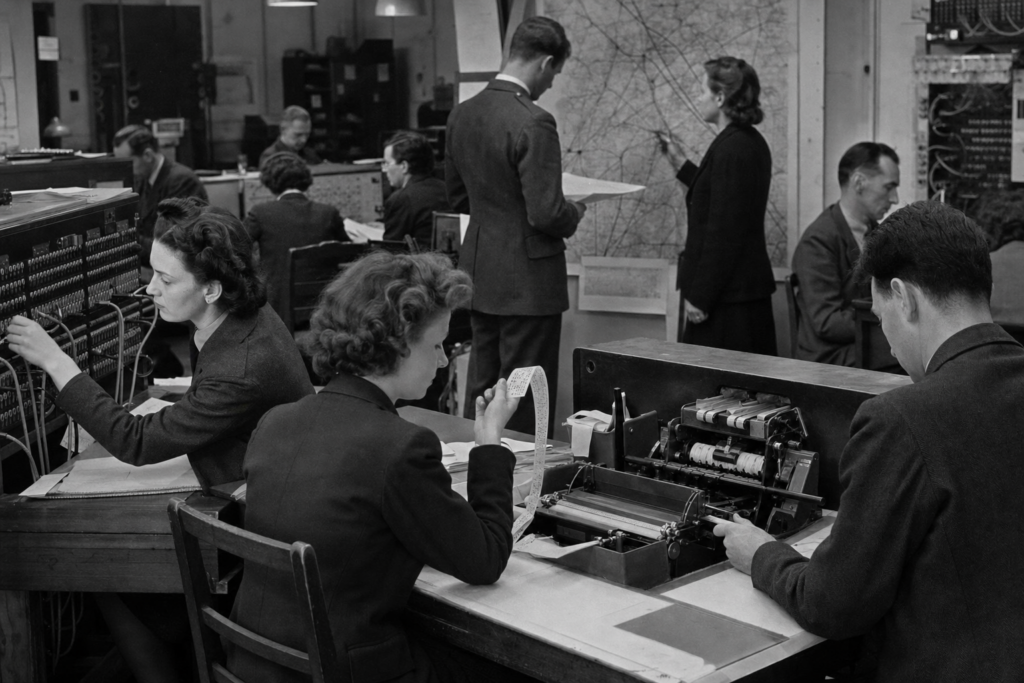
Bletchley Park was the central British codebreaking organization of the Second World War, but it was not a single room, a single machine, or the achievement of one famous individual. It was a large intelligence system that combined linguists, mathematicians, engineers, clerks, radio intercept operators, traffic analysts, machine operators, and military liaison officers. Its best-known work concerned German Enigma traffic and later the Lorenz cipher, yet the strategic value came from turning intercepted signals into usable information quickly enough for commanders to act. Codebreaking is often described as a technical puzzle, but wartime intelligence is a chain: collection, sorting, cryptanalysis, translation, evaluation, dissemination, and operational use must all work together. Bletchley Park’s history therefore shows how secrecy, industrial organization, and disciplined collaboration can create an advantage without making intelligence infallible or self-explanatory.
British and Allied stations intercepted enormous volumes of enemy radio traffic. Some messages could not immediately be read, but patterns of callsigns, timing, frequencies, and operator habits still revealed structure. This traffic analysis helped identify formations, routes, and changes in activity even when encryption remained secure. When cryptanalysts recovered message settings or plain text, the result had to be translated, checked, and compared with other sources. A decrypted report could be deceptive if it was old, incomplete, or planted; it could also reveal a source that commanders had to protect. The intelligence product known as Ultra was therefore carefully controlled. Its value depended on matching decoded information with reconnaissance, naval patrols, prisoner reports, and operational context. The lesson is that information gains force through corroboration and timely distribution, not simply through technical access to an enemy message.
Bletchley Park was the central British codebreaking organization of the Second World War, but it was not a single room, a single machine, or the achievement of one famous individual. It was a large intelligence system that combined linguists, mathematicians, engineers, clerks, radio intercept operators, traffic analysts, machine operators, and military liaison officers. Its best-known work concerned German Enigma traffic and later the Lorenz cipher, yet the strategic value came from turning intercepted signals into usable information quickly enough for commanders to act. Codebreaking is often described as a technical puzzle, but wartime intelligence is a chain: collection, sorting, cryptanalysis, translation, evaluation, dissemination, and operational use must all work together. Bletchley Park’s history therefore shows how secrecy, industrial organization, and disciplined collaboration can create an advantage without making intelligence infallible or self-explanatory.
British and Allied stations intercepted enormous volumes of enemy radio traffic. Some messages could not immediately be read, but patterns of callsigns, timing, frequencies, and operator habits still revealed structure. This traffic analysis helped identify formations, routes, and changes in activity even when encryption remained secure. When cryptanalysts recovered message settings or plain text, the result had to be translated, checked, and compared with other sources. A decrypted report could be deceptive if it was old, incomplete, or planted; it could also reveal a source that commanders had to protect. The intelligence product known as Ultra was therefore carefully controlled. Its value depended on matching decoded information with reconnaissance, naval patrols, prisoner reports, and operational context. The lesson is that information gains force through corroboration and timely distribution, not simply through technical access to an enemy message.
Bletchley Park was the central British codebreaking organization of the Second World War, but it was not a single room, a single machine, or the achievement of one famous individual. It was a large intelligence system that combined linguists, mathematicians, engineers, clerks, radio intercept operators, traffic analysts, machine operators, and military liaison officers. Its best-known work concerned German Enigma traffic and later the Lorenz cipher, yet the strategic value came from turning intercepted signals into usable information quickly enough for commanders to act. Codebreaking is often described as a technical puzzle, but wartime intelligence is a chain: collection, sorting, cryptanalysis, translation, evaluation, dissemination, and operational use must all work together. Bletchley Park’s history therefore shows how secrecy, industrial organization, and disciplined collaboration can create an advantage without making intelligence infallible or self-explanatory.
British and Allied stations intercepted enormous volumes of enemy radio traffic. Some messages could not immediately be read, but patterns of callsigns, timing, frequencies, and operator habits still revealed structure. This traffic analysis helped identify formations, routes, and changes in activity even when encryption remained secure. When cryptanalysts recovered message settings or plain text, the result had to be translated, checked, and compared with other sources. A decrypted report could be deceptive if it was old, incomplete, or planted; it could also reveal a source that commanders had to protect. The intelligence product known as Ultra was therefore carefully controlled. Its value depended on matching decoded information with reconnaissance, naval patrols, prisoner reports, and operational context. The lesson is that information gains force through corroboration and timely distribution, not simply through technical access to an enemy message.
| Element | Function | Historical significance |
|---|---|---|
| Radio intercept | Collect enemy signals | Provides raw traffic and patterns |
| Traffic analysis | Study metadata and behavior | Reveals organization without full decryption |
| Enigma Bombes | Test possible settings | Industrializes cryptanalytic search |
| Colossus | Process Lorenz traffic | Marks a major electronic computing advance |
| Ultra dissemination | Deliver evaluated intelligence | Connects secrets to operational decisions |
Enigma, Bombes, and the industrialization of analysis
Bletchley Park was the central British codebreaking organization of the Second World War, but it was not a single room, a single machine, or the achievement of one famous individual. It was a large intelligence system that combined linguists, mathematicians, engineers, clerks, radio intercept operators, traffic analysts, machine operators, and military liaison officers. Its best-known work concerned German Enigma traffic and later the Lorenz cipher, yet the strategic value came from turning intercepted signals into usable information quickly enough for commanders to act. Codebreaking is often described as a technical puzzle, but wartime intelligence is a chain: collection, sorting, cryptanalysis, translation, evaluation, dissemination, and operational use must all work together. Bletchley Park’s history therefore shows how secrecy, industrial organization, and disciplined collaboration can create an advantage without making intelligence infallible or self-explanatory.
Enigma used rotating wheels, plugboard connections, and changing daily settings to create an enormous number of possible combinations. Polish mathematicians made crucial pre-war advances, including work that was shared with Britain and France before the German invasion of Poland. At Bletchley Park, analysts and engineers developed procedures and electromechanical Bombes to search likely settings efficiently. These machines did not magically read every message. They tested logical possibilities generated by human insight, particularly likely fragments of plaintext known as cribs. The process required accurate intercepts, operators, maintenance, and a constant effort to adapt when German procedures changed. Later, the Lorenz traffic used by high command required another set of methods and led to Colossus, an early electronic programmable machine. The important point is that wartime computing grew from a practical intelligence problem and from teamwork between theorists, engineers, and operators.
Bletchley Park was the central British codebreaking organization of the Second World War, but it was not a single room, a single machine, or the achievement of one famous individual. It was a large intelligence system that combined linguists, mathematicians, engineers, clerks, radio intercept operators, traffic analysts, machine operators, and military liaison officers. Its best-known work concerned German Enigma traffic and later the Lorenz cipher, yet the strategic value came from turning intercepted signals into usable information quickly enough for commanders to act. Codebreaking is often described as a technical puzzle, but wartime intelligence is a chain: collection, sorting, cryptanalysis, translation, evaluation, dissemination, and operational use must all work together. Bletchley Park’s history therefore shows how secrecy, industrial organization, and disciplined collaboration can create an advantage without making intelligence infallible or self-explanatory.
Enigma used rotating wheels, plugboard connections, and changing daily settings to create an enormous number of possible combinations. Polish mathematicians made crucial pre-war advances, including work that was shared with Britain and France before the German invasion of Poland. At Bletchley Park, analysts and engineers developed procedures and electromechanical Bombes to search likely settings efficiently. These machines did not magically read every message. They tested logical possibilities generated by human insight, particularly likely fragments of plaintext known as cribs. The process required accurate intercepts, operators, maintenance, and a constant effort to adapt when German procedures changed. Later, the Lorenz traffic used by high command required another set of methods and led to Colossus, an early electronic programmable machine. The important point is that wartime computing grew from a practical intelligence problem and from teamwork between theorists, engineers, and operators.
Bletchley Park was the central British codebreaking organization of the Second World War, but it was not a single room, a single machine, or the achievement of one famous individual. It was a large intelligence system that combined linguists, mathematicians, engineers, clerks, radio intercept operators, traffic analysts, machine operators, and military liaison officers. Its best-known work concerned German Enigma traffic and later the Lorenz cipher, yet the strategic value came from turning intercepted signals into usable information quickly enough for commanders to act. Codebreaking is often described as a technical puzzle, but wartime intelligence is a chain: collection, sorting, cryptanalysis, translation, evaluation, dissemination, and operational use must all work together. Bletchley Park’s history therefore shows how secrecy, industrial organization, and disciplined collaboration can create an advantage without making intelligence infallible or self-explanatory.
Enigma used rotating wheels, plugboard connections, and changing daily settings to create an enormous number of possible combinations. Polish mathematicians made crucial pre-war advances, including work that was shared with Britain and France before the German invasion of Poland. At Bletchley Park, analysts and engineers developed procedures and electromechanical Bombes to search likely settings efficiently. These machines did not magically read every message. They tested logical possibilities generated by human insight, particularly likely fragments of plaintext known as cribs. The process required accurate intercepts, operators, maintenance, and a constant effort to adapt when German procedures changed. Later, the Lorenz traffic used by high command required another set of methods and led to Colossus, an early electronic programmable machine. The important point is that wartime computing grew from a practical intelligence problem and from teamwork between theorists, engineers, and operators.
Secrecy, risk, and the problem of using a secret source
Bletchley Park was the central British codebreaking organization of the Second World War, but it was not a single room, a single machine, or the achievement of one famous individual. It was a large intelligence system that combined linguists, mathematicians, engineers, clerks, radio intercept operators, traffic analysts, machine operators, and military liaison officers. Its best-known work concerned German Enigma traffic and later the Lorenz cipher, yet the strategic value came from turning intercepted signals into usable information quickly enough for commanders to act. Codebreaking is often described as a technical puzzle, but wartime intelligence is a chain: collection, sorting, cryptanalysis, translation, evaluation, dissemination, and operational use must all work together. Bletchley Park’s history therefore shows how secrecy, industrial organization, and disciplined collaboration can create an advantage without making intelligence infallible or self-explanatory.
A successful decrypt created a difficult question: how should it be used without telling the enemy that the cipher had been broken? If Allied forces reacted too directly to every message, German commanders might change procedures or systems. Intelligence officers therefore sought cover sources, adjusted the timing of action, and combined Ultra with other forms of evidence. This did not always work perfectly, and the secrecy surrounding codebreaking has encouraged later myths about omniscient intelligence. Bletchley Park could not guarantee outcomes, replace logistics, or eliminate the fog of war. It could provide a better picture of enemy intentions and movements, allowing commanders to allocate scarce ships, aircraft, and forces more effectively. In the Battle of the Atlantic, for example, information about U-boat deployments mattered most when escort capacity, long-range aircraft, weather, and convoy procedures could act on it.
Bletchley Park was the central British codebreaking organization of the Second World War, but it was not a single room, a single machine, or the achievement of one famous individual. It was a large intelligence system that combined linguists, mathematicians, engineers, clerks, radio intercept operators, traffic analysts, machine operators, and military liaison officers. Its best-known work concerned German Enigma traffic and later the Lorenz cipher, yet the strategic value came from turning intercepted signals into usable information quickly enough for commanders to act. Codebreaking is often described as a technical puzzle, but wartime intelligence is a chain: collection, sorting, cryptanalysis, translation, evaluation, dissemination, and operational use must all work together. Bletchley Park’s history therefore shows how secrecy, industrial organization, and disciplined collaboration can create an advantage without making intelligence infallible or self-explanatory.
A successful decrypt created a difficult question: how should it be used without telling the enemy that the cipher had been broken? If Allied forces reacted too directly to every message, German commanders might change procedures or systems. Intelligence officers therefore sought cover sources, adjusted the timing of action, and combined Ultra with other forms of evidence. This did not always work perfectly, and the secrecy surrounding codebreaking has encouraged later myths about omniscient intelligence. Bletchley Park could not guarantee outcomes, replace logistics, or eliminate the fog of war. It could provide a better picture of enemy intentions and movements, allowing commanders to allocate scarce ships, aircraft, and forces more effectively. In the Battle of the Atlantic, for example, information about U-boat deployments mattered most when escort capacity, long-range aircraft, weather, and convoy procedures could act on it.
Bletchley Park was the central British codebreaking organization of the Second World War, but it was not a single room, a single machine, or the achievement of one famous individual. It was a large intelligence system that combined linguists, mathematicians, engineers, clerks, radio intercept operators, traffic analysts, machine operators, and military liaison officers. Its best-known work concerned German Enigma traffic and later the Lorenz cipher, yet the strategic value came from turning intercepted signals into usable information quickly enough for commanders to act. Codebreaking is often described as a technical puzzle, but wartime intelligence is a chain: collection, sorting, cryptanalysis, translation, evaluation, dissemination, and operational use must all work together. Bletchley Park’s history therefore shows how secrecy, industrial organization, and disciplined collaboration can create an advantage without making intelligence infallible or self-explanatory.
A successful decrypt created a difficult question: how should it be used without telling the enemy that the cipher had been broken? If Allied forces reacted too directly to every message, German commanders might change procedures or systems. Intelligence officers therefore sought cover sources, adjusted the timing of action, and combined Ultra with other forms of evidence. This did not always work perfectly, and the secrecy surrounding codebreaking has encouraged later myths about omniscient intelligence. Bletchley Park could not guarantee outcomes, replace logistics, or eliminate the fog of war. It could provide a better picture of enemy intentions and movements, allowing commanders to allocate scarce ships, aircraft, and forces more effectively. In the Battle of the Atlantic, for example, information about U-boat deployments mattered most when escort capacity, long-range aircraft, weather, and convoy procedures could act on it.
Legacy: collaboration, computing, and responsible historical memory
Bletchley Park was the central British codebreaking organization of the Second World War, but it was not a single room, a single machine, or the achievement of one famous individual. It was a large intelligence system that combined linguists, mathematicians, engineers, clerks, radio intercept operators, traffic analysts, machine operators, and military liaison officers. Its best-known work concerned German Enigma traffic and later the Lorenz cipher, yet the strategic value came from turning intercepted signals into usable information quickly enough for commanders to act. Codebreaking is often described as a technical puzzle, but wartime intelligence is a chain: collection, sorting, cryptanalysis, translation, evaluation, dissemination, and operational use must all work together. Bletchley Park’s history therefore shows how secrecy, industrial organization, and disciplined collaboration can create an advantage without making intelligence infallible or self-explanatory.
Bletchley Park’s legacy includes cryptanalysis, computing history, and a broader understanding of intelligence organizations. Colossus helped demonstrate the potential of electronic computation, while the wider operation showed that intellectual work depends on administration, labor, and infrastructure. Thousands of women served as operators, clerks, translators, and analysts; their contributions are essential to the story. Secrecy delayed public recognition for decades, which is why popular memory once focused narrowly on a few names. A fuller account emphasizes collaboration and the limits of intelligence. Decrypted material must be evaluated, protected, and connected to real capabilities. The historical lesson is not that technology makes conflict predictable. It is that careful collection, sound analysis, secure communication, and institutional cooperation can improve decisions when uncertainty cannot be removed.
Bletchley Park was the central British codebreaking organization of the Second World War, but it was not a single room, a single machine, or the achievement of one famous individual. It was a large intelligence system that combined linguists, mathematicians, engineers, clerks, radio intercept operators, traffic analysts, machine operators, and military liaison officers. Its best-known work concerned German Enigma traffic and later the Lorenz cipher, yet the strategic value came from turning intercepted signals into usable information quickly enough for commanders to act. Codebreaking is often described as a technical puzzle, but wartime intelligence is a chain: collection, sorting, cryptanalysis, translation, evaluation, dissemination, and operational use must all work together. Bletchley Park’s history therefore shows how secrecy, industrial organization, and disciplined collaboration can create an advantage without making intelligence infallible or self-explanatory.
Bletchley Park’s legacy includes cryptanalysis, computing history, and a broader understanding of intelligence organizations. Colossus helped demonstrate the potential of electronic computation, while the wider operation showed that intellectual work depends on administration, labor, and infrastructure. Thousands of women served as operators, clerks, translators, and analysts; their contributions are essential to the story. Secrecy delayed public recognition for decades, which is why popular memory once focused narrowly on a few names. A fuller account emphasizes collaboration and the limits of intelligence. Decrypted material must be evaluated, protected, and connected to real capabilities. The historical lesson is not that technology makes conflict predictable. It is that careful collection, sound analysis, secure communication, and institutional cooperation can improve decisions when uncertainty cannot be removed.
Bletchley Park was the central British codebreaking organization of the Second World War, but it was not a single room, a single machine, or the achievement of one famous individual. It was a large intelligence system that combined linguists, mathematicians, engineers, clerks, radio intercept operators, traffic analysts, machine operators, and military liaison officers. Its best-known work concerned German Enigma traffic and later the Lorenz cipher, yet the strategic value came from turning intercepted signals into usable information quickly enough for commanders to act. Codebreaking is often described as a technical puzzle, but wartime intelligence is a chain: collection, sorting, cryptanalysis, translation, evaluation, dissemination, and operational use must all work together. Bletchley Park’s history therefore shows how secrecy, industrial organization, and disciplined collaboration can create an advantage without making intelligence infallible or self-explanatory.
Bletchley Park’s legacy includes cryptanalysis, computing history, and a broader understanding of intelligence organizations. Colossus helped demonstrate the potential of electronic computation, while the wider operation showed that intellectual work depends on administration, labor, and infrastructure. Thousands of women served as operators, clerks, translators, and analysts; their contributions are essential to the story. Secrecy delayed public recognition for decades, which is why popular memory once focused narrowly on a few names. A fuller account emphasizes collaboration and the limits of intelligence. Decrypted material must be evaluated, protected, and connected to real capabilities. The historical lesson is not that technology makes conflict predictable. It is that careful collection, sound analysis, secure communication, and institutional cooperation can improve decisions when uncertainty cannot be removed.