The Impenetrable Skies and the U-2 Program
In the mid-1950s, the Central Intelligence Agency (CIA) initiated a highly classified project to conduct aerial reconnaissance over the Soviet Union. The result was the Lockheed U-2, a unique aircraft featuring long, glider-like wings designed to fly at altitudes above 70,000 feet (21,300 meters). At this extreme height, the U-2 was believed to be completely immune to Soviet air defenses. Soviet radar could detect the spy planes, but the USSR’s interceptor aircraft, such as the MiG-17 and MiG-19, could not reach them, and their anti-aircraft guns were useless. For four years, the U-2 conducted unchallenged overflights, photographing secret Soviet missile sites, submarine bases, and nuclear test installations.
For the Soviet leadership, particularly Premier Nikita Khrushchev, these overflights were a profound national humiliation. The Soviets knew the flights were occurring but were powerless to stop them. Khrushchev demanded that Soviet engineers develop a weapon capable of reaching the U-2. The response was a massive, nationwide effort to deploy a new generation of guided surface-to-air missiles, setting the stage for a dramatic technological showdown in the upper atmosphere.
The Soviet Counterweapon: The S-75 Dvina
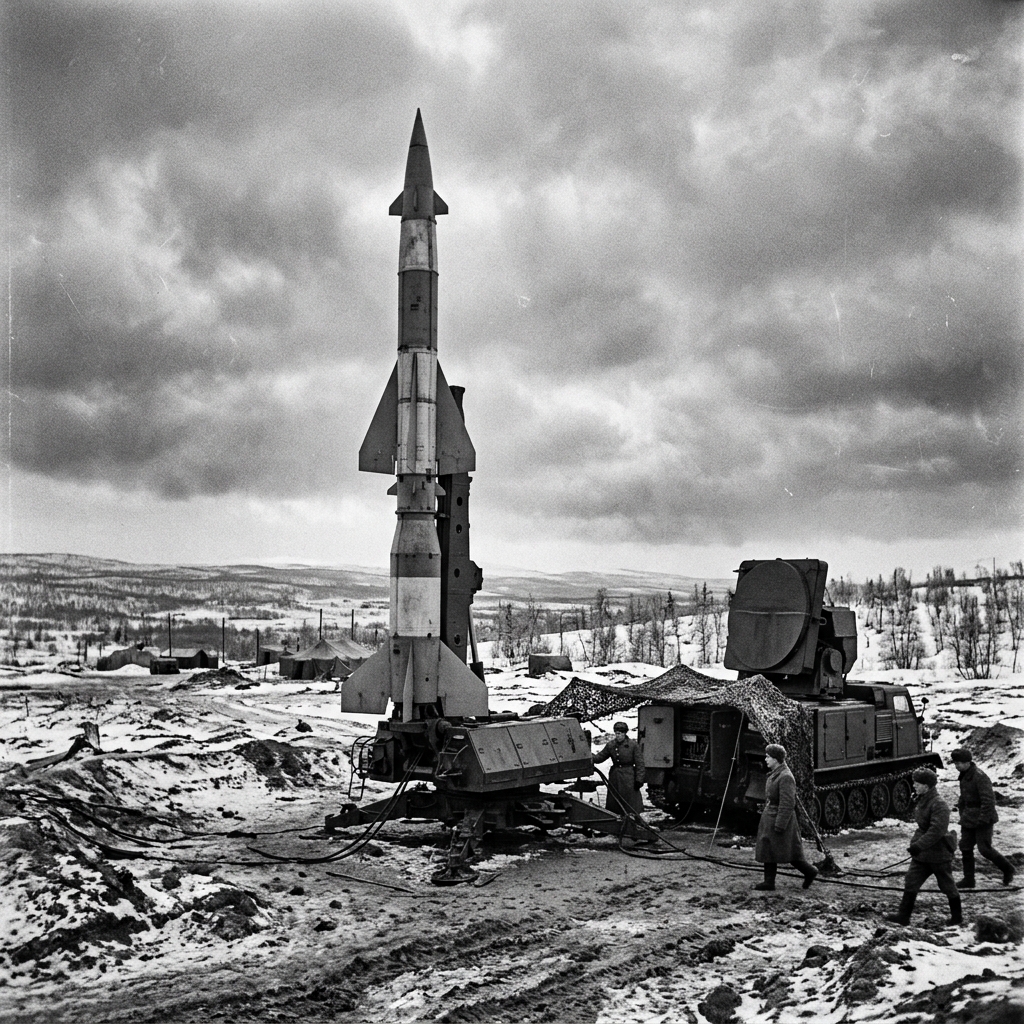
The weapon designed to shatter the U-2’s high-altitude sanctuary was the S-75 Dvina (NATO reporting name SA-2 “Guideline”). Developed by the Lavochkin OKB starting in 1953, the S-75 was a massive, two-stage missile. It utilized a solid-fuel booster rocket to launch it from its pad and a liquid-fueled sustainer motor containing nitric acid and kerosene to propel it to speeds of Mach 3.5. The missile had an operational range of 28 miles (45 km) and a maximum ceiling of over 82,000 feet (25,000 meters), placing the U-2 well within its flight envelope.
The S-75 was guided by the SNR-75 “Fan Song” radar system. The Fan Song radar scanned the sky with two narrow, fan-shaped beams to track both the target and the rising missile. The radar data was fed into an analog computer in the command cabin, which calculated steering corrections and transmitted radio command signals to the missile’s control surfaces. To ensure the target’s destruction, the S-75 carried a 440-pound (200 kg) high-explosive fragmentation warhead designed to scatter a lethal cloud of shrapnel in a 200-meter radius upon detonation. By 1959, the Soviets had deployed hundreds of S-75 batteries around their most critical military and industrial centers.
May Day 1960: The Shootdown of Francis Gary Powers
On May 1, 1960, CIA pilot Francis Gary Powers took off from Peshawar, Pakistan, in a U-2 code-named Article 360. The flight path was designed to cross the Soviet Union from south to north, photographing strategic sites before landing in Bodo, Norway. As Powers entered Soviet airspace, he was tracked by early warning radars. Soviet air defense command scrambled interceptor jets, but none could match the U-2’s altitude. As Powers approached the industrial city of Sverdlovsk (now Yekaterinburg), he entered the engagement envelope of a local S-75 Dvina missile battery commanded by Major Mikhail Voronov.
Voronov’s battery launched a salvo of three S-75 missiles. One of the missiles detonated close behind Powers’ aircraft. The blast wave shattered the U-2’s fragile tail section, sending the plane into a violent, uncontrolled spin. Powers was thrown forward in his cockpit but managed to escape the falling wreckage, parachuting safely to the ground where he was immediately captured by Soviet civilians. In the chaos of the engagement, the Soviet radar operators struggled to separate friendly and hostile targets, leading another S-75 battery to accidentally shoot down a Soviet MiG-19 fighter that was attempting to intercept Powers, tragically killing the pilot, Senior Lieutenant Sergei Safronov.
Geopolitical Fall-out and the End of High-Altitude Overflights
The downing of Powers’ U-2 triggered one of the most intense diplomatic crises of the Cold War. Believing that Powers had died in the crash and that the U-2 had been destroyed, US President Dwight D. Eisenhower issued a cover story claiming that a weather research aircraft had drifted off course. However, Premier Khrushchev caught the US in a lie, revealing that the Soviets had captured Powers alive, recovered the spy camera, and possessed clear evidence of espionage. The incident collapsed the Paris Summit between Eisenhower and Khrushchev, raising geopolitical tensions to new heights.
Strategically, the shootdown marked the end of manned US spy flights over the Soviet Union. The S-75 Dvina had proven that the high-altitude sanctuary no longer existed, forcing the United States to accelerate the development of spy satellites (the Corona program) and supersonic reconnaissance aircraft like the Lockheed SR-71 Blackbird, which relied on speed rather than altitude to survive. The S-75 Dvina went on to become the most widely deployed air defense system in history, seeing extensive service in the Vietnam War and the Middle East, proving that guided missile technology had forever changed the dynamics of airspace control.
| System / Aircraft Parameter | S-75 Dvina (SA-2 Guideline) | Lockheed U-2 Spyplane (1960) |
|---|---|---|
| Maximum Speed | Mach 3.5 | 470 mph (760 km/h) |
| Maximum Altitude / Ceiling | 82,000 feet (25,000 m) | 75,000 feet (22,800 m) |
| Operational Range | 28 miles (45 km) | 3,000 miles (4,800 km) |
| Guidance / Navigation | Radio command via Fan Song radar | Autopilot, drift-sight, celestial compass |
| Warhead / Payload | 200 kg High-Explosive Fragmentation | High-resolution panoramic cameras, ELINT receivers |
| Powers Intercept Altitude | N/A | 70,500 feet (21,500 m) |
| Combat Outcome (May 1, 1960) | Destroyed 1x U-2 (and 1x friendly MiG-19) | Shot down (Pilot Powers captured) |