Scale, supply, and the limits of the Grande Armée
Napoleon’s 1812 campaign against the Russian Empire is one of history’s clearest examples of how logistics, distance, climate, political aims, and operational tempo can defeat even a formidable army. Napoleon led the Grande Armée across the Niemen in June with a multinational force of enormous size. The campaign sought a decisive battle and political settlement before the army’s supply system collapsed. Russian forces under Barclay de Tolly and later Mikhail Kutuzov withdrew, traded space for time, and avoided the kind of early destruction Napoleon expected. The result was not simply a story of winter. Disease, desertion, exhausted animals, poor roads, inadequate forage, supply losses, and the scale of the theater weakened the army long before the retreat from Moscow. The campaign demonstrates that an army’s apparent strength at a frontier says little about how much combat power it can sustain hundreds of kilometers from its base.
The Grande Armée was large enough to create logistical problems from the first day. Supplying people, horses, artillery, wagons, ammunition, and medical services across Eastern Europe required roads and depots that could not reliably carry the volume. Napoleon’s system depended partly on magazines and partly on requisitioning food and forage locally. This approach had worked in more densely populated theaters, but the Russian campaign involved enormous distances, seasonal variation, and areas already stripped by withdrawing forces. Horses were especially important: they pulled guns and wagons, carried cavalry, and depended on large amounts of fodder. When animals died or weakened, transport capacity declined, which in turn reduced food and ammunition movement. Logistics is therefore not a separate rear-area issue. It directly determines mobility, artillery strength, reconnaissance, evacuation, and morale. The campaign’s momentum began to erode as the supply system fell behind the marching army.
Napoleon’s 1812 campaign against the Russian Empire is one of history’s clearest examples of how logistics, distance, climate, political aims, and operational tempo can defeat even a formidable army. Napoleon led the Grande Armée across the Niemen in June with a multinational force of enormous size. The campaign sought a decisive battle and political settlement before the army’s supply system collapsed. Russian forces under Barclay de Tolly and later Mikhail Kutuzov withdrew, traded space for time, and avoided the kind of early destruction Napoleon expected. The result was not simply a story of winter. Disease, desertion, exhausted animals, poor roads, inadequate forage, supply losses, and the scale of the theater weakened the army long before the retreat from Moscow. The campaign demonstrates that an army’s apparent strength at a frontier says little about how much combat power it can sustain hundreds of kilometers from its base.
The Grande Armée was large enough to create logistical problems from the first day. Supplying people, horses, artillery, wagons, ammunition, and medical services across Eastern Europe required roads and depots that could not reliably carry the volume. Napoleon’s system depended partly on magazines and partly on requisitioning food and forage locally. This approach had worked in more densely populated theaters, but the Russian campaign involved enormous distances, seasonal variation, and areas already stripped by withdrawing forces. Horses were especially important: they pulled guns and wagons, carried cavalry, and depended on large amounts of fodder. When animals died or weakened, transport capacity declined, which in turn reduced food and ammunition movement. Logistics is therefore not a separate rear-area issue. It directly determines mobility, artillery strength, reconnaissance, evacuation, and morale. The campaign’s momentum began to erode as the supply system fell behind the marching army.
Napoleon’s 1812 campaign against the Russian Empire is one of history’s clearest examples of how logistics, distance, climate, political aims, and operational tempo can defeat even a formidable army. Napoleon led the Grande Armée across the Niemen in June with a multinational force of enormous size. The campaign sought a decisive battle and political settlement before the army’s supply system collapsed. Russian forces under Barclay de Tolly and later Mikhail Kutuzov withdrew, traded space for time, and avoided the kind of early destruction Napoleon expected. The result was not simply a story of winter. Disease, desertion, exhausted animals, poor roads, inadequate forage, supply losses, and the scale of the theater weakened the army long before the retreat from Moscow. The campaign demonstrates that an army’s apparent strength at a frontier says little about how much combat power it can sustain hundreds of kilometers from its base.
The Grande Armée was large enough to create logistical problems from the first day. Supplying people, horses, artillery, wagons, ammunition, and medical services across Eastern Europe required roads and depots that could not reliably carry the volume. Napoleon’s system depended partly on magazines and partly on requisitioning food and forage locally. This approach had worked in more densely populated theaters, but the Russian campaign involved enormous distances, seasonal variation, and areas already stripped by withdrawing forces. Horses were especially important: they pulled guns and wagons, carried cavalry, and depended on large amounts of fodder. When animals died or weakened, transport capacity declined, which in turn reduced food and ammunition movement. Logistics is therefore not a separate rear-area issue. It directly determines mobility, artillery strength, reconnaissance, evacuation, and morale. The campaign’s momentum began to erode as the supply system fell behind the marching army.
| Factor | Pressure on the army | Operational consequence |
|---|---|---|
| Distance | Supply lines lengthen | Food and ammunition arrive less reliably |
| Horse losses | Transport and cavalry weaken | Mobility and artillery movement decline |
| Russian withdrawals | Local resources are reduced | French forage system fails |
| Borodino and Moscow | No decisive political settlement | The campaign continues into autumn |
| Retreat | Cold amplifies existing attrition | Cohesion and combat power collapse |
Russian strategy: space, time, and political endurance
Napoleon’s 1812 campaign against the Russian Empire is one of history’s clearest examples of how logistics, distance, climate, political aims, and operational tempo can defeat even a formidable army. Napoleon led the Grande Armée across the Niemen in June with a multinational force of enormous size. The campaign sought a decisive battle and political settlement before the army’s supply system collapsed. Russian forces under Barclay de Tolly and later Mikhail Kutuzov withdrew, traded space for time, and avoided the kind of early destruction Napoleon expected. The result was not simply a story of winter. Disease, desertion, exhausted animals, poor roads, inadequate forage, supply losses, and the scale of the theater weakened the army long before the retreat from Moscow. The campaign demonstrates that an army’s apparent strength at a frontier says little about how much combat power it can sustain hundreds of kilometers from its base.
Russian commanders faced pressure to defend territory and protect major cities, but they also recognized that a premature decisive battle might give Napoleon the result he sought. Barclay de Tolly’s withdrawals were unpopular, yet they forced the French to advance farther from their bases. Kutuzov later accepted battle at Borodino, where both armies suffered appalling losses without producing a clear strategic decision. The Russian army then abandoned Moscow, denying Napoleon the political settlement he expected. This strategy did not rely on a passive landscape alone. It required maintaining an army, mobilizing replacements, using irregular forces, and preserving the political will to continue. Russia’s depth made time a weapon, but only because state institutions and military forces could survive the loss of space. The lesson is that strategic endurance comes from organization and political purpose as well as geography.
Napoleon’s 1812 campaign against the Russian Empire is one of history’s clearest examples of how logistics, distance, climate, political aims, and operational tempo can defeat even a formidable army. Napoleon led the Grande Armée across the Niemen in June with a multinational force of enormous size. The campaign sought a decisive battle and political settlement before the army’s supply system collapsed. Russian forces under Barclay de Tolly and later Mikhail Kutuzov withdrew, traded space for time, and avoided the kind of early destruction Napoleon expected. The result was not simply a story of winter. Disease, desertion, exhausted animals, poor roads, inadequate forage, supply losses, and the scale of the theater weakened the army long before the retreat from Moscow. The campaign demonstrates that an army’s apparent strength at a frontier says little about how much combat power it can sustain hundreds of kilometers from its base.
Russian commanders faced pressure to defend territory and protect major cities, but they also recognized that a premature decisive battle might give Napoleon the result he sought. Barclay de Tolly’s withdrawals were unpopular, yet they forced the French to advance farther from their bases. Kutuzov later accepted battle at Borodino, where both armies suffered appalling losses without producing a clear strategic decision. The Russian army then abandoned Moscow, denying Napoleon the political settlement he expected. This strategy did not rely on a passive landscape alone. It required maintaining an army, mobilizing replacements, using irregular forces, and preserving the political will to continue. Russia’s depth made time a weapon, but only because state institutions and military forces could survive the loss of space. The lesson is that strategic endurance comes from organization and political purpose as well as geography.
Napoleon’s 1812 campaign against the Russian Empire is one of history’s clearest examples of how logistics, distance, climate, political aims, and operational tempo can defeat even a formidable army. Napoleon led the Grande Armée across the Niemen in June with a multinational force of enormous size. The campaign sought a decisive battle and political settlement before the army’s supply system collapsed. Russian forces under Barclay de Tolly and later Mikhail Kutuzov withdrew, traded space for time, and avoided the kind of early destruction Napoleon expected. The result was not simply a story of winter. Disease, desertion, exhausted animals, poor roads, inadequate forage, supply losses, and the scale of the theater weakened the army long before the retreat from Moscow. The campaign demonstrates that an army’s apparent strength at a frontier says little about how much combat power it can sustain hundreds of kilometers from its base.
Russian commanders faced pressure to defend territory and protect major cities, but they also recognized that a premature decisive battle might give Napoleon the result he sought. Barclay de Tolly’s withdrawals were unpopular, yet they forced the French to advance farther from their bases. Kutuzov later accepted battle at Borodino, where both armies suffered appalling losses without producing a clear strategic decision. The Russian army then abandoned Moscow, denying Napoleon the political settlement he expected. This strategy did not rely on a passive landscape alone. It required maintaining an army, mobilizing replacements, using irregular forces, and preserving the political will to continue. Russia’s depth made time a weapon, but only because state institutions and military forces could survive the loss of space. The lesson is that strategic endurance comes from organization and political purpose as well as geography.
Moscow, retreat, and the collapse of operational capacity
Napoleon’s 1812 campaign against the Russian Empire is one of history’s clearest examples of how logistics, distance, climate, political aims, and operational tempo can defeat even a formidable army. Napoleon led the Grande Armée across the Niemen in June with a multinational force of enormous size. The campaign sought a decisive battle and political settlement before the army’s supply system collapsed. Russian forces under Barclay de Tolly and later Mikhail Kutuzov withdrew, traded space for time, and avoided the kind of early destruction Napoleon expected. The result was not simply a story of winter. Disease, desertion, exhausted animals, poor roads, inadequate forage, supply losses, and the scale of the theater weakened the army long before the retreat from Moscow. The campaign demonstrates that an army’s apparent strength at a frontier says little about how much combat power it can sustain hundreds of kilometers from its base.
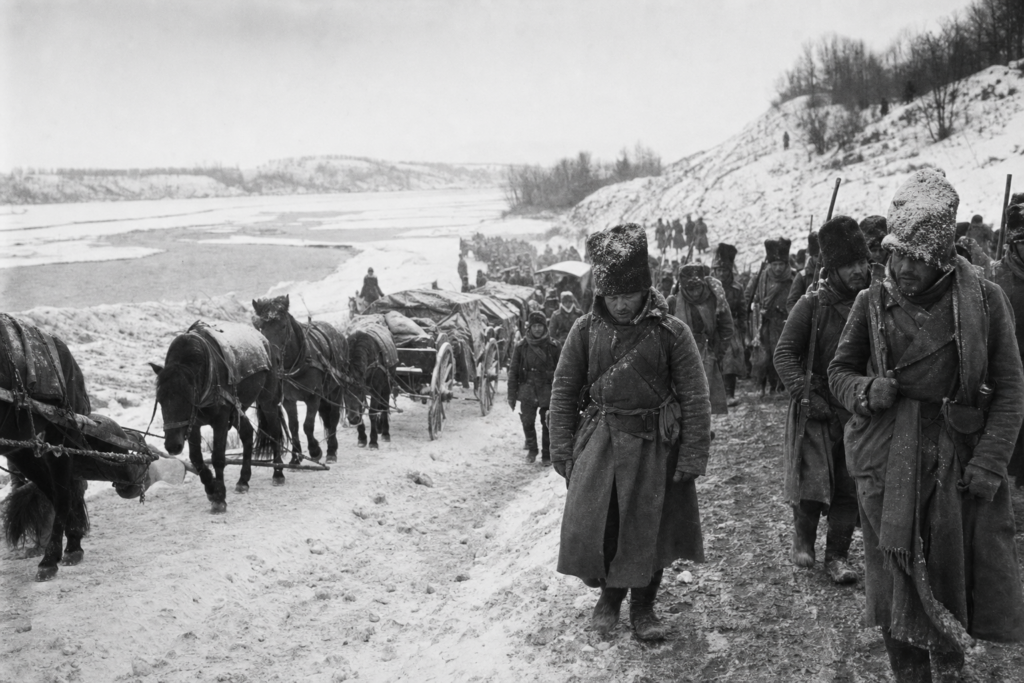
Napoleon entered Moscow in September, but the city did not deliver negotiations, winter quarters, or a restored supply system. Fires, shortages, and the absence of a settlement made continued occupation unsustainable. When the retreat began in October, the army moved through devastated areas with limited food, weak horses, and growing pressure from Russian forces. Cold weather made an existing crisis more severe, but it was not its sole cause. Units had already lost cohesion through hunger, illness, fatigue, and attrition. The crossing of the Berezina in November became a symbol of survival under extreme pressure, but it also revealed the scale of collapse: an army that had crossed into Russia in strength was now fighting to preserve remnants and escape. Operational capacity had declined across every component—transport, command, medical care, cavalry, artillery, and infantry cohesion.
Napoleon’s 1812 campaign against the Russian Empire is one of history’s clearest examples of how logistics, distance, climate, political aims, and operational tempo can defeat even a formidable army. Napoleon led the Grande Armée across the Niemen in June with a multinational force of enormous size. The campaign sought a decisive battle and political settlement before the army’s supply system collapsed. Russian forces under Barclay de Tolly and later Mikhail Kutuzov withdrew, traded space for time, and avoided the kind of early destruction Napoleon expected. The result was not simply a story of winter. Disease, desertion, exhausted animals, poor roads, inadequate forage, supply losses, and the scale of the theater weakened the army long before the retreat from Moscow. The campaign demonstrates that an army’s apparent strength at a frontier says little about how much combat power it can sustain hundreds of kilometers from its base.
Napoleon entered Moscow in September, but the city did not deliver negotiations, winter quarters, or a restored supply system. Fires, shortages, and the absence of a settlement made continued occupation unsustainable. When the retreat began in October, the army moved through devastated areas with limited food, weak horses, and growing pressure from Russian forces. Cold weather made an existing crisis more severe, but it was not its sole cause. Units had already lost cohesion through hunger, illness, fatigue, and attrition. The crossing of the Berezina in November became a symbol of survival under extreme pressure, but it also revealed the scale of collapse: an army that had crossed into Russia in strength was now fighting to preserve remnants and escape. Operational capacity had declined across every component—transport, command, medical care, cavalry, artillery, and infantry cohesion.
Napoleon’s 1812 campaign against the Russian Empire is one of history’s clearest examples of how logistics, distance, climate, political aims, and operational tempo can defeat even a formidable army. Napoleon led the Grande Armée across the Niemen in June with a multinational force of enormous size. The campaign sought a decisive battle and political settlement before the army’s supply system collapsed. Russian forces under Barclay de Tolly and later Mikhail Kutuzov withdrew, traded space for time, and avoided the kind of early destruction Napoleon expected. The result was not simply a story of winter. Disease, desertion, exhausted animals, poor roads, inadequate forage, supply losses, and the scale of the theater weakened the army long before the retreat from Moscow. The campaign demonstrates that an army’s apparent strength at a frontier says little about how much combat power it can sustain hundreds of kilometers from its base.
Napoleon entered Moscow in September, but the city did not deliver negotiations, winter quarters, or a restored supply system. Fires, shortages, and the absence of a settlement made continued occupation unsustainable. When the retreat began in October, the army moved through devastated areas with limited food, weak horses, and growing pressure from Russian forces. Cold weather made an existing crisis more severe, but it was not its sole cause. Units had already lost cohesion through hunger, illness, fatigue, and attrition. The crossing of the Berezina in November became a symbol of survival under extreme pressure, but it also revealed the scale of collapse: an army that had crossed into Russia in strength was now fighting to preserve remnants and escape. Operational capacity had declined across every component—transport, command, medical care, cavalry, artillery, and infantry cohesion.
Legacy: logistics as strategy, not background
Napoleon’s 1812 campaign against the Russian Empire is one of history’s clearest examples of how logistics, distance, climate, political aims, and operational tempo can defeat even a formidable army. Napoleon led the Grande Armée across the Niemen in June with a multinational force of enormous size. The campaign sought a decisive battle and political settlement before the army’s supply system collapsed. Russian forces under Barclay de Tolly and later Mikhail Kutuzov withdrew, traded space for time, and avoided the kind of early destruction Napoleon expected. The result was not simply a story of winter. Disease, desertion, exhausted animals, poor roads, inadequate forage, supply losses, and the scale of the theater weakened the army long before the retreat from Moscow. The campaign demonstrates that an army’s apparent strength at a frontier says little about how much combat power it can sustain hundreds of kilometers from its base.
The 1812 campaign shaped European politics and helped undermine Napoleon’s continental system, encouraging the coalitions that would eventually defeat him. Its military legacy is often summarized as a warning about invading Russia in winter, but that slogan is too simple. The most useful lesson is that logistics defines strategy. A commander must ask not only whether an army can win a battle, but whether it can feed, move, repair, reinforce, and communicate over the time and distance required by the political aim. Napoleon’s army had exceptional experience and battlefield skill, yet those strengths could not overcome a theater that consumed supplies and men faster than the system could replace them. Studying 1812 responsibly means connecting climate with planning, operational tempo with supply, and tactical success with the larger question of whether a campaign can achieve a durable political result.
Napoleon’s 1812 campaign against the Russian Empire is one of history’s clearest examples of how logistics, distance, climate, political aims, and operational tempo can defeat even a formidable army. Napoleon led the Grande Armée across the Niemen in June with a multinational force of enormous size. The campaign sought a decisive battle and political settlement before the army’s supply system collapsed. Russian forces under Barclay de Tolly and later Mikhail Kutuzov withdrew, traded space for time, and avoided the kind of early destruction Napoleon expected. The result was not simply a story of winter. Disease, desertion, exhausted animals, poor roads, inadequate forage, supply losses, and the scale of the theater weakened the army long before the retreat from Moscow. The campaign demonstrates that an army’s apparent strength at a frontier says little about how much combat power it can sustain hundreds of kilometers from its base.
The 1812 campaign shaped European politics and helped undermine Napoleon’s continental system, encouraging the coalitions that would eventually defeat him. Its military legacy is often summarized as a warning about invading Russia in winter, but that slogan is too simple. The most useful lesson is that logistics defines strategy. A commander must ask not only whether an army can win a battle, but whether it can feed, move, repair, reinforce, and communicate over the time and distance required by the political aim. Napoleon’s army had exceptional experience and battlefield skill, yet those strengths could not overcome a theater that consumed supplies and men faster than the system could replace them. Studying 1812 responsibly means connecting climate with planning, operational tempo with supply, and tactical success with the larger question of whether a campaign can achieve a durable political result.
Napoleon’s 1812 campaign against the Russian Empire is one of history’s clearest examples of how logistics, distance, climate, political aims, and operational tempo can defeat even a formidable army. Napoleon led the Grande Armée across the Niemen in June with a multinational force of enormous size. The campaign sought a decisive battle and political settlement before the army’s supply system collapsed. Russian forces under Barclay de Tolly and later Mikhail Kutuzov withdrew, traded space for time, and avoided the kind of early destruction Napoleon expected. The result was not simply a story of winter. Disease, desertion, exhausted animals, poor roads, inadequate forage, supply losses, and the scale of the theater weakened the army long before the retreat from Moscow. The campaign demonstrates that an army’s apparent strength at a frontier says little about how much combat power it can sustain hundreds of kilometers from its base.
The 1812 campaign shaped European politics and helped undermine Napoleon’s continental system, encouraging the coalitions that would eventually defeat him. Its military legacy is often summarized as a warning about invading Russia in winter, but that slogan is too simple. The most useful lesson is that logistics defines strategy. A commander must ask not only whether an army can win a battle, but whether it can feed, move, repair, reinforce, and communicate over the time and distance required by the political aim. Napoleon’s army had exceptional experience and battlefield skill, yet those strengths could not overcome a theater that consumed supplies and men faster than the system could replace them. Studying 1812 responsibly means connecting climate with planning, operational tempo with supply, and tactical success with the larger question of whether a campaign can achieve a durable political result.