A war shaped by geography and preparation
The Winter War between Finland and the Soviet Union began in November 1939 and lasted until March 1940. It remains a widely studied example of how terrain, climate, local knowledge, leadership, and adaptation can complicate the plans of a much larger military power. The Soviet Union expected a rapid victory, but Finnish forces used forests, frozen lakes, narrow roads, ski mobility, camouflage, and decentralized command to impose delays and losses. This did not mean Finland possessed unlimited strength or that winter conditions automatically favored the defender. Finland faced severe shortages of men, ammunition, artillery, and aircraft, while Soviet forces learned and adapted over the course of the war. The historical value of the campaign lies in examining both sides: Finnish operational flexibility and resilience, Soviet organizational failures, and the eventual concentration of superior firepower that forced a negotiated peace.
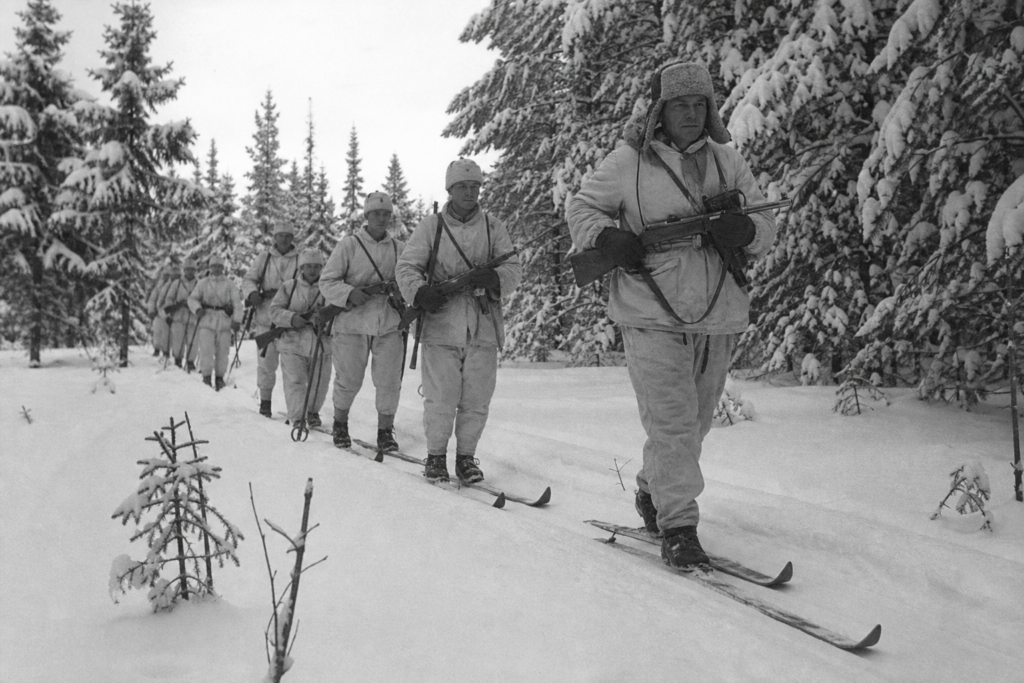
The Finnish-Soviet frontier included forests, lakes, bogs, and few reliable roads. These conditions limited the movement of large mechanized columns and made supply routes vulnerable. Finnish planners had prepared defensive positions on the Karelian Isthmus, commonly associated with the Mannerheim Line, but they also understood that the long northern front could not be defended by a continuous wall of troops. Small units needed to observe, delay, raid, and withdraw while preserving strength. Snow camouflage and skis allowed Finnish troops to move across terrain that constrained Soviet road-bound formations. Yet geography was an advantage only when combined with training, maps, local scouts, communications, and disciplined logistics. The campaign illustrates that terrain is not a passive backdrop. It becomes an operational factor when an army has the skills and institutions to use it faster and more intelligently than its opponent.
The Winter War between Finland and the Soviet Union began in November 1939 and lasted until March 1940. It remains a widely studied example of how terrain, climate, local knowledge, leadership, and adaptation can complicate the plans of a much larger military power. The Soviet Union expected a rapid victory, but Finnish forces used forests, frozen lakes, narrow roads, ski mobility, camouflage, and decentralized command to impose delays and losses. This did not mean Finland possessed unlimited strength or that winter conditions automatically favored the defender. Finland faced severe shortages of men, ammunition, artillery, and aircraft, while Soviet forces learned and adapted over the course of the war. The historical value of the campaign lies in examining both sides: Finnish operational flexibility and resilience, Soviet organizational failures, and the eventual concentration of superior firepower that forced a negotiated peace.
The Finnish-Soviet frontier included forests, lakes, bogs, and few reliable roads. These conditions limited the movement of large mechanized columns and made supply routes vulnerable. Finnish planners had prepared defensive positions on the Karelian Isthmus, commonly associated with the Mannerheim Line, but they also understood that the long northern front could not be defended by a continuous wall of troops. Small units needed to observe, delay, raid, and withdraw while preserving strength. Snow camouflage and skis allowed Finnish troops to move across terrain that constrained Soviet road-bound formations. Yet geography was an advantage only when combined with training, maps, local scouts, communications, and disciplined logistics. The campaign illustrates that terrain is not a passive backdrop. It becomes an operational factor when an army has the skills and institutions to use it faster and more intelligently than its opponent.
The Winter War between Finland and the Soviet Union began in November 1939 and lasted until March 1940. It remains a widely studied example of how terrain, climate, local knowledge, leadership, and adaptation can complicate the plans of a much larger military power. The Soviet Union expected a rapid victory, but Finnish forces used forests, frozen lakes, narrow roads, ski mobility, camouflage, and decentralized command to impose delays and losses. This did not mean Finland possessed unlimited strength or that winter conditions automatically favored the defender. Finland faced severe shortages of men, ammunition, artillery, and aircraft, while Soviet forces learned and adapted over the course of the war. The historical value of the campaign lies in examining both sides: Finnish operational flexibility and resilience, Soviet organizational failures, and the eventual concentration of superior firepower that forced a negotiated peace.
The Finnish-Soviet frontier included forests, lakes, bogs, and few reliable roads. These conditions limited the movement of large mechanized columns and made supply routes vulnerable. Finnish planners had prepared defensive positions on the Karelian Isthmus, commonly associated with the Mannerheim Line, but they also understood that the long northern front could not be defended by a continuous wall of troops. Small units needed to observe, delay, raid, and withdraw while preserving strength. Snow camouflage and skis allowed Finnish troops to move across terrain that constrained Soviet road-bound formations. Yet geography was an advantage only when combined with training, maps, local scouts, communications, and disciplined logistics. The campaign illustrates that terrain is not a passive backdrop. It becomes an operational factor when an army has the skills and institutions to use it faster and more intelligently than its opponent.
| Feature | Finnish approach | Operational effect |
|---|---|---|
| Forest and lake terrain | Use mobility away from roads | Constrains large formations |
| Ski units | Rapid dispersed movement | Supports reconnaissance and raids |
| Motti tactics | Isolate road columns | Targets supply and command links |
| Camouflage and local knowledge | Reduce visibility and improve navigation | Creates tactical surprise |
| Soviet reorganization | Concentrate artillery and engineers | Changes the balance by February 1940 |
Motti tactics and the vulnerability of columns
The Winter War between Finland and the Soviet Union began in November 1939 and lasted until March 1940. It remains a widely studied example of how terrain, climate, local knowledge, leadership, and adaptation can complicate the plans of a much larger military power. The Soviet Union expected a rapid victory, but Finnish forces used forests, frozen lakes, narrow roads, ski mobility, camouflage, and decentralized command to impose delays and losses. This did not mean Finland possessed unlimited strength or that winter conditions automatically favored the defender. Finland faced severe shortages of men, ammunition, artillery, and aircraft, while Soviet forces learned and adapted over the course of the war. The historical value of the campaign lies in examining both sides: Finnish operational flexibility and resilience, Soviet organizational failures, and the eventual concentration of superior firepower that forced a negotiated peace.
One of the best-known Finnish methods was the motti: isolating segments of an enemy column, cutting roads, and attacking smaller pockets rather than confronting a larger force head-on. Soviet units advancing on narrow forest roads often depended on a single route for fuel, food, ammunition, medical evacuation, and command communication. Finnish ski units could strike these links, create confusion, and prevent separated elements from supporting one another. The tactic was not a mystical national technique; it depended on reconnaissance, speed, weather, morale, and the ability to concentrate briefly at a chosen point. It also worked best against formations that were poorly coordinated, insufficiently prepared for winter, or constrained by rigid orders. The lesson is broader than this war: a smaller force can sometimes reduce an opponent’s numerical advantage by attacking connectivity, timing, and supply rather than its strongest front.
The Winter War between Finland and the Soviet Union began in November 1939 and lasted until March 1940. It remains a widely studied example of how terrain, climate, local knowledge, leadership, and adaptation can complicate the plans of a much larger military power. The Soviet Union expected a rapid victory, but Finnish forces used forests, frozen lakes, narrow roads, ski mobility, camouflage, and decentralized command to impose delays and losses. This did not mean Finland possessed unlimited strength or that winter conditions automatically favored the defender. Finland faced severe shortages of men, ammunition, artillery, and aircraft, while Soviet forces learned and adapted over the course of the war. The historical value of the campaign lies in examining both sides: Finnish operational flexibility and resilience, Soviet organizational failures, and the eventual concentration of superior firepower that forced a negotiated peace.
One of the best-known Finnish methods was the motti: isolating segments of an enemy column, cutting roads, and attacking smaller pockets rather than confronting a larger force head-on. Soviet units advancing on narrow forest roads often depended on a single route for fuel, food, ammunition, medical evacuation, and command communication. Finnish ski units could strike these links, create confusion, and prevent separated elements from supporting one another. The tactic was not a mystical national technique; it depended on reconnaissance, speed, weather, morale, and the ability to concentrate briefly at a chosen point. It also worked best against formations that were poorly coordinated, insufficiently prepared for winter, or constrained by rigid orders. The lesson is broader than this war: a smaller force can sometimes reduce an opponent’s numerical advantage by attacking connectivity, timing, and supply rather than its strongest front.
The Winter War between Finland and the Soviet Union began in November 1939 and lasted until March 1940. It remains a widely studied example of how terrain, climate, local knowledge, leadership, and adaptation can complicate the plans of a much larger military power. The Soviet Union expected a rapid victory, but Finnish forces used forests, frozen lakes, narrow roads, ski mobility, camouflage, and decentralized command to impose delays and losses. This did not mean Finland possessed unlimited strength or that winter conditions automatically favored the defender. Finland faced severe shortages of men, ammunition, artillery, and aircraft, while Soviet forces learned and adapted over the course of the war. The historical value of the campaign lies in examining both sides: Finnish operational flexibility and resilience, Soviet organizational failures, and the eventual concentration of superior firepower that forced a negotiated peace.
One of the best-known Finnish methods was the motti: isolating segments of an enemy column, cutting roads, and attacking smaller pockets rather than confronting a larger force head-on. Soviet units advancing on narrow forest roads often depended on a single route for fuel, food, ammunition, medical evacuation, and command communication. Finnish ski units could strike these links, create confusion, and prevent separated elements from supporting one another. The tactic was not a mystical national technique; it depended on reconnaissance, speed, weather, morale, and the ability to concentrate briefly at a chosen point. It also worked best against formations that were poorly coordinated, insufficiently prepared for winter, or constrained by rigid orders. The lesson is broader than this war: a smaller force can sometimes reduce an opponent’s numerical advantage by attacking connectivity, timing, and supply rather than its strongest front.
Soviet adaptation and the limits of early Finnish success
The Winter War between Finland and the Soviet Union began in November 1939 and lasted until March 1940. It remains a widely studied example of how terrain, climate, local knowledge, leadership, and adaptation can complicate the plans of a much larger military power. The Soviet Union expected a rapid victory, but Finnish forces used forests, frozen lakes, narrow roads, ski mobility, camouflage, and decentralized command to impose delays and losses. This did not mean Finland possessed unlimited strength or that winter conditions automatically favored the defender. Finland faced severe shortages of men, ammunition, artillery, and aircraft, while Soviet forces learned and adapted over the course of the war. The historical value of the campaign lies in examining both sides: Finnish operational flexibility and resilience, Soviet organizational failures, and the eventual concentration of superior firepower that forced a negotiated peace.
Early Soviet failures were serious. Command purges, poor reconnaissance, inadequate winter clothing, weak coordination between infantry, armor, artillery, and engineers, and unrealistic political assumptions all contributed. However, treating the Red Army as permanently incompetent is historically inaccurate. During the war, Soviet command reorganized units, improved artillery preparation, concentrated forces on the Karelian Isthmus, and brought greater engineering capacity to bear. In February 1940, sustained bombardment and massed attacks began to break Finnish positions. Finland’s ability to resist could not overcome its material shortages indefinitely. The Moscow Peace Treaty ended the fighting in March, forcing Finland to cede territory but preserving its independence. This outcome is essential: adaptation is not only a defender’s skill. A larger force that learns, concentrates resources, and corrects its procedures can change the balance of a campaign.
The Winter War between Finland and the Soviet Union began in November 1939 and lasted until March 1940. It remains a widely studied example of how terrain, climate, local knowledge, leadership, and adaptation can complicate the plans of a much larger military power. The Soviet Union expected a rapid victory, but Finnish forces used forests, frozen lakes, narrow roads, ski mobility, camouflage, and decentralized command to impose delays and losses. This did not mean Finland possessed unlimited strength or that winter conditions automatically favored the defender. Finland faced severe shortages of men, ammunition, artillery, and aircraft, while Soviet forces learned and adapted over the course of the war. The historical value of the campaign lies in examining both sides: Finnish operational flexibility and resilience, Soviet organizational failures, and the eventual concentration of superior firepower that forced a negotiated peace.
Early Soviet failures were serious. Command purges, poor reconnaissance, inadequate winter clothing, weak coordination between infantry, armor, artillery, and engineers, and unrealistic political assumptions all contributed. However, treating the Red Army as permanently incompetent is historically inaccurate. During the war, Soviet command reorganized units, improved artillery preparation, concentrated forces on the Karelian Isthmus, and brought greater engineering capacity to bear. In February 1940, sustained bombardment and massed attacks began to break Finnish positions. Finland’s ability to resist could not overcome its material shortages indefinitely. The Moscow Peace Treaty ended the fighting in March, forcing Finland to cede territory but preserving its independence. This outcome is essential: adaptation is not only a defender’s skill. A larger force that learns, concentrates resources, and corrects its procedures can change the balance of a campaign.
The Winter War between Finland and the Soviet Union began in November 1939 and lasted until March 1940. It remains a widely studied example of how terrain, climate, local knowledge, leadership, and adaptation can complicate the plans of a much larger military power. The Soviet Union expected a rapid victory, but Finnish forces used forests, frozen lakes, narrow roads, ski mobility, camouflage, and decentralized command to impose delays and losses. This did not mean Finland possessed unlimited strength or that winter conditions automatically favored the defender. Finland faced severe shortages of men, ammunition, artillery, and aircraft, while Soviet forces learned and adapted over the course of the war. The historical value of the campaign lies in examining both sides: Finnish operational flexibility and resilience, Soviet organizational failures, and the eventual concentration of superior firepower that forced a negotiated peace.
Early Soviet failures were serious. Command purges, poor reconnaissance, inadequate winter clothing, weak coordination between infantry, armor, artillery, and engineers, and unrealistic political assumptions all contributed. However, treating the Red Army as permanently incompetent is historically inaccurate. During the war, Soviet command reorganized units, improved artillery preparation, concentrated forces on the Karelian Isthmus, and brought greater engineering capacity to bear. In February 1940, sustained bombardment and massed attacks began to break Finnish positions. Finland’s ability to resist could not overcome its material shortages indefinitely. The Moscow Peace Treaty ended the fighting in March, forcing Finland to cede territory but preserving its independence. This outcome is essential: adaptation is not only a defender’s skill. A larger force that learns, concentrates resources, and corrects its procedures can change the balance of a campaign.
Legacy: resilience without romantic simplification
The Winter War between Finland and the Soviet Union began in November 1939 and lasted until March 1940. It remains a widely studied example of how terrain, climate, local knowledge, leadership, and adaptation can complicate the plans of a much larger military power. The Soviet Union expected a rapid victory, but Finnish forces used forests, frozen lakes, narrow roads, ski mobility, camouflage, and decentralized command to impose delays and losses. This did not mean Finland possessed unlimited strength or that winter conditions automatically favored the defender. Finland faced severe shortages of men, ammunition, artillery, and aircraft, while Soviet forces learned and adapted over the course of the war. The historical value of the campaign lies in examining both sides: Finnish operational flexibility and resilience, Soviet organizational failures, and the eventual concentration of superior firepower that forced a negotiated peace.
The Winter War became central to Finnish national memory and influenced international perceptions of the Soviet military before Germany’s invasion in 1941. Its legacy should be read with care. Finnish courage, civilian mobilization, and tactical skill were real, but the war also brought heavy losses and painful territorial concessions. The campaign warns against simplistic stories in which winter alone defeats a larger army or in which a smaller defender can always compensate for material imbalance. Its enduring lessons concern preparation and adaptation. Forces that understand their environment, protect logistics, decentralize decisions responsibly, and learn from battlefield feedback can create disproportionate effects. At the same time, resilience needs supplies, reinforcements, and a realistic political objective. History is most useful when it recognizes both the ingenuity that delayed defeat and the structural limits that eventually shaped the peace.
The Winter War between Finland and the Soviet Union began in November 1939 and lasted until March 1940. It remains a widely studied example of how terrain, climate, local knowledge, leadership, and adaptation can complicate the plans of a much larger military power. The Soviet Union expected a rapid victory, but Finnish forces used forests, frozen lakes, narrow roads, ski mobility, camouflage, and decentralized command to impose delays and losses. This did not mean Finland possessed unlimited strength or that winter conditions automatically favored the defender. Finland faced severe shortages of men, ammunition, artillery, and aircraft, while Soviet forces learned and adapted over the course of the war. The historical value of the campaign lies in examining both sides: Finnish operational flexibility and resilience, Soviet organizational failures, and the eventual concentration of superior firepower that forced a negotiated peace.
The Winter War became central to Finnish national memory and influenced international perceptions of the Soviet military before Germany’s invasion in 1941. Its legacy should be read with care. Finnish courage, civilian mobilization, and tactical skill were real, but the war also brought heavy losses and painful territorial concessions. The campaign warns against simplistic stories in which winter alone defeats a larger army or in which a smaller defender can always compensate for material imbalance. Its enduring lessons concern preparation and adaptation. Forces that understand their environment, protect logistics, decentralize decisions responsibly, and learn from battlefield feedback can create disproportionate effects. At the same time, resilience needs supplies, reinforcements, and a realistic political objective. History is most useful when it recognizes both the ingenuity that delayed defeat and the structural limits that eventually shaped the peace.
The Winter War between Finland and the Soviet Union began in November 1939 and lasted until March 1940. It remains a widely studied example of how terrain, climate, local knowledge, leadership, and adaptation can complicate the plans of a much larger military power. The Soviet Union expected a rapid victory, but Finnish forces used forests, frozen lakes, narrow roads, ski mobility, camouflage, and decentralized command to impose delays and losses. This did not mean Finland possessed unlimited strength or that winter conditions automatically favored the defender. Finland faced severe shortages of men, ammunition, artillery, and aircraft, while Soviet forces learned and adapted over the course of the war. The historical value of the campaign lies in examining both sides: Finnish operational flexibility and resilience, Soviet organizational failures, and the eventual concentration of superior firepower that forced a negotiated peace.
The Winter War became central to Finnish national memory and influenced international perceptions of the Soviet military before Germany’s invasion in 1941. Its legacy should be read with care. Finnish courage, civilian mobilization, and tactical skill were real, but the war also brought heavy losses and painful territorial concessions. The campaign warns against simplistic stories in which winter alone defeats a larger army or in which a smaller defender can always compensate for material imbalance. Its enduring lessons concern preparation and adaptation. Forces that understand their environment, protect logistics, decentralize decisions responsibly, and learn from battlefield feedback can create disproportionate effects. At the same time, resilience needs supplies, reinforcements, and a realistic political objective. History is most useful when it recognizes both the ingenuity that delayed defeat and the structural limits that eventually shaped the peace.