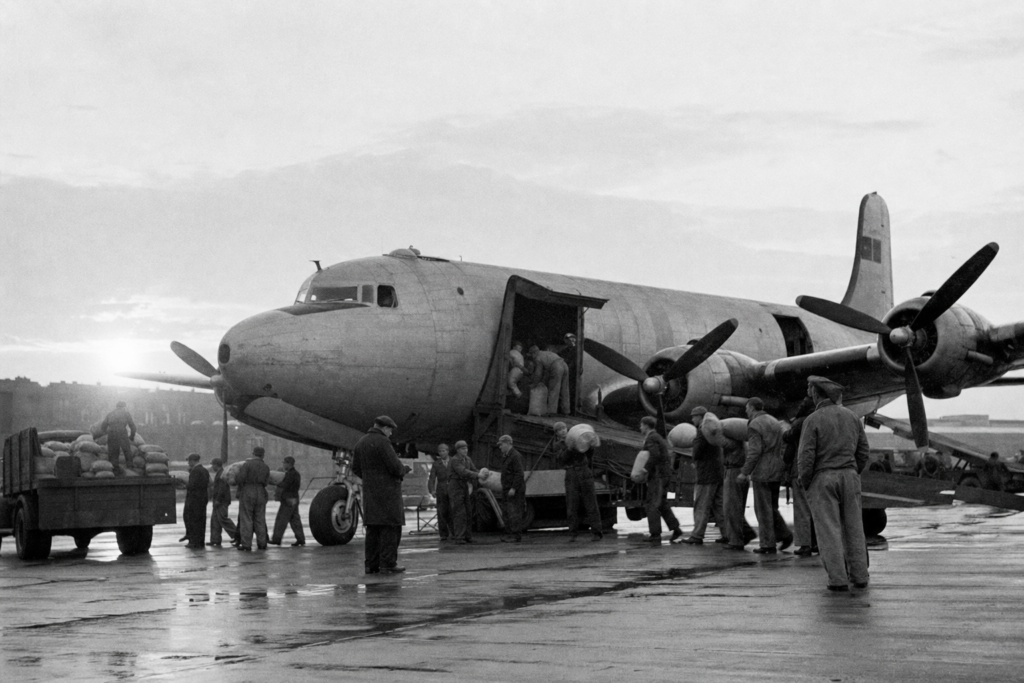
A city under blockade and the choice of an air bridge
The Berlin Airlift began in a city that had become the most exposed political space in post-war Europe. Germany was divided into occupation zones after 1945, while Berlin itself sat deep inside the Soviet zone but was divided among the four victorious powers. In June 1948 the Soviet authorities blocked most road, rail, and water access to the western sectors. The measure followed disputes about currency reform and the future of Germany, but its immediate practical target was a population of more than two million people dependent on outside supplies. Western officials faced an uncomfortable choice. A convoy challenge could trigger a military confrontation; withdrawal would signal that pressure could change the status of Berlin without negotiation. The air corridors established after the war offered a narrow third option. Aircraft could move food, coal, medicine, and essential industrial goods without crossing a roadblock. What looked at first like an emergency improvisation became a sustained test of logistics, political resolve, and administrative discipline.
The airlift should not be understood as a dramatic flight of a few heroic aircraft. Its central problem was arithmetic. Berlin needed daily calories, fuel, medical supplies, and materials for public services; aircraft had to carry each load from western airfields, land, unload, refuel, and depart in a tightly controlled sequence. Early estimates were revised as planners measured consumption and runway capacity. The operation therefore became a living system in which weather reports, cargo manifests, maintenance schedules, and civilian rationing were connected. The Western allies did not promise abundance. They organized a minimum viable urban economy while keeping the city supplied enough to resist coercion. That distinction matters because the effectiveness of the airlift came from matching political objectives to a realistic logistical design rather than from pretending that air transport was a simple substitute for rail or barge traffic.
Berliners were not passive recipients in this system. Local authorities adjusted rationing, repaired facilities, organized unloading work, and communicated the practical limits of the operation. Civilian endurance gave the airlift political meaning: a delivery schedule was also a public assurance that the western sectors would not be abandoned. The psychological dimension was especially important during the first winter, when coal shortages and bad weather made every disruption visible. The Allied command had to show that it could respond to setbacks without hiding them. Public confidence rested less on a single spectacular day than on the recurring evidence of arriving aircraft and functioning utilities. The episode demonstrates why wartime and crisis logistics are social systems. Transport capacity matters, but so do expectations, local institutions, labor, and credible communication about scarcity.
By the time the blockade was lifted in May 1949, the airlift had changed the strategic landscape. It had shown that a democratically governed coalition could sustain a long operation without escalating into direct war. It also accelerated the institutional division of Europe: the Federal Republic of Germany was established in the west, the German Democratic Republic in the east, and NATO emerged soon afterward. None of those outcomes resulted from aircraft alone. The airlift created time for diplomacy and state-building while denying the blockade its intended leverage. Its historical value is therefore broader than a story of aviation. It is a case study in how a limited, carefully administered operation can connect humanitarian relief, deterrence, alliance management, and urban resilience. The lesson is not that air power always solves a blockade; it is that a plan succeeds when its political aim, available infrastructure, and civilian requirements are designed together.
| Date | Development | Why it mattered |
|---|---|---|
| June 1948 | Soviet blockade begins | Surface access to western Berlin is cut |
| July 1948 | Airlift capacity expands | Emergency flights become a sustained system |
| August 1948 | Black Friday disrupts operations | Procedures are tightened to protect flow |
| November 1948 | Tegel opens | A new airport increases capacity and redundancy |
| May 1949 | Blockade lifted | The airlift's political objective is achieved |
How standardization turned aircraft into a supply system
The operational breakthrough came from standardization. At first, different national practices and improvised loading methods reduced efficiency. Lieutenant General William H. Tunner, who had experience with large-scale air transport, pushed the operation toward a production-line rhythm. Aircraft were assigned routes and time slots; crews were expected to land, unload, and depart without unnecessary variation. Radar and ground-control procedures helped maintain spacing in poor visibility. At the airports, teams handled cargo in defined sequences, while maintenance was planned around high sortie rates rather than treated as an afterthought. This was not glamorous work, but it converted limited infrastructure into dependable throughput. A transport system becomes resilient when small delays do not cascade into the entire schedule, and the airlift planners treated every minute on the ground as a strategic resource.
The aircraft mix reflected practical constraints. American C-54 Skymasters became the principal workhorses because their capacity and reliability suited the routes, while British and Commonwealth aircraft added capability across different cargo types. Coal was particularly difficult because it was heavy and required enormous volume; food, flour, dried goods, medical supplies, and machinery had different packing and handling requirements. The operation also depended on the return journey. Planes could not simply fly in full and depart empty without wasting capacity, so outbound and return loads were planned as part of the same system. Maintenance, fuel, crews, air traffic control, and runway repair formed an interdependent chain. Histories that focus only on the number of flights can miss this point: the decisive achievement was not one aircraft’s performance but the coordination of hundreds of small, repeatable tasks.
Weather exposed the system’s weak points. Fog, ice, low cloud, and winter conditions repeatedly threatened operations, while the airport surfaces at Tempelhof, Gatow, and later Tegel had to absorb traffic far beyond their original assumptions. The response combined engineering and procedure. Tegel was built rapidly in the French sector, with Berlin labor playing a critical role; existing facilities received improvements; and air crews adopted stricter approaches when conditions deteriorated. On so-called Black Friday in August 1948, a series of incidents interrupted the flow and made clear that ad hoc decisions could cause dangerous congestion. Tunner’s response was to restore discipline, keep aircraft moving, and refine ground procedures. The episode illustrates a recurring lesson in high-tempo operations: a crisis is often solved less by increasing activity than by simplifying decisions and protecting the system’s bottlenecks.
The airlift’s capacity rose because organizers learned continuously. Planners used data from each day to adjust cargo priorities, loading methods, maintenance intervals, and flight schedules. This feedback loop separated the operation from a symbolic relief effort. It became an industrial-scale service with measurable output, redundancy, and contingency plans. Yet the measurements remained tied to human needs. Tonnage mattered because it translated into bread, heat, hospital supplies, and transport for a city under pressure. The balance between metric and mission is a useful historical lesson. Large organizations can become obsessed with counts, sorties, or headlines; the Berlin operation worked because its managers repeatedly returned to the question of which cargo and which improvement would keep civilian life viable tomorrow, next week, and through the coming winter.
Deterrence, alliance management, and a contest of endurance
The Berlin Airlift was also a carefully bounded political signal. The United States, United Kingdom, and France did not treat it as a substitute for diplomacy, nor did they frame every Soviet action as a reason for immediate military retaliation. Instead, the operation made continued access to Berlin a fact on the ground and in the air. This constrained the choices available to all parties. The Soviet Union could maintain the blockade, but it could not easily prevent aircraft from using the agreed corridors without creating a direct international crisis. The western powers could demonstrate commitment without sending an armed column through a checkpoint. The result was a contest of endurance in which logistics made policy credible. This is why the airlift is frequently studied alongside deterrence: it showed resolve through sustained action rather than through a single threat.
Alliance management was as important as aircraft availability. Britain, the United States, France, and the western German authorities had different resources, political pressures, and public audiences. An operation that appeared unilateral could have weakened the coalition; an operation slowed by constant political negotiation could have failed in practice. Coordination institutions, shared planning, and clear division of responsibilities helped keep those risks manageable. The airlift also required civilian-military cooperation on both sides of the transport chain. Municipal authorities had to manage rationing and labor, while military commands managed routes and security. Such arrangements are often invisible in popular memory, but they explain why the operation could continue for months rather than collapsing after the first emergency phase.
The blockade did not occur in a vacuum. European societies were still recovering from total war, displacement, destruction, and food shortages. That background shaped the moral force of the airlift. Supplying Berlin was not simply a contest over territory; it was a visible claim that civilians should not be used as a bargaining instrument in a political dispute. At the same time, the operation had limits. Rations were constrained, living conditions remained difficult, and the city stayed divided long after 1949. A serious historical reading should avoid turning the episode into uncomplicated triumph. Its success did not remove Cold War tensions; it reorganized them. The airlift made western commitment more credible while also hardening the structures of division that would define Berlin for decades.
For modern readers, the strategic lesson is not a formula to be copied. Air transport is expensive, weather-sensitive, and dependent on secure access to airspace and airfields. The conditions in 1948 were unusually specific: recognized corridors existed, allied forces controlled departure bases, and the political objective was limited and comprehensible. What endures is the method of connecting ends and means. Leaders identified a goal—keeping western Berlin supplied and politically viable—then built institutions capable of delivering that goal day after day. They did not confuse rhetoric with capacity. That discipline remains relevant whenever governments consider relief corridors, evacuation operations, or sanctions pressure: a strategy becomes persuasive only when the supporting logistics can survive disruption.
Decision-makers also had to distinguish between a temporary interruption and a long campaign. That meant planning reserves, replacement crews, spare parts, and alternative landing capacity before a visible emergency exhausted them. Political leaders needed regular, credible reporting so that public statements matched what airfields could actually deliver. This relationship between information and capacity protected the coalition from two opposite errors: declaring victory too early or treating every delay as proof of failure. The airlift’s record shows that endurance is managed. It is created through realistic planning assumptions, clear responsibility, and the willingness to revise procedures when evidence changes.
What the Berlin Airlift changed—and what it could not solve
The most durable legacy of the Berlin Airlift lies in the relationship between infrastructure and political freedom. Airports, runways, warehouses, rail links, energy reserves, and trained workers can appear mundane until access is threatened. In Berlin, those assets became the physical basis for a city’s ability to choose its future. Tegel airport, built under intense pressure, symbolized more than engineering speed; it represented the creation of an alternative route when existing connections were denied. The wider lesson is that resilience is usually built before a crisis, through redundancy, maintenance, and institutions that can coordinate quickly. Emergency improvisation mattered in 1948, but it succeeded because planners could draw upon experienced crews, airfields, industrial capacity, and a population prepared to cooperate.
The episode also changed how many people understood air mobility. Before 1948, strategic bombing and military aviation dominated public images of air power. The airlift highlighted a different role: sustained transport in support of civilian survival and political stability. This did not make aviation inherently humanitarian; aircraft remained instruments shaped by political decisions. But it demonstrated that logistics could be visible, disciplined, and strategically consequential without being destructive. The symbolic moments—the ‘candy bomber’ flights and aircraft arriving at regular intervals—were powerful because they rested on a large and demanding supply system. Historical memory often preserves the human gesture, while analysis should preserve the structures that made that gesture possible.
Berlin’s later history adds another layer of meaning. The city remained a focal point of Cold War confrontation, from the uprising of 1953 to the building of the Berlin Wall in 1961 and the crises that followed. The airlift did not solve the German question, but it established a precedent that access and civilian life in West Berlin were matters of international responsibility. That precedent influenced later diplomacy and public expectations. It also made the city a powerful symbol for people on both sides of the divide. Studying the airlift in this longer context prevents a narrow focus on the blockade’s end date. Historical operations leave institutional and emotional traces that shape later decisions, often long after the original planners have left office.
A useful way to assess the airlift is to ask what would have happened if its routines had failed. If flight schedules had become chaotic, if coal deliveries had fallen through winter, or if allied governments had fractured politically, the blockade would have gained leverage. Success came from preventing those failures through thousands of ordinary decisions: accurate manifests, disciplined landing patterns, safe maintenance, shared information, and honest rationing. This is the final lesson for historical readers. Great events are not sustained by slogans alone. They depend on organizations able to learn, repair, coordinate, and keep promises under pressure. The Berlin Airlift remains compelling precisely because it makes those usually hidden forms of competence visible.
The history of the airlift is therefore valuable for more than commemorating a Cold War episode. It directs attention toward the quiet systems that protect civilian life: inventory records, repair crews, safe approaches, trained dispatchers, shared standards, and institutions trusted to distribute scarce goods fairly. These systems are rarely celebrated until a crisis reveals their absence. Berlin made them visible because the consequences of disruption were immediate and public. Remembering the operation well means remembering both its pilots and the many civilian and military workers whose routine competence turned a narrow corridor into a dependable lifeline.
Finally, the airlift reminds historians to examine scale without losing individual experience. A tonnage total can tell us whether the system met a daily target, but it cannot on its own describe the family waiting for fuel, the mechanic completing a night repair, or the dispatcher making a safe decision in bad weather. Good historical analysis keeps both views together. It explains the institutional design and also asks how that design was felt by people living inside it. In Berlin, the repeated arrival of aircraft became meaningful because it translated abstract commitments into dependable evidence that the city had not been left alone.
That evidence was cumulative. Each safe landing, accurate delivery, and repaired runway reinforced the next day’s confidence. The air bridge endured because people could see its promises being converted into practical, repeated results.
It remains a benchmark for disciplined humanitarian logistics under political pressure.