Political Signal From The Latest War Diplomacy
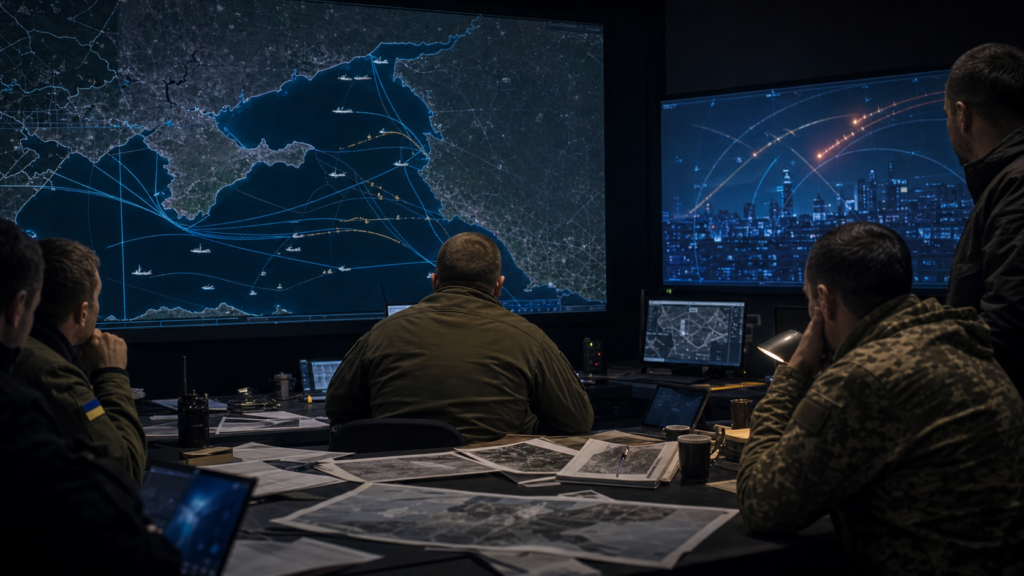
The immediate news hook is this: The Guardian’s July 8 Ukraine war briefing linked reported Ukrainian strikes on Russian shadow-fleet tankers in the Sea of Azov with continuing Russian attacks on Kyiv and Odesa, showing how the war’s political center is now tied to logistics pressure far from the front line. For FoxyShield readers, the deeper story is the political bargaining now linking air defense, sanctions, drone production and peace diplomacy into one connected war-policy package.
Azov Shadow-Tanker Strikes Turn Kyiv’s Air War Into A Wider Logistics Campaign matters because it changes Ukraine’s status in allied debate. Kyiv is no longer presenting itself only as a recipient of emergency equipment. It is arguing that battlefield data, industrial improvisation and operational discipline are assets NATO itself needs.
The main actors are Ukraine’s unmanned systems forces, Russian shadow-fleet operators, maritime insurers, Kyiv and Odesa air-defense commands, EU sanctions officials, and NATO defense planners. That mix is important because the decision chain no longer runs through one capital or one weapons warehouse. It moves through licenses, factories, export controls, joint training, budget votes and battlefield verification.
The factual basis is narrow but consequential: The reporting cited Ukrainian claims of hits on multiple tankers, continued Russian missile and drone pressure on major cities, and a diplomatic backdrop that includes sanctions work and NATO-era defense-industry coordination. The political reading is that summit language without delivery mechanisms will look weaker every time Russia fires another ballistic missile, launches another drone wave or shifts logistics around sanctions.
Ukraine’s diplomatic pitch also reflects a lesson from five years of full-scale war: deterrence is now measured by production tempo as much as by declarations. A communique can reassure publics, but a missile line, a drone factory or a sanctions enforcement cell changes enemy planning.
For Moscow, the risk is that Ukraine’s coalition work becomes more institutional and less episodic. When support is organized as standing production, legal enforcement and shared doctrine, Russia has fewer opportunities to wait out a news cycle or exploit temporary political fatigue.
For allies, the uncomfortable question is whether they can translate sympathy into repeatable capacity. The war has exposed that stockpiles, procurement rules and industrial bottlenecks are political vulnerabilities. Kyiv is now making those vulnerabilities visible in front of NATO leaders.
Source basis: theguardian.com, kyivindependent.com, president.gov.ua, ec.europa.eu. These sources support the dated event, the policy frame and the public claims used here; FoxyShield treats the battlefield implications as analysis rather than confirmed operational detail.
The practical implication is that editors, analysts and policymakers should judge this issue by durable mechanisms: named budgets, binding timelines, enforceable restrictions, delivery routes and battlefield feedback loops. Without those details, the news remains political theater; with them, it becomes a measurable shift in wartime capacity.
The practical implication is that editors, analysts and policymakers should judge this issue by durable mechanisms: named budgets, binding timelines, enforceable restrictions, delivery routes and battlefield feedback loops. Without those details, the news remains political theater; with them, it becomes a measurable shift in wartime capacity.
The practical implication is that editors, analysts and policymakers should judge this issue by durable mechanisms: named budgets, binding timelines, enforceable restrictions, delivery routes and battlefield feedback loops. Without those details, the news remains political theater; with them, it becomes a measurable shift in wartime capacity.
The practical implication is that editors, analysts and policymakers should judge this issue by durable mechanisms: named budgets, binding timelines, enforceable restrictions, delivery routes and battlefield feedback loops. Without those details, the news remains political theater; with them, it becomes a measurable shift in wartime capacity.
The practical implication is that editors, analysts and policymakers should judge this issue by durable mechanisms: named budgets, binding timelines, enforceable restrictions, delivery routes and battlefield feedback loops. Without those details, the news remains political theater; with them, it becomes a measurable shift in wartime capacity.
Military Mechanism Behind The Political Bargain
The military mechanism behind Azov Shadow-Tanker Strikes Turn Kyiv’s Air War Into A Wider Logistics Campaign starts with a simple operational reality: Russia uses missiles, drones, fuel logistics and political signaling as one system. Ukraine’s answer therefore cannot be one system alone; it must combine interception, production, sanctions, long-range pressure and alliance planning.
Air defense remains the most immediate layer because every successful Russian strike can alter the political calendar. Casualties and infrastructure fires create pressure on governments, while shortages of interceptors make even advanced systems vulnerable to exhaustion during repeated attacks.
Drones are the second layer because they compress the time between innovation and battlefield use. Ukraine can test, adapt and scale designs under live pressure, then offer partners lessons about sensors, electronic warfare, targeting discipline, logistics and maintenance that no peacetime exercise can fully reproduce.
Sanctions form the third layer. They do not stop a missile in flight, but they can complicate the flows of components, oil revenue, shipping services and insurance that keep Russia’s war machine running. Their effect depends on enforcement and on closing rerouting channels through third countries.
Long-range strikes are the fourth layer. They are politically sensitive, but they make rear-area logistics and industrial sites part of the bargaining environment. When Crimea, fuel depots, ports or refineries become harder to protect, Moscow’s cost calculation changes even if the front line moves slowly.
The practical test is integration. A drone agreement is weaker if it is not linked to production finance. A sanctions package is weaker if ships can simply change names and flags. A Patriot battery is weaker if interceptors cannot arrive at the tempo of Russian attacks.
That is why the latest politics around Ukraine are not separate from military mechanics. NATO membership language, licensing debates and summit meetings now sit directly beside questions of radar coverage, missile stocks, drone supply chains and maritime tracking.
For this topic, FoxyShield’s operating assumption is to watch whether reported tanker damage becomes a repeatable pressure pattern, whether Russia reroutes fuel and insurance chains, and whether allied sanctions enforcement keeps pace with Ukraine’s kinetic campaign. That is the difference between a headline and a shift in the military balance.
The practical implication is that editors, analysts and policymakers should judge this issue by durable mechanisms: named budgets, binding timelines, enforceable restrictions, delivery routes and battlefield feedback loops. Without those details, the news remains political theater; with them, it becomes a measurable shift in wartime capacity.
The practical implication is that editors, analysts and policymakers should judge this issue by durable mechanisms: named budgets, binding timelines, enforceable restrictions, delivery routes and battlefield feedback loops. Without those details, the news remains political theater; with them, it becomes a measurable shift in wartime capacity.
The practical implication is that editors, analysts and policymakers should judge this issue by durable mechanisms: named budgets, binding timelines, enforceable restrictions, delivery routes and battlefield feedback loops. Without those details, the news remains political theater; with them, it becomes a measurable shift in wartime capacity.
The practical implication is that editors, analysts and policymakers should judge this issue by durable mechanisms: named budgets, binding timelines, enforceable restrictions, delivery routes and battlefield feedback loops. Without those details, the news remains political theater; with them, it becomes a measurable shift in wartime capacity.
The practical implication is that editors, analysts and policymakers should judge this issue by durable mechanisms: named budgets, binding timelines, enforceable restrictions, delivery routes and battlefield feedback loops. Without those details, the news remains political theater; with them, it becomes a measurable shift in wartime capacity.
The practical implication is that editors, analysts and policymakers should judge this issue by durable mechanisms: named budgets, binding timelines, enforceable restrictions, delivery routes and battlefield feedback loops. Without those details, the news remains political theater; with them, it becomes a measurable shift in wartime capacity.
| Factor | Operational meaning | Political consequence |
|---|---|---|
| Azov tanker hits | Raises cost of maritime fuel support near Crimea | Turns shadow-fleet risk into a political liability |
| Kyiv and Odesa strikes | Keeps civilian and infrastructure defense under pressure | Sustains Ukraine's demand for faster air-defense deliveries |
| Sanctions channel | Targets insurance, vessels and revenue pathways | Links EU legal pressure with Ukrainian battlefield pressure |
| NATO industry context | Frames drones and interceptors as production problems | Moves the debate from aid packages to durable capacity |
Diplomatic Pressure Points For Allies And Moscow
The diplomatic pressure point is that Azov Shadow-Tanker Strikes Turn Kyiv’s Air War Into A Wider Logistics Campaign forces allies to choose between symbolic support and structural commitments. Structural commitments are harder, because they require money, legal work, technology transfer and sustained political explanation to domestic voters.
Ukraine is trying to make delay costly. By tying its requests to Europe’s own security, Kyiv argues that help to Ukraine is not charity and not only moral obligation. It is a forward investment in deterrence, industrial learning and protection against Russian escalation beyond Ukraine.
This also changes the way Moscow reads negotiations. If Russia sees aid as temporary, it can keep the war going and wait for elections, budget disputes or alliance fatigue. If Russia sees allied production hardening, talks become less attractive as a stalling tactic.
Washington’s role remains central even when Europe wants more autonomy. US licenses, US stockpiles, US intelligence cooperation and US political signals can accelerate or slow everything else. That is why every European initiative still has an American dimension.
European leaders face a parallel challenge: they must prove that higher defense spending is not only accounting. It must produce interceptors, drones, spare parts, training cycles and sanctions enforcement tools that Ukraine can use quickly enough to matter.
Kyiv’s political advantage is credibility from combat. Its disadvantage is dependency on decisions outside its control. The current diplomacy tries to convert credibility into binding formats before battlefield pressure and domestic politics in partner countries create another gap.
Russia will test the result through escalation, disinformation and logistical adaptation. It can strike cities, spread narratives about war fatigue, reroute tankers, move components through intermediaries and look for legal ambiguity. The coalition answer has to be faster than that adaptation.
The core judgment is that the latest war politics are moving from promises toward systems. Whether those systems mature will determine whether the Ankara moment becomes a passing headline or a durable shift in allied behavior.
The practical implication is that editors, analysts and policymakers should judge this issue by durable mechanisms: named budgets, binding timelines, enforceable restrictions, delivery routes and battlefield feedback loops. Without those details, the news remains political theater; with them, it becomes a measurable shift in wartime capacity.
The practical implication is that editors, analysts and policymakers should judge this issue by durable mechanisms: named budgets, binding timelines, enforceable restrictions, delivery routes and battlefield feedback loops. Without those details, the news remains political theater; with them, it becomes a measurable shift in wartime capacity.
The practical implication is that editors, analysts and policymakers should judge this issue by durable mechanisms: named budgets, binding timelines, enforceable restrictions, delivery routes and battlefield feedback loops. Without those details, the news remains political theater; with them, it becomes a measurable shift in wartime capacity.
The practical implication is that editors, analysts and policymakers should judge this issue by durable mechanisms: named budgets, binding timelines, enforceable restrictions, delivery routes and battlefield feedback loops. Without those details, the news remains political theater; with them, it becomes a measurable shift in wartime capacity.
The practical implication is that editors, analysts and policymakers should judge this issue by durable mechanisms: named budgets, binding timelines, enforceable restrictions, delivery routes and battlefield feedback loops. Without those details, the news remains political theater; with them, it becomes a measurable shift in wartime capacity.
The practical implication is that editors, analysts and policymakers should judge this issue by durable mechanisms: named budgets, binding timelines, enforceable restrictions, delivery routes and battlefield feedback loops. Without those details, the news remains political theater; with them, it becomes a measurable shift in wartime capacity.
The practical implication is that editors, analysts and policymakers should judge this issue by durable mechanisms: named budgets, binding timelines, enforceable restrictions, delivery routes and battlefield feedback loops. Without those details, the news remains political theater; with them, it becomes a measurable shift in wartime capacity.
What FoxyShield Readers Should Track Next
Readers should first track whether watch whether reported tanker damage becomes a repeatable pressure pattern, whether Russia reroutes fuel and insurance chains, and whether allied sanctions enforcement keeps pace with Ukraine’s kinetic campaign. The strongest signal will not be the number of leaders using Ukraine-friendly language; it will be whether their governments publish delivery schedules, industrial contracts and enforcement measures.
Second, track the relationship between Russian strikes and allied response time. If new attacks are followed by immediate interceptor releases, funding tranches or sanctions steps, the coalition is learning. If each attack triggers only another round of statements, deterrence remains too slow.
Third, watch how Ukraine frames itself after Ankara. The more Kyiv is described as a producer, trainer and data source, the more the alliance debate changes. The more Kyiv is described only as a recipient, the easier it is for skeptics to treat support as an optional expense.
Fourth, watch Moscow’s logistics. Fuel routes, shadow-fleet behavior, refinery disruptions and Crimea supply chains may reveal whether pressure is reaching systems Russia cannot easily replace. Those indicators are often more useful than daily rhetorical exchanges.
Fifth, watch legal and industrial follow-through. A political agreement without procurement language is fragile. A procurement framework without export controls is leaky. A sanctions list without maritime enforcement is symbolic. The real story is always in the implementation layer.
Sixth, watch whether peace diplomacy is paired with pressure. Negotiations can become serious when Moscow sees fewer benefits from delay. Ukraine’s current strategy appears designed to make military, economic and political time work against the aggressor rather than against Kyiv.
FoxyShield’s bottom line is that the politics of the war are becoming more technical. The hottest political news is not only who met whom; it is which production lines, licenses, ships, interceptors and command assumptions changed after the meeting.
That is why this article is classified as military-news rather than a diplomatic note. The political decisions now being made around Ukraine directly shape air defense coverage, strike options, Russian logistics and the probability that any future negotiation happens from a position of strength.
The practical implication is that editors, analysts and policymakers should judge this issue by durable mechanisms: named budgets, binding timelines, enforceable restrictions, delivery routes and battlefield feedback loops. Without those details, the news remains political theater; with them, it becomes a measurable shift in wartime capacity.
The practical implication is that editors, analysts and policymakers should judge this issue by durable mechanisms: named budgets, binding timelines, enforceable restrictions, delivery routes and battlefield feedback loops. Without those details, the news remains political theater; with them, it becomes a measurable shift in wartime capacity.
The practical implication is that editors, analysts and policymakers should judge this issue by durable mechanisms: named budgets, binding timelines, enforceable restrictions, delivery routes and battlefield feedback loops. Without those details, the news remains political theater; with them, it becomes a measurable shift in wartime capacity.
The practical implication is that editors, analysts and policymakers should judge this issue by durable mechanisms: named budgets, binding timelines, enforceable restrictions, delivery routes and battlefield feedback loops. Without those details, the news remains political theater; with them, it becomes a measurable shift in wartime capacity.
The practical implication is that editors, analysts and policymakers should judge this issue by durable mechanisms: named budgets, binding timelines, enforceable restrictions, delivery routes and battlefield feedback loops. Without those details, the news remains political theater; with them, it becomes a measurable shift in wartime capacity.
The practical implication is that editors, analysts and policymakers should judge this issue by durable mechanisms: named budgets, binding timelines, enforceable restrictions, delivery routes and battlefield feedback loops. Without those details, the news remains political theater; with them, it becomes a measurable shift in wartime capacity.