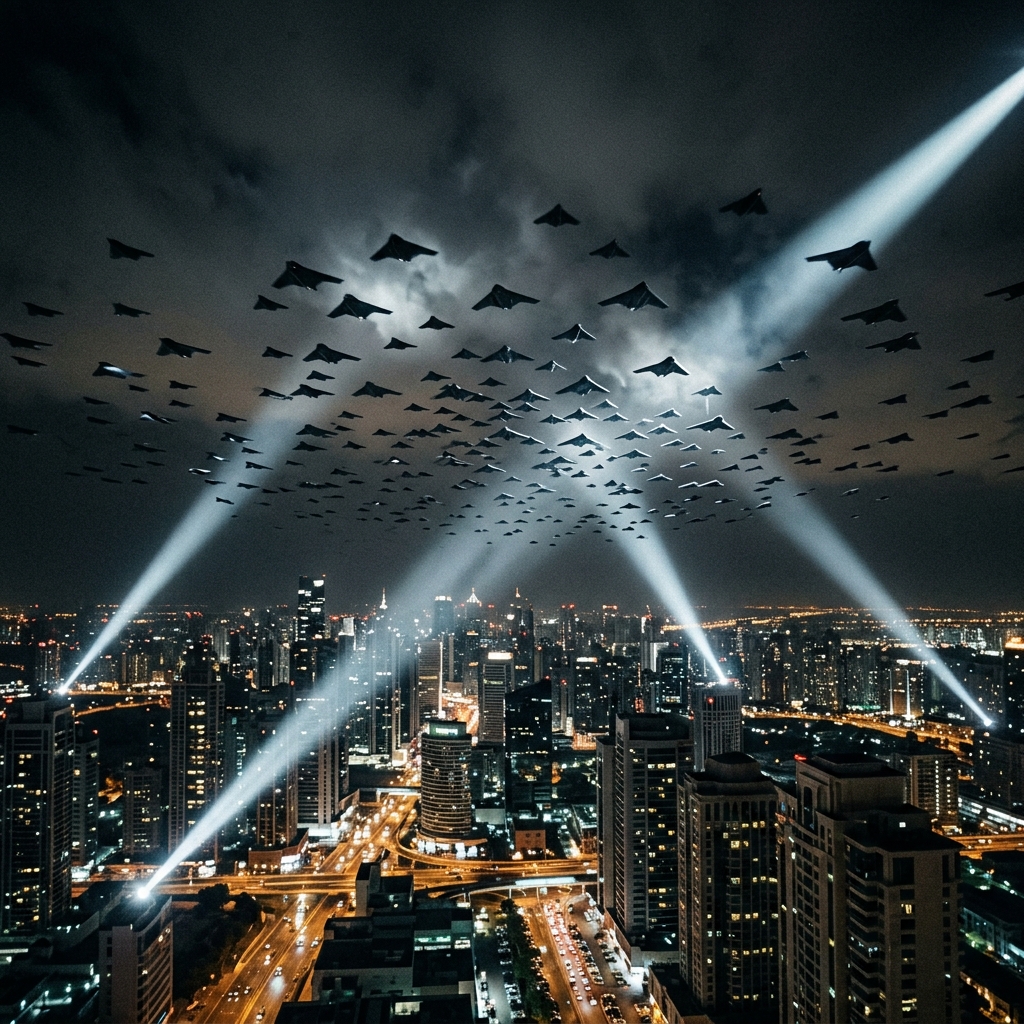
A Swarm in the Night Sky
In an unprecedented display of long-range strike capabilities, a massive swarm of Ukrainian delta-wing attack drones successfully breached the heavily fortified airspace surrounding Moscow. Video footage captured by local residents and verified by open-source intelligence analysts shows dozens of drones navigating through the city’s outer defensive rings. The sheer volume of incoming projectiles overwhelmed local air defense systems, resulting in multiple impacts on strategic military and industrial targets within the Moscow region.
- Over 60 incoming drones tracked simultaneously by regional radar networks.
- Multiple confirmed strikes on aviation engineering facilities and electronic warfare research centers.
- Temporary closure of all major Moscow airports (Vnukovo, Domodedovo, Sheremetyevo) during the attack.
This operation marks a significant escalation in the use of uncrewed aerial vehicles (UAVs) to strike deep into the heart of the Russian military-industrial complex.
Bypassing the "Impenetrable" Shield
For decades, Moscow’s air defense network, consisting of overlapping S-400, Pantsir-S1, and Tor-M2 systems, was considered nearly impenetrable. However, this attack revealed critical vulnerabilities in how these systems handle low-altitude, high-volume swarms. By flying at extremely low altitudes and utilizing advanced waypoint navigation that exploits gaps in radar coverage, the Ukrainian drones managed to avoid early detection. Furthermore, electronic warfare (EW) countermeasures deployed by the attackers effectively jammed local GPS signals, confusing defending automated systems.
Psychological and Economic Fallout
Beyond the physical destruction of military infrastructure, the psychological impact of the swarm is profound. The visible failure of state-of-the-art defenses to protect the capital has shattered the illusion of security carefully curated by Russian state media. Economically, the disruption of air traffic and the forced relocation of critical manufacturing facilities further away from the capital create significant logistical bottlenecks and financial strain on the Russian war effort.
The Evolution of Drone Warfare
Military analysts predict that this strike is merely a precursor to more complex, AI-coordinated swarm attacks. As domestic production of long-range kamikaze drones ramps up in Ukraine, the frequency and scale of these deep strikes are expected to increase. The Russian military is now faced with the daunting task of redesigning its capital defense strategy from the ground up, diverting precious air defense assets away from the frontline.
| Parameter | Attack Details | Strategic Consequence |
|---|---|---|
| Estimated Drone Count | 60+ | Saturated local air defenses |
| Primary Targets Hit | Aviation & EW Factories | Delayed military production |
| Airspace Disruption | Full lockdown (3 hours) | Economic and logistical delay |
| Defensive System Failure | Low-altitude bypass | Forces relocation of AD assets |