As of July 6: what can be confirmed
Updated July 6, 2026, 02:07 Kyiv time. FoxyShield has not found confirmation in open official or major international sources of a separate new strike on Kyiv during this current night at the time of writing. The latest confirmed mass attack on the capital remains the night of July 1-2, 2026, with casualty and rescue updates continuing through July 3-5.
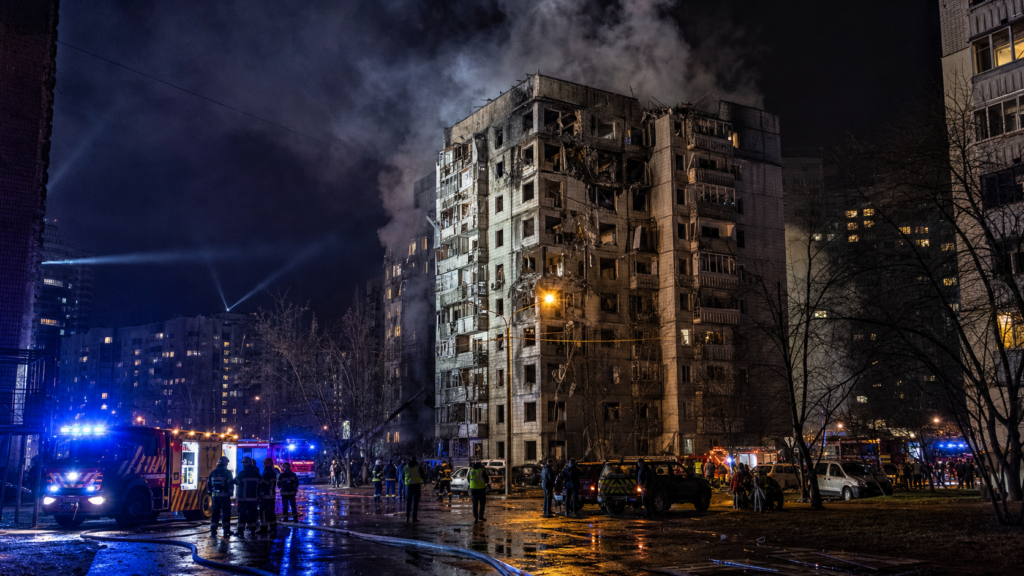
According to a Kyiv city update, 30 people were killed in Kyiv after the mass attack, 92 residents were injured, and 56 wounded people remained in hospitals on the morning of July 3. Suspilne, citing Ukraine’s emergency service, reported that search and rescue work at the destroyed nine-story apartment block in Darnytskyi district ended with 10 people killed there.
The operational picture points to a high-density combined strike. According to figures carried by the Kyiv Independent from Ukraine’s Air Force, Russia launched 74 missiles and 496 long-range drones; 48 missiles and 476 drones were shot down or suppressed, but 25 ballistic missiles and 12 drones struck 33 locations. This was not just another night attack, but an attempt to overload Kyiv’s defenses with multiple weapon classes at once.
Why the strike was so destructive
The key factor was the combination of mass and target profile. Drones created sustained pressure on radars, mobile fire teams and guidance channels, while missiles, especially ballistic missiles, compressed reaction time. Even when many intercepts succeed, debris and penetrations can still cause fires, shatter windows, damage facades and destroy residential buildings.
The Guardian described the attack as one of the deadliest on Kyiv since the start of the full-scale war, with dozens killed or injured, fires across the city and heavy damage to residential areas. AP also reported a massive missile and drone attack on the capital with heavy civilian casualties.
For FoxyShield, three layers must be separated: civilian losses, air-defense performance and the strategic intent of the strike. A high interception rate does not cancel the damage when the starting salvo approaches several hundred aerial targets. In fact, the size of the salvo explains why a city can still suffer dozens of damage sites even while its defenses perform effectively.
Tactical reading: air-defense overload and psychological pressure
Militarily, the night of July 1-2 looks like an attack on the endurance of Kyiv’s defensive system. Drones served as saturation and exhaustion tools, cruise missiles as multi-vector pressure, and ballistic missiles as the most difficult segment to intercept. The pattern tries to force air defenses to spend interceptors, reveal firing positions and work under permanent time pressure.
The second effect is psychological. Kyiv endured a strike that combined a prolonged overnight threat, residential destruction and rescue work under rubble. Reuters Connect reported that rescuers continued work in different parts of the capital as the death toll rose to 30. This type of attack hits infrastructure, housing and social resilience at the same time.
The third effect is political. A mass strike on the capital strengthens Ukraine’s requests for additional air-defense systems, interceptor missiles and predictable supply. The issue is not only whether a city has individual systems, but whether it has enough interceptor depth to absorb a multi-stage salvo.
What to watch next
The most important indicators for the next 24-72 hours are whether another combined salvo is launched at the capital, whether new official data identifies missile types, whether strikes shift toward energy, transport or defense-industrial targets, and whether partners change their language on urgent air-defense deliveries.
Hospital and rescue updates also matter. After large attacks, casualty figures often change as people seek medical help later and as rescue teams work through collapsed structures. That is why FoxyShield fixes numbers with time and source instead of treating them as static.
Bottom line: the confirmed picture right now is not a new unverified July 6 strike, but the aftermath of an extremely large July 1-2 attack. For Kyiv, it tested the limits of urban air defense, rescue capacity and civilian resilience. For Ukraine’s allies, it signals that capital air defense remains a daily survival issue, not a symbolic request.
| Indicator | Confirmed value | Source / note |
|---|---|---|
| Killed in Kyiv | 30 | Kyiv city authorities, SES, Reuters Connect |
| Injured in Kyiv | 92 | Kyiv city authorities; 56 hospitalized on the morning of July 3 |
| Killed at the Darnytskyi nine-story apartment block | 10 | SES / Suspilne after rescue work ended |
| Attack assets launched | 74 missiles + 496 drones | Ukraine's Air Force via Kyiv Independent |
| Targets intercepted or suppressed | 48 missiles + 476 drones | Ukraine's Air Force via Kyiv Independent |
| Recorded penetrations | 25 ballistic missiles and 12 drones at 33 locations | Kyiv Independent citing Ukraine's Air Force |