Operational Picture
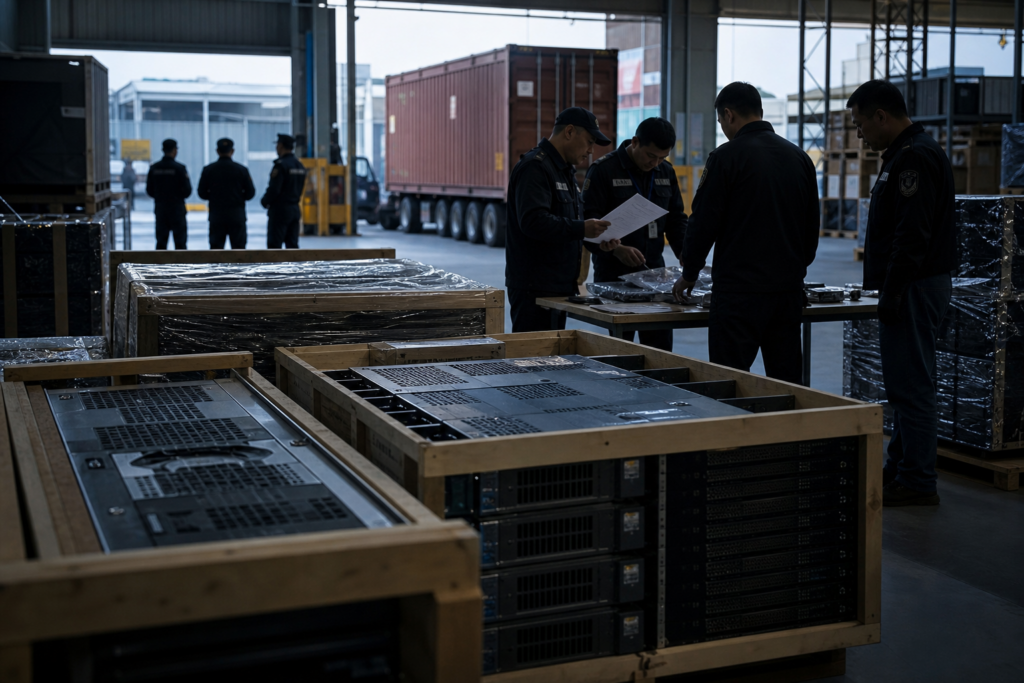
Taiwanese prosecutors’ investigation into alleged diversion of Supermicro servers with Nvidia AI hardware to China shows that the chip crisis is now an enforcement problem, not just an industrial one. Reports describe questioning, searches or voluntary access to devices connected to Supermicro-linked personnel and supply-chain partners. The key operational issue is simple: advanced accelerators are small enough to conceal, valuable enough to finance complex intermediaries, and strategic enough to trigger law-enforcement cooperation across jurisdictions.
The immediate military significance is not a single trigger event but the cumulative change in the operating environment. Each move forces allied planners to spend readiness, intelligence capacity and political attention on what used to be treated as routine space. That is exactly how gray-zone pressure creates strategic cost without crossing the threshold of declared conflict.
The tactical layer is important, but the strategic layer is the endurance contest. A state that can force its opponent to keep radars active, ships deployed, customs teams alert, and political leaders publicly responding gains leverage even without firing. This is why repeated low-level incidents should be treated as a campaign, not as disconnected events.
Why It Matters Strategically
Taiwanese prosecutors’ investigation into alleged diversion of Supermicro servers with Nvidia AI hardware to China shows that the chip crisis is now an enforcement problem, not just an industrial one. Reports describe questioning, searches or voluntary access to devices connected to Supermicro-linked personnel and supply-chain partners. The key operational issue is simple: advanced accelerators are small enough to conceal, valuable enough to finance complex intermediaries, and strategic enough to trigger law-enforcement cooperation across jurisdictions.
For planners, the main question is whether the pattern remains episodic or becomes normalized. Normalization would reduce warning time and make crisis signaling harder to distinguish from rehearsed daily pressure. This is why the event should be read through logistics, ISR, legal positioning and alliance coordination rather than through tactical headlines alone.
The regional consequence is that defense planning and industrial planning are now overlapping. Ports, fabs, cloud facilities, submarine cables, air bases, and coast guard stations are part of the same risk picture. If any single link is stressed, the effect can propagate through military readiness and commercial supply chains at the same time.
Indicators to Watch
Taiwanese prosecutors’ investigation into alleged diversion of Supermicro servers with Nvidia AI hardware to China shows that the chip crisis is now an enforcement problem, not just an industrial one. Reports describe questioning, searches or voluntary access to devices connected to Supermicro-linked personnel and supply-chain partners. The key operational issue is simple: advanced accelerators are small enough to conceal, valuable enough to finance complex intermediaries, and strategic enough to trigger law-enforcement cooperation across jurisdictions.
The most relevant indicators are changes in vessel density, aircraft routing, inspection activity, legal messaging, insurance costs, customs enforcement, and allied public statements. A stable number can still be escalatory if it occurs in a new area, against a new target class, or with a new legal claim attached.
- Taiwan probe concerns alleged Nvidia-equipped Supermicro server diversion to China
- Reports cite Keelung prosecutors and supply-chain partners including Albatron and Chief Telecom
- Supermicro says it cooperates and is not target of the probe
- U.S. cases allege broader attempts to route AI servers to China
Warning indicators should be weighted by novelty as much as by scale. A modest patrol in a new area, a customs case involving a new intermediary, or a legal statement aimed at a new maritime zone may matter more than a larger but familiar movement. Analysts should track whether the actor is testing response thresholds.
FoxyShield Assessment
Taiwanese prosecutors’ investigation into alleged diversion of Supermicro servers with Nvidia AI hardware to China shows that the chip crisis is now an enforcement problem, not just an industrial one. Reports describe questioning, searches or voluntary access to devices connected to Supermicro-linked personnel and supply-chain partners. The key operational issue is simple: advanced accelerators are small enough to conceal, valuable enough to finance complex intermediaries, and strategic enough to trigger law-enforcement cooperation across jurisdictions.
FoxyShield assesses the trend as a medium-to-high strategic warning signal. The risk is not immediate kinetic escalation in every case; the risk is that coercive pressure, export-control evasion and infrastructure dependency are merging into one theater-level competition around Taiwan and Southeast Asia.
The immediate policy requirement is resilience: distributed logistics, redundant communications, tighter end-user verification, and clearer alliance messaging. None of these measures by itself prevents coercion, but together they raise the cost of ambiguity and reduce the chance that an opponent can exploit a slow political response.
| Indicator | Current signal | Operational meaning |
|---|---|---|
| Taiwan probe concerns alleged Nvidia-equipped Supermicro server diversion to China | Active / reported | Raises planning or enforcement priority |
| Reports cite Keelung prosecutors and supply-chain partners including Albatron and Chief Telecom | Active / reported | Raises planning or enforcement priority |
| Supermicro says it cooperates and is not target of the probe | Active / reported | Raises planning or enforcement priority |
| U.S. cases allege broader attempts to route AI servers to China | Active / reported | Raises planning or enforcement priority |