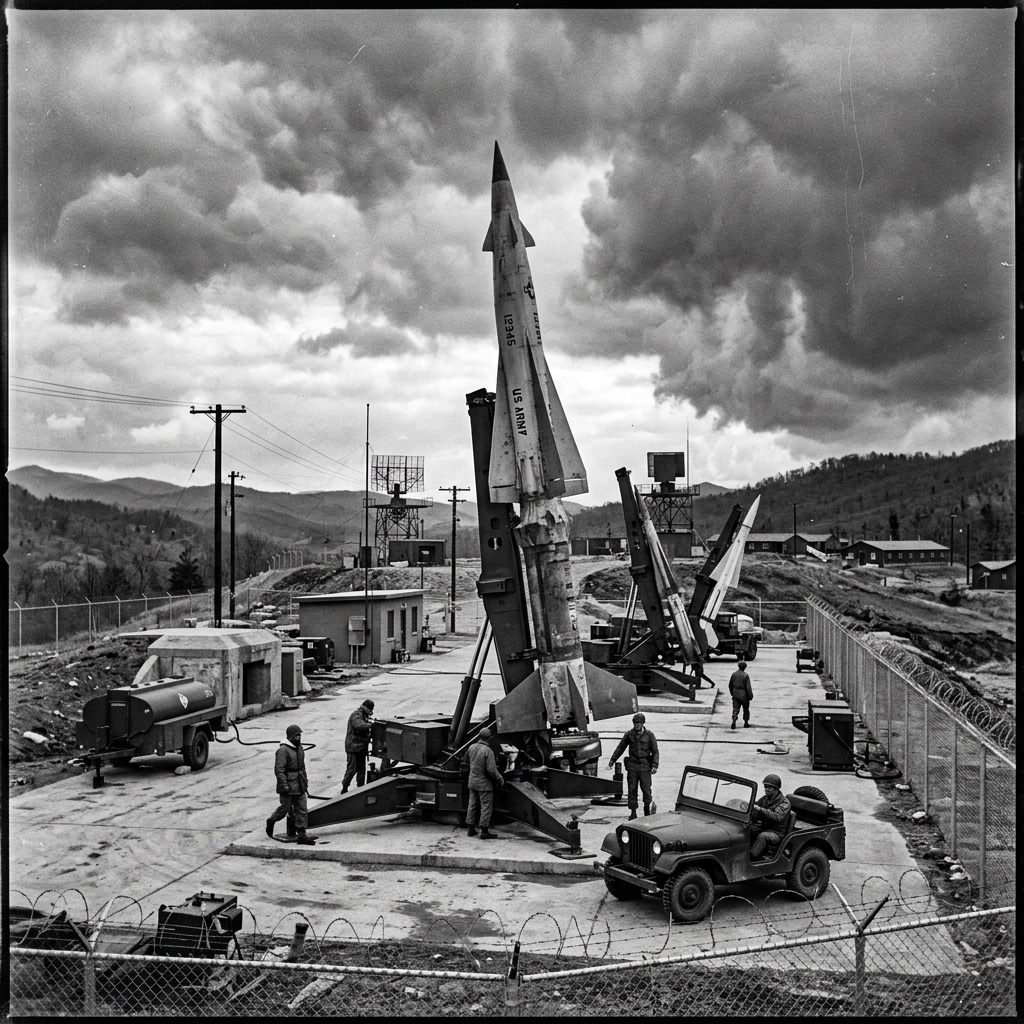
Origins of the Nike Program
Following the end of the Second World War and the onset of the Cold War, the United States faced a new and terrifying strategic threat. The Soviet Union had developed the Tupolev Tu-4 bomber (a reverse-engineered copy of the American B-29) and was rapidly building a stockpile of atomic weapons. For the first time in its history, the US mainland was vulnerable to a devastating strategic attack. Traditional anti-aircraft artillery (AAA) was incapable of reaching the high-altitude, fast-flying Soviet bombers. To defend its major cities, industrial centers, and military bases, the US Army initiated Project Nike in 1945, contracting Bell Laboratories and Douglas Aircraft to develop the world’s first integrated surface-to-air missile system.
The program was named after Nike, the winged goddess of victory in Greek mythology. The engineering challenge was immense: the system had to detect incoming targets at long range, launch a supersonic missile, and guide it to intercept the target at altitudes above 40,000 feet. This required the development of new radar systems, analog computers, and rocket propulsion. The result was a highly complex, multi-layered defensive shield that would eventually see over 250 Nike missile sites constructed across the United States, guarding cities from New York to Los Angeles.
Nike Ajax: The World's First Operational SAM
In December 1953, the MIM-3 Nike Ajax officially entered service, becoming the world’s first operational guided surface-to-air missile system. The Nike Ajax was a two-stage missile, utilizing a solid-fuel booster rocket to launch it off the pad and a liquid-fueled sustainer motor for its cruise phase. It achieved speeds of Mach 2.25 and had an operational range of 25 miles (40 km). To destroy the target, the missile carried three separate high-explosive fragmentation warheads located in the nose, center, and tail, designed to create a lethal cloud of shrapnel upon detonation.
The guidance system of the Nike Ajax was a marvel of analog electronics, relying on three distinct radars. The Acquisition Radar searched the skies for incoming targets. Once a target was identified, the Target Tracking Radar (TTR) locked onto it. Upon launch, the Missile Tracking Radar (MTR) locked onto the rising Nike missile. An analog computer in the ground station continuously compared the positions of the target and the missile, calculating the optimal intercept point and transmitting steering commands to the missile via radio signals. Just before intercept, the computer sent a detonation command to trigger the warheads. While effective, the Ajax had a key limitation: it could only engage one target at a time, making it vulnerable to saturation attacks.
Nike Hercules: Going Nuclear
To counter the threat of massed formations of Soviet bombers and early cruise missiles, the US Army introduced the significantly larger MIM-14 Nike Hercules in 1958. The Hercules replaced the liquid-fueled Ajax with solid-propellant rockets for both its booster and sustainer stages, dramatically improving safety and reducing launch preparation times. It had an operational range of over 90 miles (140 km) and could reach speeds of Mach 3.65, allowing it to intercept targets far from the cities it protected.
The most significant feature of the Nike Hercules was its ability to carry a W31 nuclear warhead with yields ranging from 2 to 20 kilotons. The concept of using a nuclear weapon for air defense was simple: the blast and radiation from a nuclear detonation in the upper atmosphere would obliterate an entire formation of bombers, as well as disable their electronic systems, without requiring the extreme precision of a direct hit. The Hercules radar system was also upgraded to include the Target Tracking Radar (TTR) and the new Target Ranging Radar (TRR) to counter Soviet electronic jamming, making it the premier air defense weapon of the early Cold War era.
Decommissioning and Technological Legacy
By the mid-1960s, the strategic landscape shifted. The Soviet Union began deploying Intercontinental Ballistic Missiles (ICBMs) as their primary strategic delivery system, rendering the bomber-oriented Nike shield increasingly obsolete. While the US Army explored anti-ballistic missile (ABM) upgrades under Project Nike Zeus, political and treaty considerations eventually led to the termination of the domestic air defense program. Decommissioning of the Nike sites began in the late 1960s, and by 1974, all domestic Nike Hercules batteries were deactivated, with a few sites in Alaska and Europe remaining active until the late 1970s and 1980s.
Despite its decommissioning, Project Nike left a profound technological legacy. The program pioneered the development of phased-array radars, automated fire control computers, and solid-fuel rocket boosters. Many of the scientists and engineers who worked on the Nike program went on to develop the Patriot missile system and contribute to the early US space program. Today, the remains of Nike launch sites stand as silent historical monuments to the early Cold War, representing the first time in history that a nation built an automated, electronic shield to protect its airspace.
| Technical Specification | MIM-3 Nike Ajax (1953) | MIM-14 Nike Hercules (1958) |
|---|---|---|
| Maximum Range | 25 miles (40 km) | 90 miles (140 km) |
| Maximum Speed | Mach 2.25 | Mach 3.65 |
| Interception Altitude | Up to 65,000 feet (20,000 m) | Up to 150,000 feet (45,000 m) |
| Warhead Type | 3x High-Explosive Blast-Fragmentation | W31 Nuclear (2-20 kt) or High-Explosive |
| Propulsion (Sustainer) | Liquid-fuel (nitric acid/aniline) | Solid-propellant rocket |
| Guidance System | Command guidance (TTR, MTR, Analog Computer) | Command guidance (Improved TTR, TRR, MTR) |
| Primary Mission | Defense against strategic bombers | Defense against bomber formations & early missiles |