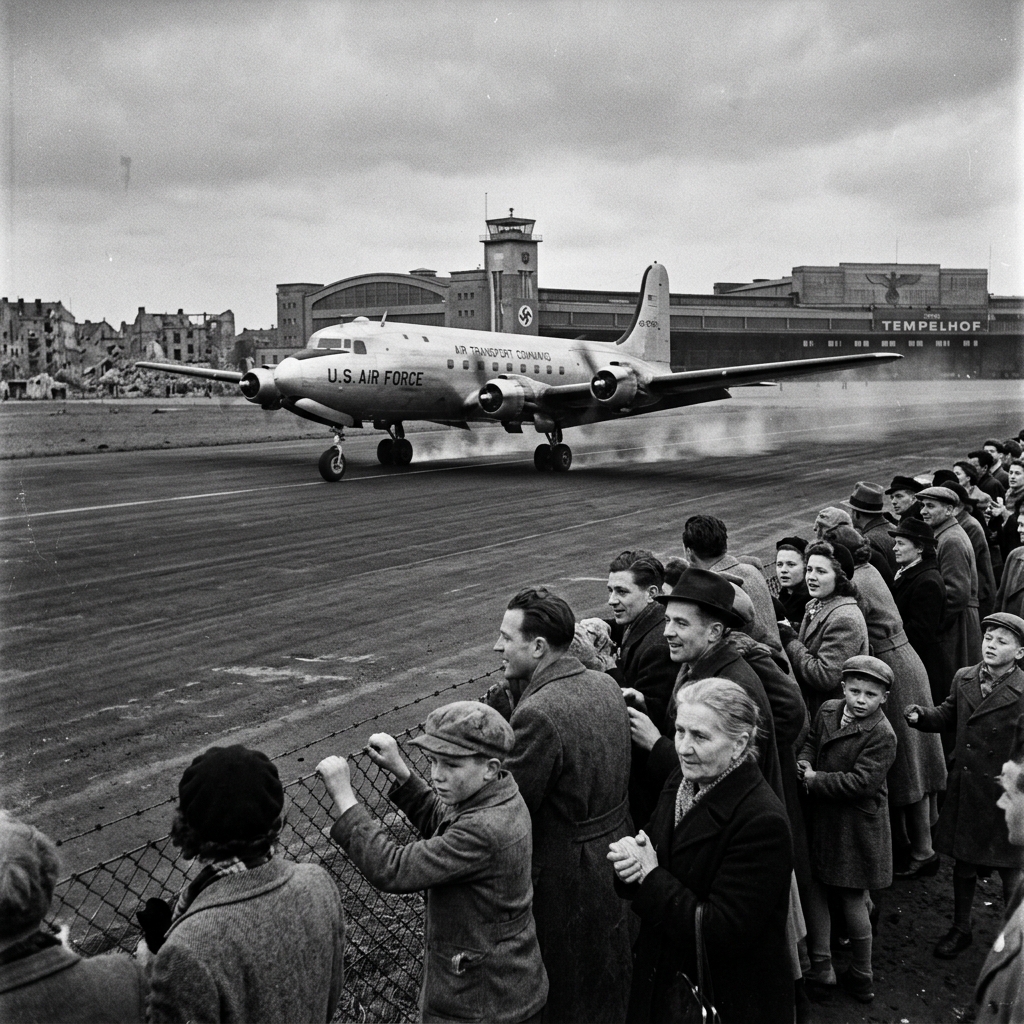
The Blockade and the Logistics Challenge
On June 24, 1948, the Soviet Union blocked all road, rail, and water access to the Allied-controlled sectors of Berlin, cut off electricity, and halted food distribution. General Secretary Joseph Stalin intended to starve the city of West Berlin into submission, forcing the Western Allies (the US, UK, and France) to abandon their outpost deep within Soviet-occupied eastern Germany. With over 2.5 million citizens facing starvation and freezing temperatures, the Allies were left with only one option: to supply the entire city solely by air through three narrow, 20-mile-wide air corridors guaranteed by treaty. This began Operation Vittles, commonly known as the Berlin Airlift.
The logistical scale of the challenge was unprecedented. To keep West Berlin alive, the Allies had to deliver a minimum of 4,500 tons of food, coal, and medical supplies every single day. Initially, military planners believed that supplying a major city entirely by air was impossible. During the opening weeks, the airlift was chaotic and disorganized, with aircraft arriving at random intervals, causing massive backups on the runways at Tempelhof and Gatow airports. To survive the upcoming winter, the Allies needed to transform a improvised military operation into a highly industrialized, radar-controlled assembly line.
Industrializing the Air Corridors: William Tunner's System
In July 1948, Major General William H. Tunner took command of the airlift. Known for his logistics expertise, Tunner immediately established a strict, rhythmic system to maximize air corridor efficiency. He stripped away the romance of flying, treating the airlift as a continuous railroad in the sky. Aircraft were scheduled to fly at precise speeds, altitudes, and time intervals. Tunner’s most famous rule was that if a pilot missed an approach due to poor visibility or congested runways, they were not allowed to circle and try again; instead, they had to return to their home base in West Germany immediately, carrying their cargo with them, to avoid disrupting the flow of following aircraft.
Under Tunner’s system, C-54 Skymasters flew in a continuous loop. They took off from West German bases, flew to Berlin via the northern or southern corridors, landed, unloaded in under 30 minutes, and returned via the central corridor. The target interval between landings was reduced to exactly three minutes. However, maintaining this rigid schedule became nearly impossible as autumn arrived, bringing dense European fog and low cloud cover that blinded pilots and threatened to halt the entire operation at a time when Berlin’s coal stockpiles were at their lowest.
GCA Radar: Landing in the Fog
The technological savior of the Berlin Airlift was the Ground Controlled Approach (GCA) radar, specifically the AN/MPN-1 mobile radar system. Prior to the airlift, landing in zero-visibility fog was highly dangerous and rarely attempted. GCA radar changed everything. The system utilized two separate radar units: a Search Radar to detect aircraft up to 30 miles away and coordinate their entry into the approach queue, and a highly precise Precision Approach Radar (PAR) to track the aircraft’s exact elevation and azimuth relative to the runway glide path.
Using GCA, a team of controllers sat in a dark mobile trailer next to the runway, watching the radar scopes. Instead of the pilot navigating visually, the controller literally talked the pilot down to the runway, providing continuous verbal instructions on heading adjustments and descent rates. Operators monitored the radar blip, correcting any deviation from the glide path in real-time. This allowed C-54s to land in zero-visibility conditions at three-minute intervals, night and day. The GCA radar effectively neutralized the harsh German winter, ensuring that the flow of supplies to Berlin continued uninterrupted through the worst weather.
A New Era for Aviation and Radar Control
By the spring of 1949, the Berlin Airlift had surpassed all expectations. On April 16, 1949, during the “Easter Parade” demonstration, the Allies set a record by landing 1,398 flights in 24 hours—one landing every 62 seconds—delivering nearly 13,000 tons of coal and food. Realizing that the blockade had failed to achieve its objectives, the Soviet Union lifted all restrictions on May 12, 1949. Operation Vittles continued for several months to build up stockpiles, officially ending in September 1949 after delivering over 2.3 million tons of supplies on 278,000 flights.
Beyond its Cold War strategic significance, the Berlin Airlift laid the foundation for modern commercial aviation. The strict scheduling, standardized flight routes, and, most importantly, the use of GCA radar for voice-guided landing and radar separation, became the basis for modern Air Traffic Control (ATC) systems used worldwide today. The operation proved that large-scale logistical operations could be successfully managed in all weather conditions using radar technology, transforming the radar from a defensive military tool into the cornerstone of global civilian air safety.
| Operational Metric | Value / Specification |
|---|---|
| Total Cargo Delivered | 2,326,406 tons (mostly coal and food) |
| Total Flights Flown | 278,228 flights (Allied combined) |
| Target Landing Interval | 3 minutes (Reduced to 62 seconds during Peak) |
| Key Radar Technology | AN/MPN-1 Ground Controlled Approach (GCA) Radar |
| Primary Cargo Aircraft | Douglas C-54 Skymaster (10-ton capacity) |
| Allied Aircraft Losses (Accidents) | 17 American and 8 British aircraft lost in crashes |
| Peak Daily Tonnage Record | 12,941 tons (Easter Parade – April 16, 1949) |