The Terror from Pas-de-Calais
In the early hours of June 13, 1944—just one week after the Allied landings in Normandy—a strange, buzzing sound echoed over the English Channel. Shortly after, a small, pilotless aircraft carrying a one-ton warhead crashed into London, marking the beginning of the world’s first cruise missile campaign. This was the Vergeltungswaffe 1 (V-1), commonly known as the “flying bomb” or “buzz bomb” due to the pulsejet engine’s distinctive roar. Launched from massive ramp sites in the French region of Pas-de-Calais, the V-1s were aimed directly at London, designed to terrorize the civilian population and force the British government to divert military forces from the European front.
Unlike piloted bombers, the V-1 was a robotic weapon. Guided by a simple gyroscopic autopilot and a magnetic compass, it flew at a constant altitude and speed until a mechanical counter, driven by a small propeller on the nose, reached zero. At that point, the elevator controls were jammed, sending the missile into a steep dive. When the engine cut out, a terrifying silence fell over the target area, followed seconds later by a massive explosion. Facing this non-stop robotic assault, which launched up to 100 bombs a day, British air defense commanders had to construct a multi-layered shield that integrated fighters, anti-aircraft guns, and barrage balloons into a unified system code-named Operation Diver.
Fighter Interception: Tipping the Wings
The first line of defense against the flying bombs was the Fighter Command. However, intercepting a V-1 was exceptionally difficult. The missile flew at speeds of 350 to 400 miles per hour at altitudes between 2,000 and 3,000 feet—a regime where most Allied fighters struggled to keep pace. Only the fastest aircraft, such as the Hawker Tempest, the Griffon-powered Spitfire XIV, and the newly deployed Gloster Meteor jet fighter, could match the V-1’s speed. Pilots had to dive from high altitude to gain enough speed to close in on the bombs before they reached London.
Shooting down a V-1 carried extreme risks. If a pilot opened fire from close range, the explosion of the one-ton warhead could destroy their own aircraft. To avoid this, pilots developed a daring tactic known as “wing-tipping.” A pilot would fly alongside the flying bomb, place their wingtip just inches beneath the V-1’s wing, and then roll their aircraft. The turbulent airflow would flip the V-1’s wing up, overriding its gyroscopic autopilot and sending the missile spinning out of control into the English Channel or the open fields of Kent. This tactic allowed pilots to neutralize the threat without firing a single round of ammunition.
Operation Diver: Anti-Aircraft Guns and the Proximity Fuze
The second layer of the air shield consisted of thousands of anti-aircraft guns. Initially, these guns were placed in a belt around London. However, shooting at the low-flying, fast-moving V-1s over populated areas was dangerous, as stray shells caused civilian casualties. In July 1944, General Sir Frederick Pile, commander of Anti-Aircraft Command, made the bold decision to relocate all anti-aircraft guns to the coast of Kent and Sussex. This gave the gunners a clear line of sight over the sea and open countryside, allowing them to fire continuously at the incoming missiles.
The effectiveness of the gun belt was revolutionized by three American-supplied technological innovations: the SCR-584 radar, the Bell Labs electronic predictor, and the VT proximity fuze. The SCR-584 radar tracked the flying bombs automatically, feeding coordinate data to the predictor, which calculated the target’s path and aimed the guns automatically. The VT proximity fuze utilized a tiny radio transmitter-receiver inside the shell’s nose; when the shell passed within 70 feet of a V-1, the reflected radio signal triggered the detonator. This eliminated the need for precise time fuzes, increasing the kill rate of anti-aircraft guns from less than 10% to over 74% by August 1944.
The Barrage Balloons and the Final Toll
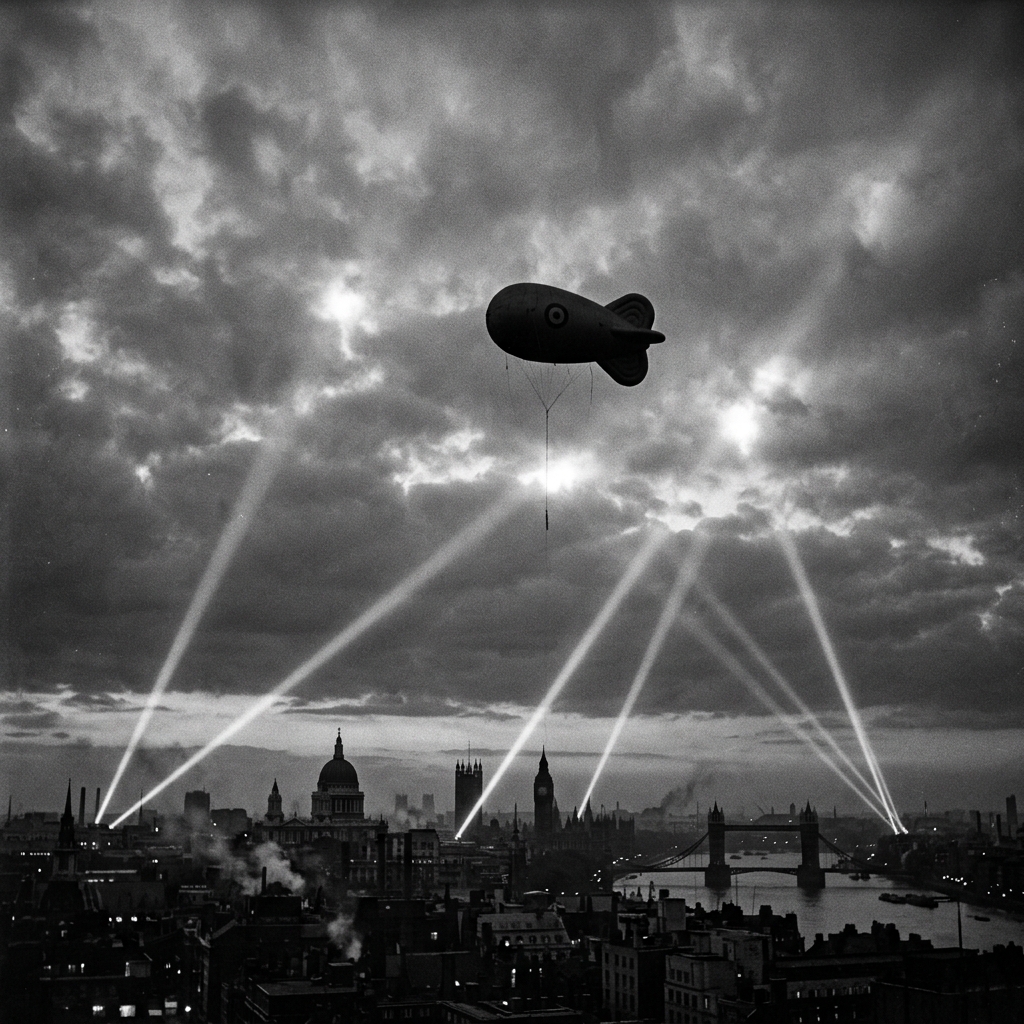
The third and final layer of defense was the Barrage Balloon Command. A massive belt of over 2,000 barrage balloons was deployed in the southern outskirts of London. These large, helium-filled balloons were anchored to the ground by thick steel cables. Because the V-1s flew at a constant altitude, they were highly vulnerable to these cables. If a flying bomb struck a cable, the impact would slice off its wing or destabilize its flight, causing it to crash before reaching the city center. The barrage balloons served as a vital net, catching nearly 300 V-1s that had slipped past the fighters and guns.
By October 1944, the V-1 threat to London was largely neutralized as Allied ground forces captured the launch sites in northern France. Over the course of the campaign, Germany launched over 10,000 V-1s at Britain. While over 6,000 civilians were killed, the integrated defensive shield of Operation Diver successfully destroyed over 54% of the incoming missiles, saving thousands of lives. The battle against the V-1 was a preview of modern missile defense, proving that an integrated, multi-layered shield combining radar, automated fire control, and fast interceptors was the only way to defeat automated aerial threats.
| Defense Layer / Weapon | Key Technology / Aircraft | Average Speed | Role in Operation Diver | Intercept Success Rate (Late 1944) |
|---|---|---|---|---|
| Fighter Interception | Hawker Tempest, Spitfire XIV, Gloster Meteor | 350 – 410 mph | Destroy/disable V-1s over the English Channel | Approx. 35% of total kills |
| Anti-Aircraft Artillery | QF 3.7-inch guns, SCR-584 radar, VT Proximity Fuze | Projectile: 2,600 ft/s | Automated fire belt on the southeastern coast | Approx. 74% of targets engaged in Aug 1944 |
| Barrage Balloons | Low-altitude helium balloons, steel cables | Stationary | Passive physical barrier in southern London | Destroyed 279 V-1 bombs |