The Iraqi Rear Sanctuary
In the opening months of the Iran-Iraq War (1980–1988), the Iraqi Air Force (IrAF) suffered heavy losses at the hands of the Islamic Republic of Iran Air Force (IRIAF), which operated modern, American-supplied F-14 Tomcats, F-4 Phantoms, and F-5 Tigers. To protect its strategic assets, the Iraqi command relocated its most valuable combat aircraft—including Soviet-supplied Tupolev Tu-22 strategic bombers, MiG-23 interceptors, and Sukhoi Su-20 fighter-bombers—to the Al-Walid airbase complex, commonly known as H-3. Situated in western Iraq near the Jordanian border, H-3 was located over 400 miles from the Iranian border, placing it far beyond the combat range of Iranian fighters and establishing what Iraqi commanders believed was a safe rear sanctuary.
From this sanctuary, Iraqi Tu-22 bombers launched raids against Iranian cities and oil infrastructure, secure in the knowledge that they could not be intercepted. However, the Iranian command refused to accept this strategic disadvantage. They realized that if they could destroy these bombers on the ground at H-3, they could neutralize Iraq’s strategic strike capability and restore air superiority over the front lines. But reaching H-3 required planning an operation that pushed the absolute limits of aviation technology, logistics, and pilot endurance.
The Audacious Flight Path: Evading Regional Radars
A direct flight route from Iran to H-3 was impossible. The path was guarded by dense Iraqi air defense networks, and a direct approach would give Iraqi interceptors ample warning to scramble and shoot down the attackers. To achieve surprise, the IRIAF designed an audacious, circuitous flight path. The plan called for a strike package of eight F-4E Phantoms to fly north along the Iran-Iraq border, cross into the extreme northern corner of Iraq near the Turkish border, and then fly west along the Iraq-Syria border to approach H-3 from the northwest, bypassing all primary Iraqi early warning radars.
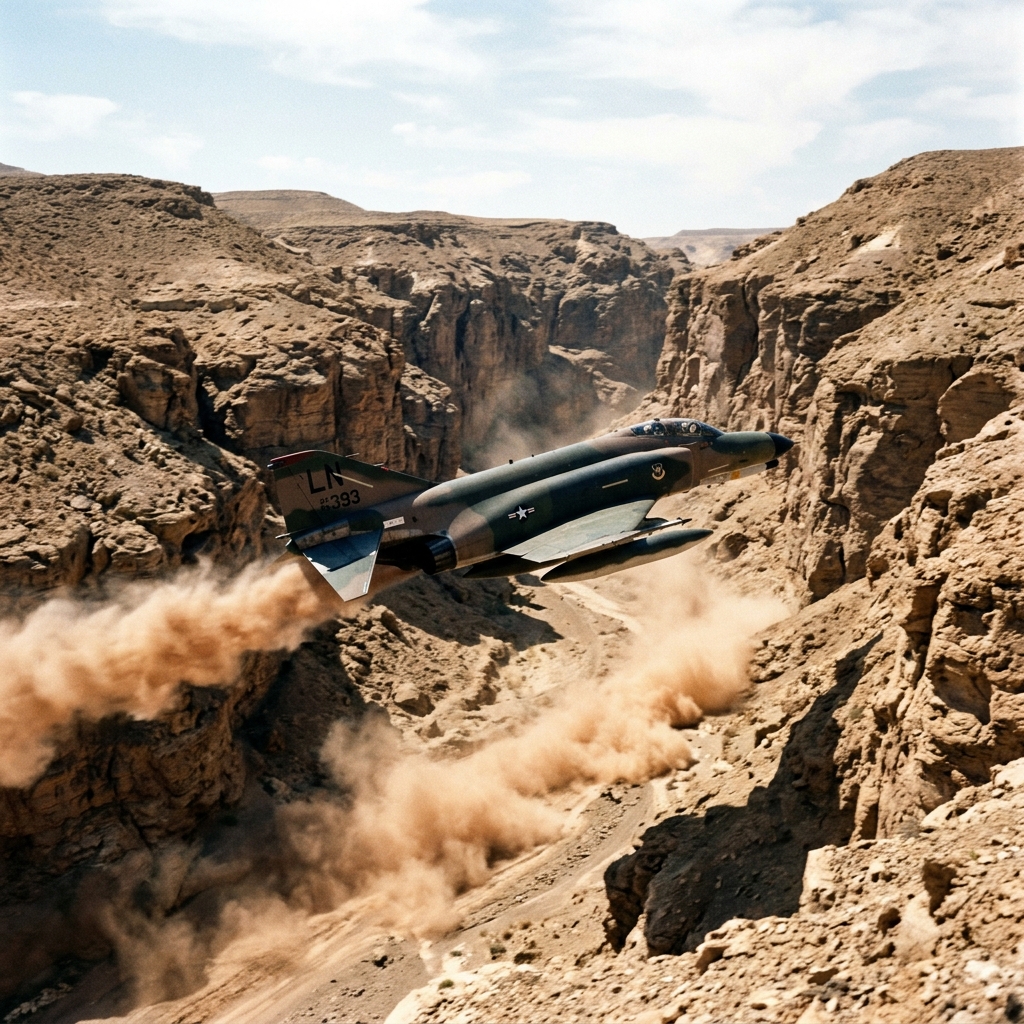
This route, however, was fraught with extreme danger. The F-4s had to fly at altitudes of less than 100 feet (30 meters) above the ground, weaving through mountain valleys and desert canyons to avoid detection by Turkish and Syrian radars as well as Iraqi air defense sites. Flying at such low altitudes at high speeds required intense concentration, as a single pilot error or gust of wind would result in a fatal crash. Furthermore, the total flight distance exceeded 1,200 miles, far exceeding the F-4 Phantom’s internal fuel capacity, making mid-air refueling mandatory.
Mid-Air Refueling and the Precision Blitz
To solve the fuel problem, the IRIAF designed a complex refueling plan utilizing two Boeing 707 and two Boeing 747 aerial tankers. The tankers took off from Tehran under the guise of commercial flights, flying along international civil airways before dropping to low altitude over eastern Syria and western Jordan to meet the incoming strike force. The tankers met the F-4 Phantoms at low altitude, refueling them twice during the journey—once on the way to the target and once on the return flight—a highly dangerous operation executed in radio silence close to hostile borders.
On the morning of April 4, 1981, the eight Iranian F-4 Phantoms approached the H-3 airbase complex from the northwest, split into two groups of four, and launched a surprise blitz. The Iraqi forces, expecting no attack so deep in their rear, were caught completely unprepared. The Phantoms swept over the airbases at low altitude, releasing cluster bombs and precision munitions on parked aircraft, runways, hangars, and radar installations. Within minutes, the bases were transformed into infernos of burning fuel and exploding munitions, with the Syrian and Iraqi air defense networks failing to react before the attackers fled.
Tactical Analysis and Legacy of the Raid
The H-3 raid was a spectacular tactical success. According to intelligence reports, the strike destroyed between 45 and 48 Iraqi aircraft, including three Tu-22 strategic bombers, six Tu-16 medium bombers, and dozens of MiG-23s, Su-20s, and Mi-24 helicopters. The loss of these aircraft severely degraded Iraq’s offensive capability and gave Iran air superiority for the next several months of the war. Most remarkably, all eight Iranian F-4 Phantoms completed the mission and returned safely to their bases, with only one aircraft suffering minor damage from anti-aircraft shrapnel.
Today, the H-3 Air Base Raid stands as one of the most daring and successful low-altitude strike operations in military history, comparable to the RAF’s famous Dambusters raid or Israel’s Operation Opera. It demonstrated that low-altitude flying, coupled with creative logistics and electronic deception, could neutralize a modern air defense network and strike targets deep within a heavily defended territory. The raid remains a textbook example of SEAD and low-altitude penetration tactics studied in military academies worldwide.
| Operational Parameter | Specification / Result |
|---|---|
| Strike Aircraft | 8x McDonnell Douglas F-4E Phantom II |
| Aerial Refueling Tankers | 2x Boeing 707-320C, 2x Boeing 747-200F |
| Total Flight Distance | Approx. 1,200 miles (2,000 km) round-trip |
| Flight Altitude (Penetration) | Less than 100 feet (30 meters) AGL |
| Iraqi Aircraft Destroyed (Est.) | 45 – 48 (Tu-22, Tu-16, MiG-23, Su-20, Mi-24) |
| Iranian Aircraft Losses | 0 (All 8 F-4s returned safely) |
| Refueling Phases | 4 total mid-air refuelings (2 outbound, 2 inbound) |