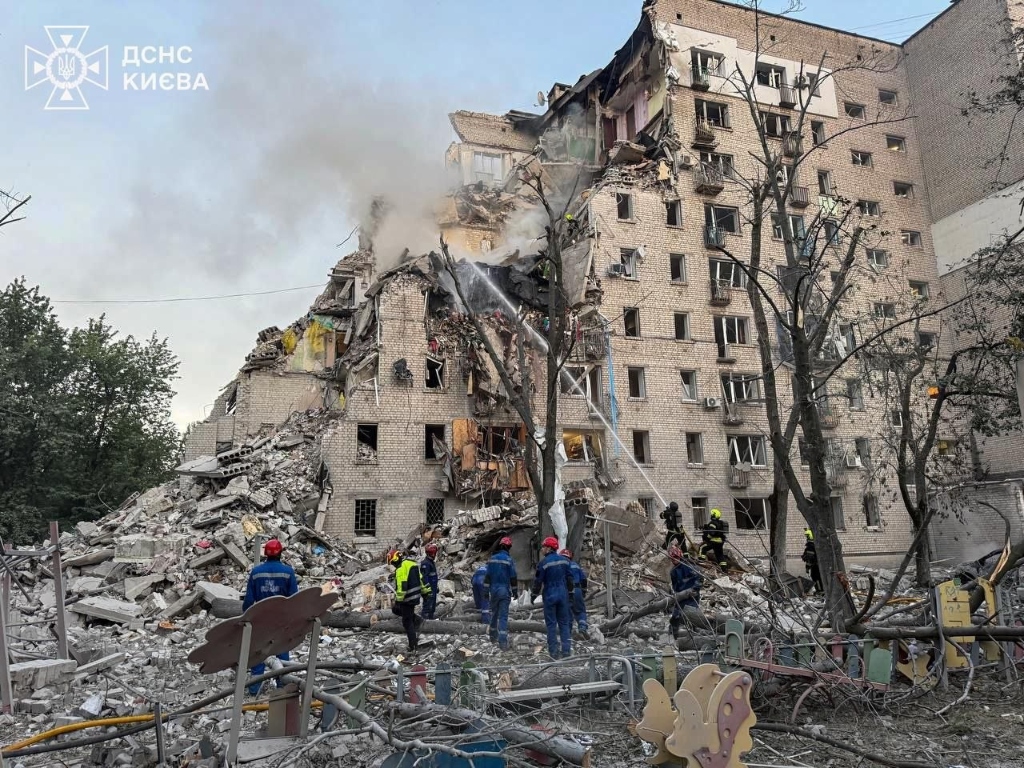
Tragedy in Kyiv: Massive Russian Missile Strike Hits Residential Areas
In the early hours of July 2, 2026, the capital of Ukraine became the target of one of the most intense and devastating Russian missile and drone attacks since the beginning of the full-scale conflict. A massive wave of precision munitions breached the city’s defenses, leading to severe destruction in multiple municipal districts. The State Emergency Service of Ukraine (DSNS) confirmed that a direct hit on a multi-story residential brick building caused extensive structural collapse, burying residents under heavy rubble.
As search and rescue operations continue under extremely hazardous conditions, the casualty toll has risen dramatically. Local authorities and emergency personnel have confirmed that at least 17 people have lost their lives, with dozens of others sustaining moderate to critical injuries. Rescuers are working tirelessly to clear the concrete debris and locate potential survivors who may still be trapped in the lower sections and basement of the collapsed structure. The tragedy has prompted widespread condolences from international organizations and foreign leaders, who have condemned the targeting of dense urban environments.
Technical Assessment: Munitions Mix and Air Defense Performance
The scale of the attack on the night of July 2 highlights a sophisticated effort by Russian forces to overwhelm the Ukrainian air defense network using a complex mixture of drone decoys, cruise missiles, and high-velocity ballistic assets. According to reports from the Ukrainian Air Force, a total of 570 aerial targets were detected across the country, comprising 74 missiles of various classes and 496 attack drones, including newer jet-powered Shahed variants. The sheer volume of incoming threats was designed to saturate interceptor radars and exhaust ammunition stockpiles.
While Ukrainian air defense units demonstrated high efficiency by neutralizing 524 targets—chiefly cruise missiles and slow-flying attack drones—the interception rate for high-velocity ballistic and hypersonic missiles remained low. The strike package included 4 Zircon hypersonic missiles, 24 Iskander-M/S-400 ballistic missiles, 34 Kh-101 cruise missiles, and 8 Kalibr cruise missiles. Security analysts point out that the ballistic missiles, which follow a steep trajectory and possess short flight times, posed the greatest challenge to local defenses, with 25 ballistic missiles ultimately penetrating the defense perimeter to hit targets across all municipal districts of Kyiv.
Impact on Kyiv's Critical and Civilian Infrastructure
The physical destruction caused by the missile barrage is widespread, affecting over 20 residential buildings, several commercial enterprises, and vital utility nodes. Kyiv Mayor Vitali Klitschko reported that the damage extended beyond residential quarters to include a hotel, a scientific research institute, and an ambulance dispatch center. The strike on electrical substations led to localized power grids failing, leaving thousands of apartments without electricity or water supply in the immediate aftermath of the attack. Emergency engineering crews were dispatched immediately to isolate damaged lines and restore basic services.
Despite the severe damage to the city’s infrastructure, the casualty count was significantly mitigated by the proactive use of the Kyiv Metro system as a bomb shelter. Over the course of the night, metro stations housed a record-breaking 52,500 citizens, providing a secure underground refuge for families, elderly residents, and children. The State Emergency Service and municipal volunteers established distribution points for water, food, and medical assistance within the stations, demonstrating a highly organized civil defense response under severe stress.
Strategic Implications and Urgent Air Defense Requirements
The devastating strike has renewed debates regarding the adequacy of Ukraine’s air defense umbrella and the urgent need for advanced systems capable of intercepting ballistic and hypersonic threats. In response to the tragedy, the Kyiv city administration declared July 3, 2026, a day of official mourning to honor the victims of the residential strike. Ukrainian military commanders and political leaders have intensified their appeals to international allies, emphasizing that without additional Patriot batteries, SAMP/T systems, and corresponding interceptor missiles, defending urban populations against coordinated ballistic salvos remains incredibly difficult.
Strategic analysts warn that the Russian military is exploiting gaps in medium- and long-range air defense coverage as Ukraine distributes its limited assets to protect both frontline troops and critical energy hubs. This latest bombardment, signals a continuing strategy of urban pressure. As rescue teams continue to search the rubble in Kyiv, the international community faces growing pressure to accelerate the delivery of modern defensive platforms to secure Ukrainian airspace and prevent similar civilian catastrophes.
| Parameter / Target Class | Launched / Confirmed | Downed / Intercepted |
|---|---|---|
| Total Aerial Targets | 570 | 524 |
| Ballistic Missiles (Iskander-M / S-400) | 24 | Unspecified (Low) |
| Hypersonic Missiles (Zircon) | 4 | Unspecified |
| Cruise Missiles (Kh-101 / Kalibr) | 42 | Majority Intercepted |
| Attack Drones (Shahed-type) | 496 | Majority Intercepted |
| Confirmed Fatalities | 17 (Under investigation) | N/A |
| Confirmed Injuries | 90+ | N/A |
| Sheltered in Kyiv Metro | 52,500 citizens | N/A |