Strategic Role and Upgrades
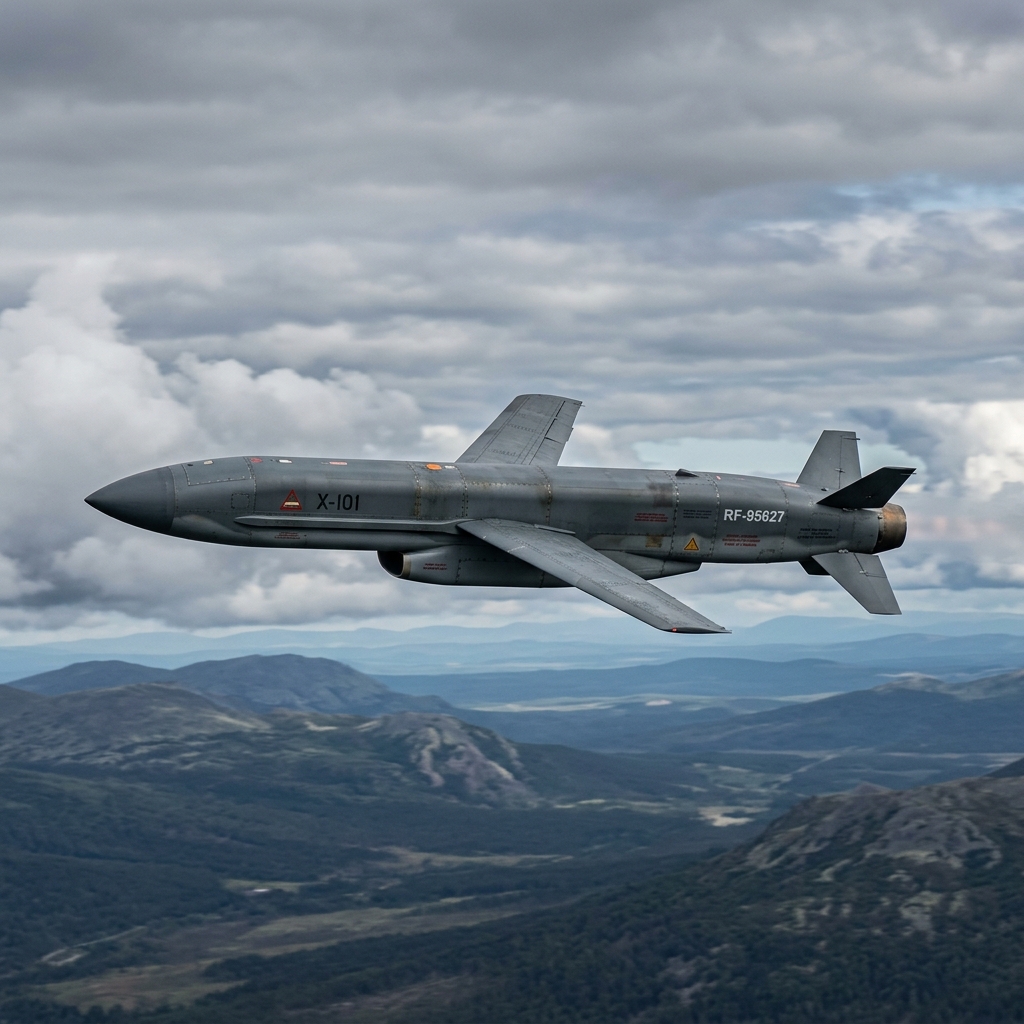
The Kh-101 is a Russian strategic air-launched cruise missile that forms the backbone of their long-range strike capabilities in Ukraine. Launched primarily from Tu-95MS and Tu-160 bombers, it features radar-evading characteristics and flies at subsonic speeds of Mach 0.6–0.8. Recent modernizations have significantly increased its lethality, trading maximum range for a dual-warhead configuration weighing approximately 800 kg, and introducing cluster submunitions to target infrastructure.
Advanced Countermeasures
To combat the high interception rates of Ukrainian air defenses, Russia integrated the SP-504 self-protection jammer suite into the Kh-101. This active electronic warfare module is designed to disrupt radar tracking and deploy passive decoy flares during the terminal phase of the flight. Along with an electro-optical scene-matching correlation system, these enhancements attempt to ensure the missile reaches its designated target.
Production and Supply Chains
Despite international sanctions, Russia maintains a steady production of 40 to 50 Kh-101 missiles per month. Wreckage analysis reveals a continued reliance on foreign-made microelectronics for its guidance and navigation systems. Ukrainian air defenders have adapted to these threats, successfully intercepting a large majority of incoming cruise missiles through a layered defense strategy.
Future Implications
The continuous upgrades of the Kh-101 signify Russia’s intent to sustain long-range attacks. As countermeasures evolve on both sides, the race between missile technology and air defense systems will likely remain a critical factor in the ongoing conflict.
| Specification | Details |
|---|---|
| Missile Type | Air-launched cruise missile |
| Speed | Subsonic (Mach 0.6 – 0.8) |
| Payload | Approx. 800 kg (Tandem warhead) |
| Key Upgrades | SP-504 Jammer, Cluster Munitions |