The Campaign to Retake Iraq’s Second City
The operation to retake Mosul began on 17 October 2016, more than two years after ISIS captured the city and proclaimed its caliphate. The campaign combined Iraqi Counter Terrorism Service units, army divisions, federal police, Kurdish Peshmerga and other formations, supported by a United States-led coalition. Mosul’s population, size and political importance made the battle far more complex than an assault on an isolated stronghold.
ISIS had time to prepare belts of defenses, tunnels, firing positions, booby traps and vehicle-borne bombs. It used civilians as shields and sought to make every street costly. Coalition intelligence, air power and artillery provided major advantages, but firepower was constrained by the need to protect civilians and preserve routes for evacuation and humanitarian support. The campaign therefore became a test of tactical endurance and political legitimacy.
East Mosul and the Learning Curve
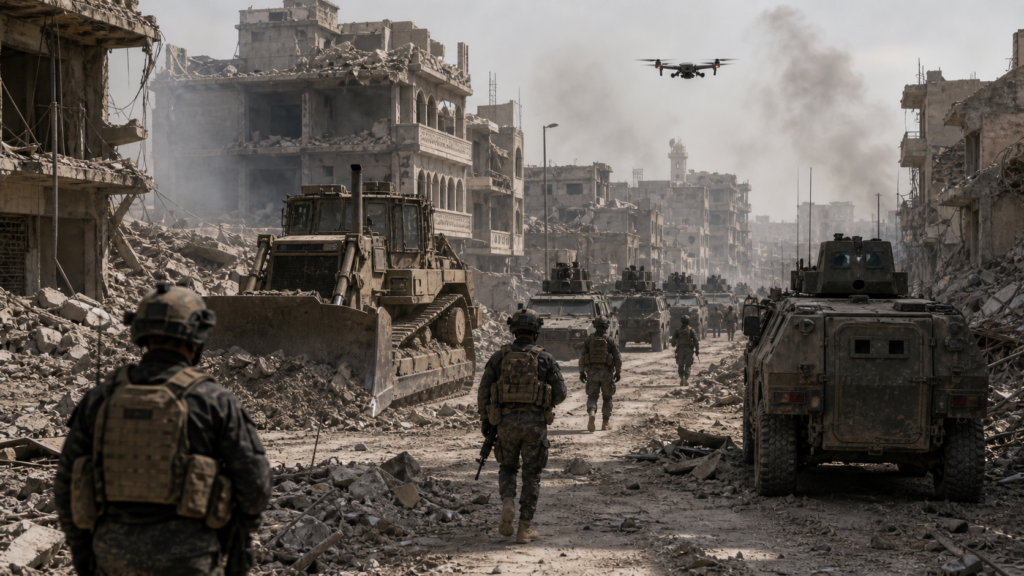
Forces approached from several directions, with Peshmerga helping isolate the city while Iraqi units entered from the east and south. The Counter Terrorism Service carried much of the early urban fighting. ISIS used armored suicide car bombs, small drones, snipers and hidden movement routes to attack advancing columns. Bulldozers and engineering vehicles became essential for clearing barriers and opening lanes.
Progress in eastern Mosul exposed coordination problems and placed heavy pressure on elite units. Iraqi forces adapted by improving the integration of intelligence, coalition strikes, armor, engineers and local maneuver. The Tigris River divided the city, and the destruction of bridges limited ISIS movement but also complicated the attackers’ logistics. By January 2017 eastern Mosul had largely been retaken, yet the denser western districts promised a harder battle.
| Challenge | ISIS method | Coalition/Iraqi response |
|---|---|---|
| Armored suicide vehicles | Fast attacks through streets and breaches | Barriers, anti-tank weapons, surveillance and precision strikes |
| Dense urban cover | Tunnels, snipers and fortified buildings | Engineers, small-unit clearing and persistent intelligence |
| Commercial drones | Observation and small munition drops | Electronic countermeasures, concealment and rapid movement |
| Civilian presence | Human shields and blocked escape | Corridors, restrictive targeting and humanitarian coordination |
| Old City streets | Routes too narrow for many vehicles | Dismounted assault and armored bulldozers |
West Mosul and the Old City
The offensive resumed in February 2017 toward western Mosul, including the airport and government district. The Old City’s narrow streets reduced the usefulness of heavy vehicles and compressed soldiers, civilians and defenders into a small area. ISIS positions were embedded in buildings, and suicide attackers continued to exploit rubble and concealed routes. The closer forces moved toward the final enclave, the more difficult distinction and proportionality became.
Iraqi units advanced with coalition air and artillery support, but civilian casualties and destruction were severe. The al-Nuri Mosque, where the caliphate had been proclaimed, was destroyed as Iraqi forces approached; ISIS and the coalition disputed responsibility. Prime Minister Haider al-Abadi declared victory in Mosul on 10 July 2017. Organized control had ended, although surviving militants continued insurgent activity.
What Mosul Teaches About Modern Urban War
Mosul showed that a materially inferior defender can exploit a city to slow a powerful coalition. Cheap drones, suicide vehicles, tunnels and prepared buildings imposed time and casualties. The attacker needed not only precision weapons, but infantry, engineers, armored protection, intelligence fusion, medical evacuation and units able to repeat exhausting clearance tasks for months.
The battle also demonstrated that liberation and destruction can occur simultaneously. Defeating ISIS removed a brutal governing apparatus, yet large areas were devastated and civilians paid the greatest price. Tactical victory did not automatically solve displacement, reconstruction, governance or the grievances exploited by extremists. For military planners, the central lesson is that urban warfare is a system problem: success depends on connecting combat power with civilian protection, information, logistics and a credible political plan for the day after.