A Hijacking Becomes a Strategic Crisis
On 27 June 1976, Air France Flight 139 was hijacked after leaving Athens and eventually flown to Entebbe Airport in Uganda. The hijackers separated many Israeli and Jewish passengers from other hostages. Uganda’s ruler Idi Amin supported the hijackers and Ugandan troops guarded the old terminal. After most non-Israeli passengers were released, more than one hundred hostages remained under threat.
Israel publicly negotiated while intelligence services and the military studied a rescue. The distance—roughly four thousand kilometers from Israel—made the problem exceptional. Aircraft would need to reach Uganda, land at night, surprise the guards, identify the hostages, neutralize the hijackers and depart before a larger Ugandan response. Any delay, navigation error or loss of surprise could turn the terminal into a killing zone.
Intelligence, Rehearsal and the Value of the Terminal Plan
Planning benefited from information supplied by released hostages, airline crews, intelligence contacts and knowledge of the terminal’s construction. Israeli firms had previously worked in Uganda, helping planners understand the building. Teams rehearsed movement through a model and divided the mission into assault, perimeter security, aircraft protection, refueling and medical tasks.
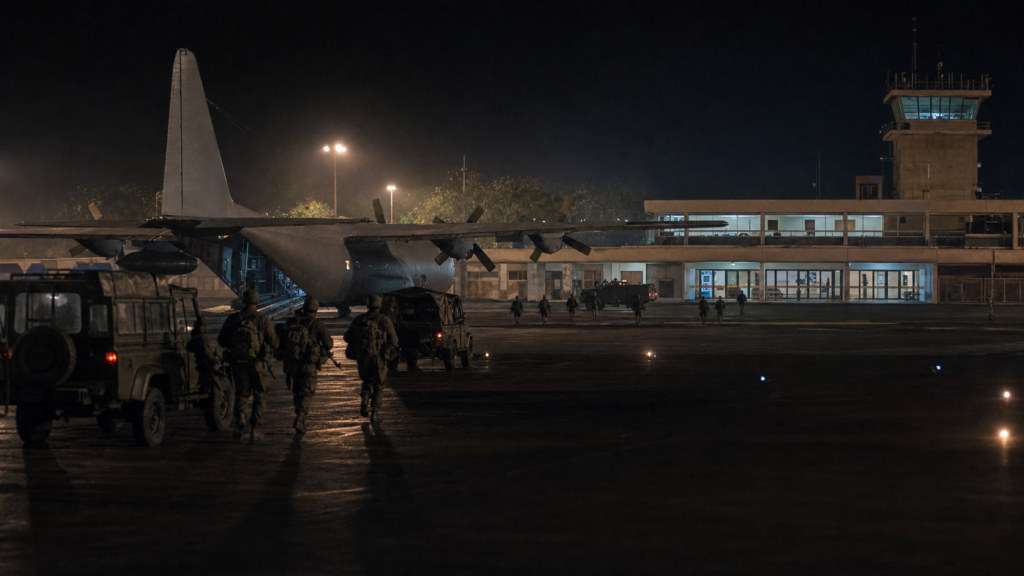
The plan used C-130 transports capable of operating from the runway and carrying troops and vehicles. A black Mercedes and Land Rovers were intended to resemble Amin’s motorcade and close the distance before defenders understood what was happening. The deception was imperfect, but it illustrates a broader principle: special operations use speed and recognition delay to create local superiority where overall forces are weak.
| Element | Purpose | Primary risk |
|---|---|---|
| Long-range C-130 flight | Deliver assault force without nearby bases | Navigation, fuel and detection |
| Vehicle deception | Approach terminal before alarm spreads | Guards recognize changed procedures |
| Assault teams | Kill hijackers and protect hostages | Misidentification and crossfire |
| Perimeter and aircraft security | Hold runway and suppress response | Ugandan reinforcement or aircraft attack |
| Medical and evacuation plan | Remove hostages rapidly | Delay caused by casualties |
The Raid on the Night of 3–4 July
The first transport landed at Entebbe shortly before midnight. The assault force drove toward the old terminal, but guards challenged the convoy and shooting began earlier than intended. Commandos rushed the building, identified the hijackers and secured the hostage hall within minutes. Other teams established security, fought Ugandan troops and destroyed Ugandan fighter aircraft on the ground to reduce the threat during departure.
The rescue succeeded, but not without losses. Three hostages were killed during the operation, and Lieutenant Colonel Yonatan Netanyahu, commander of the assault element, was killed. An elderly hostage, Dora Bloch, who had earlier been taken to hospital, was later murdered by Ugandan authorities. The force evacuated 102 hostages. The outcome combined preparation with rapid improvisation once the original deception began to fail.
Legacy, Deterrence and Legal Controversy
Entebbe became a model for long-range special operations because it aligned intelligence, aviation, rehearsals, medical support and political decision-making around a narrow objective. It showed that distance could be overcome if surprise created a brief window of superiority. It also reinforced Israel’s stated refusal to accept that hostages abroad were beyond rescue.
The operation violated Ugandan sovereignty and generated international legal debate. Israel argued that Uganda had collaborated with the hijackers and that rescue was necessary to protect lives. The controversy matters because tactical success does not remove political consequences. Entebbe’s durable lesson is not that daring substitutes for caution. It is that exceptional risk can be managed only through detailed intelligence, simple priorities, rehearsed coordination and leaders prepared for the plan to break on contact.