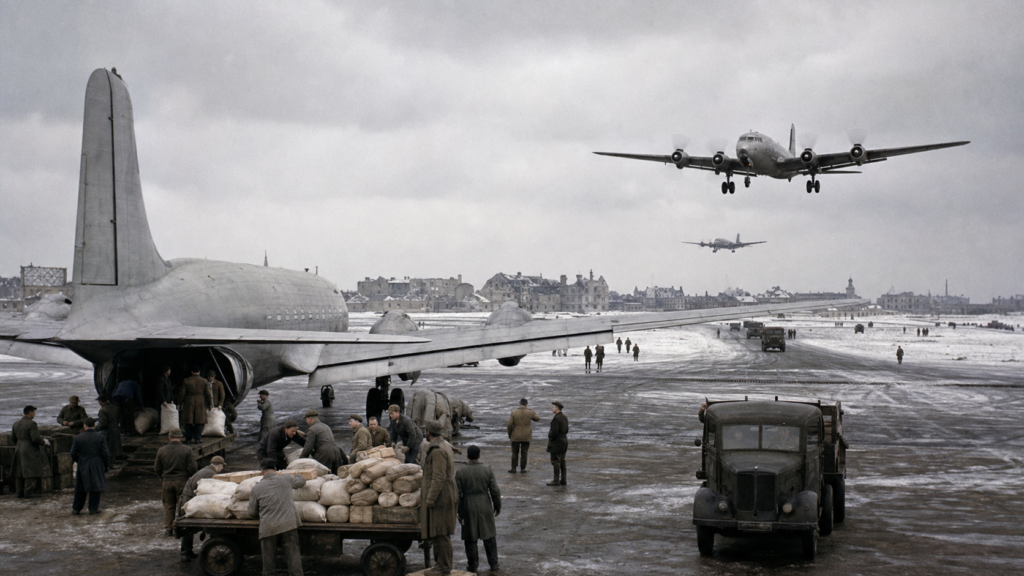
A Blockade at the Birth of the Cold War
In June 1948, the Soviet Union cut road, rail and water access from the western occupation zones of Germany to the western sectors of Berlin. The immediate dispute involved currency reform, but the confrontation concerned the political future of Germany and whether the Western powers could be forced out of a city deep inside the Soviet zone. Roughly two million West Berliners depended on outside supplies.
The United States, Britain and their partners faced unattractive choices. Abandoning Berlin would damage credibility across Europe; forcing a land convoy through Soviet checkpoints risked war. Air access, however, rested on agreed corridors. The Allies chose to sustain the city by aircraft, initially as an emergency measure. The operation became a test of whether organization and industrial capacity could turn a narrow legal opening into strategic endurance.
Turning Aircraft Movements Into a Supply Machine
An airlift could succeed only if treated as a production system rather than a collection of heroic flights. Aircraft types were standardized, maintenance schedules tightened and traffic flowed through three corridors under precise control. Crews followed fixed approach patterns and short unloading times. If an aircraft missed its landing window, it generally returned rather than disrupt the sequence.
Coal was the hardest cargo: bulky, dusty and required in enormous quantity for electricity and heating. Food, medicine and industrial materials also had to arrive continuously. Ground crews, mechanics, controllers, weather teams and Berlin laborers were as important as pilots. New capacity, including Tegel Airport, was created rapidly. By spring 1949 aircraft were landing at intervals measured in minutes, transforming uncertainty into a predictable logistics rhythm.
| Period | Operational development | Strategic effect |
|---|---|---|
| June 1948 | Blockade begins; emergency lift starts | Western presence remains without a ground confrontation |
| Summer–autumn 1948 | Larger transports, standardized routes and maintenance | Daily tonnage rises and reliability improves |
| Winter 1948–1949 | Bad weather and coal demand stress the system | Endurance becomes the decisive test |
| April–May 1949 | Record delivery effort; blockade lifted on 12 May | Soviet pressure fails to remove the Western powers |
The Human and Political Dimension
The operation imposed risk and hardship. Aircraft accidents killed aircrew and personnel, while Berliners endured shortages, cold and rationing. Yet cooperation between former wartime enemies became politically powerful. The airlift portrayed the Western presence not simply as occupation, but as protection of a city whose population had chosen to resist coercion.
The famous candy drops associated with pilot Gail Halvorsen captured this change in miniature, but the strategic success came from relentless routine. Every safe landing reinforced confidence; every day the city continued functioning reduced the blockade’s leverage. Soviet forces could harass traffic and create uncertainty, but shooting down transports would have risked a direct conflict whose consequences were impossible to control.
Why the Airlift Worked
The blockade ended on 12 May 1949, although flights continued for months to build reserves. The airlift worked because the objective was limited and clear: sustain West Berlin, avoid initiating combat and demonstrate that pressure would not break the commitment. It combined legal access, technical discipline, large transport capacity and political unity.
The operation also exposed the limits of coercion when the target has alternatives and outside support. It accelerated the division of Germany and strengthened Western security cooperation that soon took institutional form in NATO. For modern planners, Berlin remains a reminder that logistics is not a supporting detail. When access, throughput, maintenance and public confidence are aligned, logistics itself can become the main strategic instrument.