The Surprise That Broke Israel’s Assumptions
On 6 October 1973, Egypt and Syria attacked Israeli positions on Yom Kippur. Egyptian forces crossed the Suez Canal while Syrian formations advanced on the Golan Heights. The operational surprise was not created by an absence of warning signs, but by an intelligence concept that discounted them. Israeli leaders believed Egypt would avoid war without a stronger ability to strike deep into Israel and that Syria would not attack alone. Mobilization was delayed until the threat had become immediate.
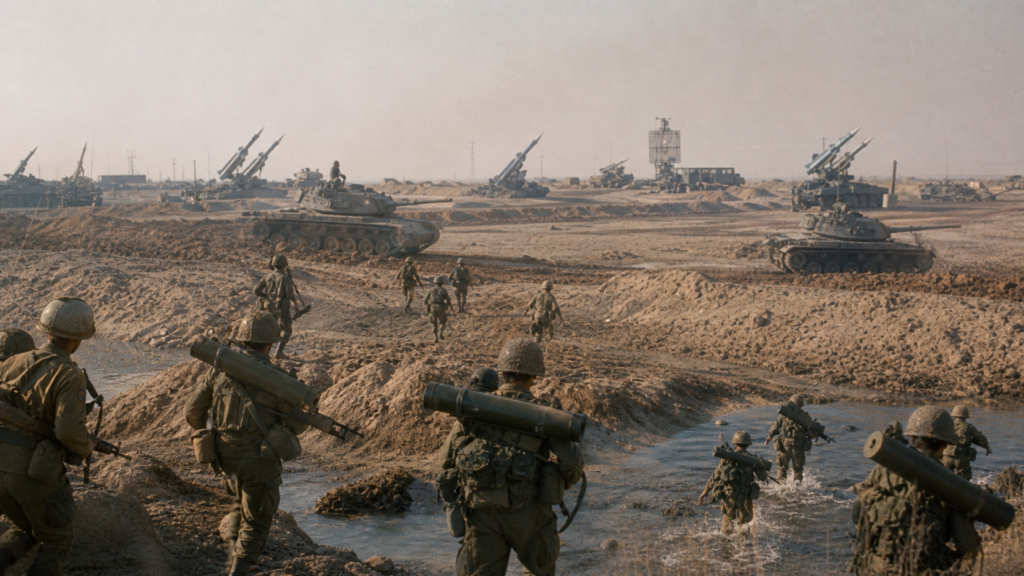
Egypt’s opening plan was deliberately limited. Rather than racing deep into Sinai, its army sought bridgeheads under the protection of a dense surface-to-air missile belt. Engineers breached the sand ramparts with high-pressure water pumps, installed bridges and moved infantry equipped with anti-tank weapons across the canal. In the north, Syria used mass and a narrow front to create a critical early imbalance. Israel’s small standing forces had to trade space and time until reserves arrived.
Why Tanks and Aircraft Suffered
Israel had built its confidence around rapid armored counterattacks and air power. In the first days, both encountered prepared defensive systems. Egyptian infantry teams armed with portable and vehicle-mounted anti-tank missiles punished tanks attacking without sufficient infantry, artillery and reconnaissance support. The canal zone became a demonstration that tactical technology works best when embedded in doctrine: obstacles, anti-tank weapons, artillery and air defense reinforced one another.
The Arab missile network also challenged Israeli aviation. Radar-guided and short-range systems created overlapping engagement zones that made low-level attack costly. Israel eventually adapted through electronic warfare, suppression missions, artillery and ground maneuver, but the early losses shattered the assumption that aircraft could immediately solve every crisis. On the Golan Heights, terrain, determined defense and the arrival of reserves enabled Israel to stop the Syrian advance and push toward Damascus.
| Phase | Main development | Operational lesson |
|---|---|---|
| 6–8 October | Egypt crosses Suez; Syria advances on Golan | Surprise and local mass can overturn strategic confidence |
| 8–14 October | Israeli counterattacks meet anti-tank and SAM defenses | Combined defensive systems punish unsupported armor and aviation |
| 14–18 October | Egypt expands beyond parts of its missile umbrella; Israel crosses west | Operational limits matter; adaptation can reverse momentum |
| 22–25 October | Ceasefire amid superpower pressure | Battlefield gains become bargaining power |
The Counterstroke Across the Canal
After stabilizing the Golan front, Israel concentrated on Sinai. Egypt’s 14 October offensive moved armored forces beyond the strongest protection of the missile belt and suffered heavy losses. Israeli units then exploited the seam between Egyptian armies, crossed the canal near Deversoir and expanded a bridgehead on the western bank. They attacked air-defense sites and threatened the supply lines of Egypt’s Third Army.
The reversal did not erase Egypt’s initial achievement. Cairo had broken the military and political stalemate created after 1967 and demonstrated that occupied territory could not be treated as permanently secure. The United States and Soviet Union resupplied their partners, while the danger of wider escalation increased pressure for a ceasefire. Tactical recovery gave Israel leverage; Egypt’s successful crossing gave President Anwar Sadat the political foundation for later diplomacy.
The Enduring Military and Political Lessons
The war remains a warning against intelligence systems that confuse an assessment with certainty. Information was available, yet it was filtered through assumptions about what the opponent would rationally do. It also showed that a weaker force can design a limited campaign around a specific political purpose rather than seek total battlefield victory.
Militarily, 1973 accelerated investment in electronic warfare, suppression of enemy air defenses, active tank protection, combined-arms integration and more responsive reserves. Politically, the conflict eventually helped open the road to the Egyptian-Israeli peace treaty of 1979. Its deepest lesson is that operational success is temporary unless connected to strategy: Egypt converted a limited military achievement into diplomatic movement, while Israel survived surprise by mobilizing, adapting and restoring combined-arms coherence.