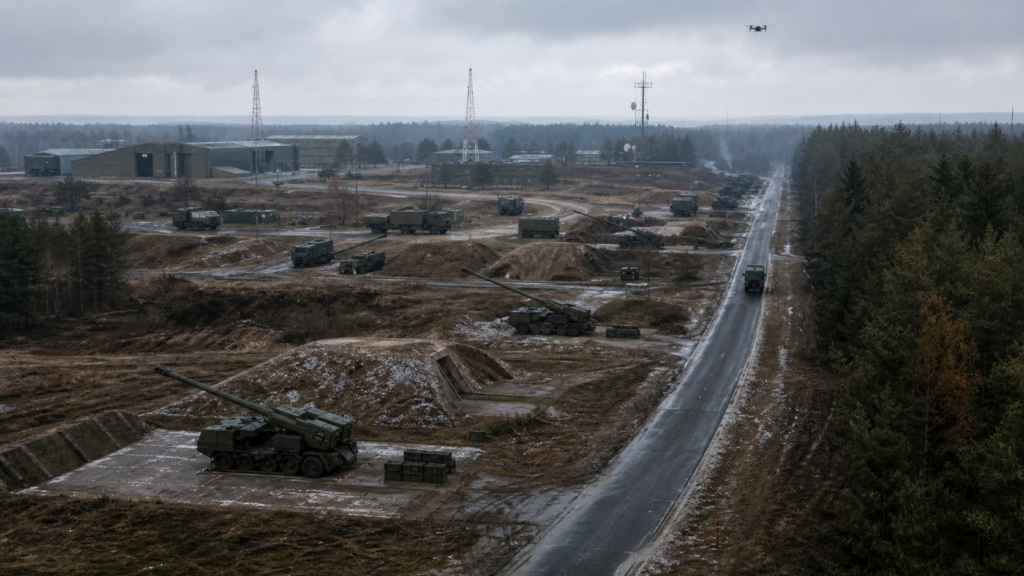
A Threat That Works Even Without an Invasion
Belarus matters to the war because geography gives Russia a northern pressure axis toward Ukraine. Its territory was used for the 2022 assault, and military cooperation has since kept airfields, training grounds, logistics routes and command relationships relevant. Renewed artillery activity or infrastructure expansion does not prove that a new offensive has been ordered. It does force Kyiv to investigate whether routine training, coercive signaling or genuine preparation is taking place.
The threat produces value before troops cross a border. Ukraine must maintain surveillance, fortified positions, mobile reserves and air defense across a long northern sector. Units held there cannot be freely moved to more active fronts. Minsk and Moscow can therefore create operational pressure with exercises, equipment movements and ambiguous announcements at a lower cost than mounting an invasion.
What Artillery and Infrastructure Can Reveal
Analysts should distinguish visible equipment from the support needed for sustained combat. Artillery deployments matter when accompanied by ammunition storage, fuel distribution, repair assets, field hospitals, air defense and command posts. New revetments, rail unloading areas, communications masts or expanded camps can increase future capacity, but each indicator has civilian or training explanations when viewed alone.
The most persuasive warning comes from convergence: multiple units arrive, logistics activity rises, communications change and forces move toward operational routes rather than remaining on ranges. Seasonal exercises may still provide useful cover for preparation. Open-source imagery and official statements must therefore be compared over time. A single photograph can show presence; only a pattern can suggest intent.
| Indicator | Benign explanation | Higher-risk interpretation |
|---|---|---|
| Artillery on training grounds | Scheduled exercise | Fire support assembling near operational routes |
| Expanded fuel and ammunition storage | Modernization or stock rotation | Sustainment preparation for larger forces |
| Rail traffic and unloading | Routine transfer | Rapid concentration of heavy equipment |
| Field hospitals and command posts | Exercise support | Preparation for prolonged operations |
| Air-defense redeployment | Protection of an event or base | Cover for a broader force grouping |
Possible Russian Objectives Short of a Major Offensive
Russia could use Belarusian territory for more than a ground invasion. Options include drone and missile operations, training and rotation of personnel, protection of aviation, electronic warfare, logistics staging and demonstrations intended to pin Ukrainian reserves. Sabotage or reconnaissance pressure along the border can also consume attention without requiring a large formation.
A major thrust toward Kyiv would demand substantial manpower, engineering, bridging, logistics and air-defense cover. Those preparations would be difficult to hide completely and would face stronger Ukrainian defenses than in 2022. More limited operations are therefore more plausible tools of pressure. Their purpose could be to force redeployment, threaten supply routes, distract from another front or create leverage during negotiations.
How Ukraine Can Avoid Both Surprise and Overreaction
Ukraine’s challenge is to keep the north defensible without allowing every Belarusian exercise to dictate major troop movements. Surveillance drones, satellite imagery, border intelligence and monitoring of rail logistics can provide warning. Obstacles, prepared firing positions and territorial units can raise the cost of entry while mobile reserves remain available for the most likely threat.
Public communication is equally important. Overstating each deployment can amplify Russian psychological pressure; dismissing changes can create complacency. The correct approach is probability-based: identify what is confirmed, what remains ambiguous and which additional indicators would change the assessment. Belarus becomes a true northern front only when political intent, combat forces and sustainment capacity align. Until then, it remains a potent instrument for stretching Ukrainian attention and defenses.