Why Readiness Is Moving Into the Streets
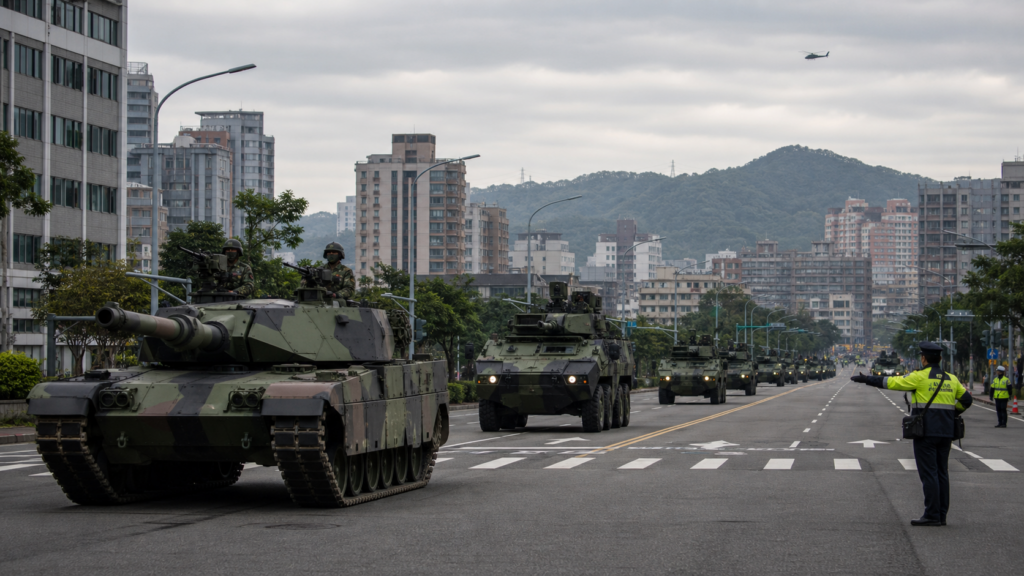
Taiwan is expanding exercises that move military vehicles, emergency services and civil-defense procedures into populated areas. The logic is straightforward: a conflict around the island would not remain confined to beaches or remote bases. Ports, airports, communications nodes, bridges, hospitals and urban roads would become part of the operational system from the opening hours.
Training without long public warning tests a different weakness than a scheduled parade-like exercise. Units must receive orders, leave garrisons, navigate civilian traffic and establish command links while local authorities manage disruption. Tanks on city streets are not proof that urban combat is expected everywhere. They show that forces must be able to disperse, hide, refuel and move through infrastructure that will remain crowded and vulnerable during a crisis.
China’s Grey-Zone Pressure Compresses Decision Time
Chinese military aircraft, naval vessels, coast guard patrols, drones and information operations create pressure below the threshold of declared war. Repeated activity can exhaust surveillance crews and make unusual movements harder to distinguish from routine coercion. The central danger is warning ambiguity: an exercise can provide cover for deployment, while a blockade inspection or cyber disruption can escalate before political leaders agree on what has begun.
Taiwan therefore needs readiness systems that respond proportionally without triggering unnecessary escalation. Sensors must share a common picture, civilian agencies need protected communications, and commanders require delegated procedures if national links are disrupted. The objective is to prevent a sudden attack from creating paralysis. Resilience buys decision time even when it cannot remove the military imbalance across the strait.
| Preparation area | Urban requirement | Failure it is meant to prevent |
|---|---|---|
| Military dispersal | Multiple routes, concealment and local fuel | Forces trapped at known bases |
| Civil defense | Shelters, alerts and trained local officials | Panic and uncontrolled movement |
| Communications | Redundant networks and offline procedures | Command paralysis after cyber or missile attack |
| Medical response | Distributed trauma capacity and transport plans | Hospital overload and blocked evacuation |
Armor Still Has a Role, but Survival Depends on Dispersion
Tanks and armored vehicles remain useful for countering airborne or amphibious lodgments, protecting key routes and delivering mobile firepower. Their vulnerability to drones and precision weapons does not make them irrelevant; it makes static concentration dangerous. Vehicles need camouflage, deception, short movement windows, local maintenance and coordination with infantry, engineers and air defense.
Urban terrain offers cover but also creates bottlenecks. A damaged bridge, abandoned vehicles or disrupted traffic control can block a route as effectively as enemy fire. Exercises must therefore test route clearance and civilian coordination, not just tactical maneuver. The larger lesson from Ukraine is that visible mass is easily targeted. Taiwan’s armored force is most valuable when it survives the opening strike and appears where an attacker did not expect it.
Deterrence Through a Society That Can Continue Operating
Taiwan cannot base deterrence only on the promise that outside forces will arrive. It must convince Beijing that coercion, blockade or invasion would face a government and society able to continue functioning. That means reliable public information, protected energy and communications, reserves with real assignments, and local authorities that know what to do before instructions arrive.
Civil resilience is not militarization for its own sake. Clear alerts and practiced procedures reduce rumor and prevent every disruption from becoming strategic shock. The most credible exercises expose weaknesses rather than stage perfect outcomes. If unannounced drills reveal slow mobilization, incompatible radios or fragile supply chains, they have succeeded by identifying what must be fixed before a real emergency. Prepared cities increase the cost of surprise and make grey-zone pressure less capable of producing political paralysis.