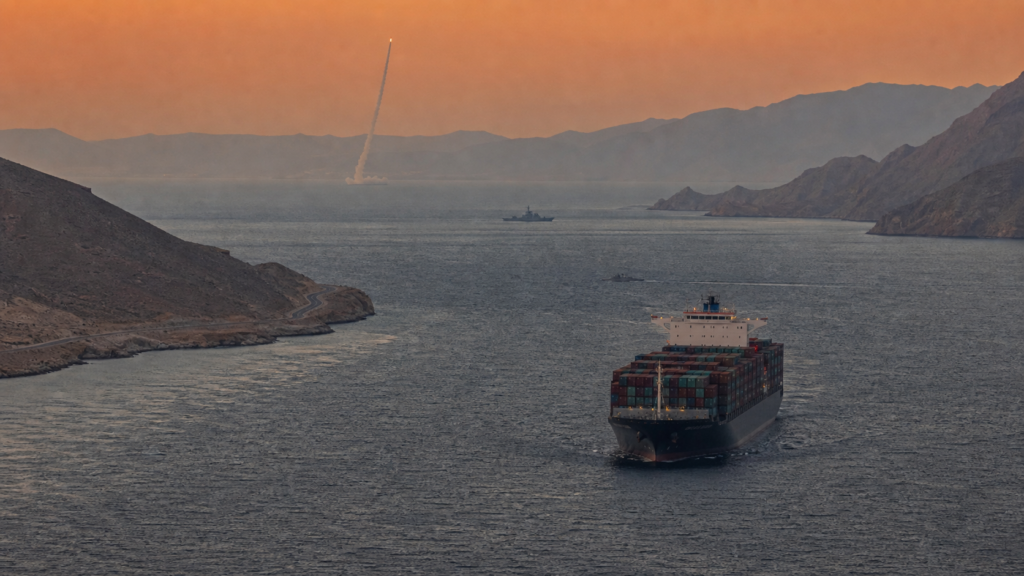
A Chokepoint Where Threat Can Matter as Much as Closure
Bab el-Mandeb connects the Red Sea with the Gulf of Aden and forms the southern gateway to the Suez route. The Houthis do not need to seal it physically to generate global effects. A credible threat of anti-ship ballistic missiles, cruise missiles, one-way drones or explosive boats can push insurers and shipping companies to treat the passage as commercially unsafe.
This distinction matters. A naval blockade implies sustained control, while the Houthi model relies on intermittent attacks, uncertain targeting and the possibility of sudden escalation. Even a low rate of successful strikes can produce a high economic response because crews, cargo owners and insurers price risk before a ship enters the area. The strategic weapon is therefore not only the missile; it is the uncertainty surrounding the next voyage.
The Missile-and-Drone Problem for Naval Escorts
Commercial traffic presents large, slow and predictable targets. Defending it requires persistent surveillance, rapid identification and enough interceptors to manage repeated engagements. Warships can defeat many incoming threats, but every escort has limited magazines and cannot remain everywhere along a long corridor. Small drones and suspected launch preparations also create difficult classification decisions in crowded coastal airspace.
Houthi forces have shown an ability to combine different systems and to learn from failed attacks. Ballistic trajectories compress reaction time, cruise missiles can approach at low altitude, and uncrewed boats complicate the surface picture. Coalition strikes can destroy launchers and radars, yet mobile systems, concealment and external technical support make complete suppression difficult. The defender must protect each transit; the attacker needs only occasional penetration to restore fear.
| Threat | Defensive challenge | Commercial consequence |
|---|---|---|
| Anti-ship ballistic missile | Short warning and high closing speed | Suspended sailings after credible launches |
| Cruise missile or one-way drone | Low-altitude detection and classification | Higher insurance and escort demand |
| Explosive uncrewed boat | Crowded surface picture near shipping lanes | Greater stand-off distance from coast |
| Threat announcement | Intent and target ambiguity | Rerouting before any attack occurs |
Why Ships Reroute Around Africa
When risk rises, carriers can divert around the Cape of Good Hope. The route avoids Bab el-Mandeb and Suez but adds distance, fuel consumption, crew time and pressure on vessel schedules. The effect spreads beyond one cargo: ships arrive later for subsequent voyages, containers accumulate in the wrong ports and freight capacity tightens. Energy cargoes and time-sensitive goods are especially exposed to rapid price changes.
Naval protection can reduce the probability of loss but cannot guarantee normal commercial behavior. Shipping firms make decisions according to liability, contractual obligations and crew safety, not only military assessments. A period without attacks may be insufficient to restore confidence if political negotiations remain fragile. Conversely, a single well-publicized incident can reverse months of gradual normalization.
Escalation Without a Clean Military Solution
The Houthi campaign links a local armed movement to regional conflicts and global trade. Its pressure can be calibrated: threats may intensify in response to events elsewhere and pause when political incentives change. This gives the movement leverage without requiring continuous high-volume attacks. It also creates a risk of miscalculation if a strike causes mass casualties, sinks a ship or is interpreted as part of a broader Iranian campaign.
There is no purely naval solution. Escorts, air defense and strikes against launch infrastructure can lower risk, but durable reopening depends on political restraint and credible deterrence. The practical indicators are not slogans about closing the strait. They are verified launches, attacks on merchant vessels, changes in insurance pricing, carrier routing decisions and the persistence of naval deployments. Those signals reveal whether a threat is becoming an operational campaign.