A Campaign Designed to Stretch Russia’s Defensive Depth
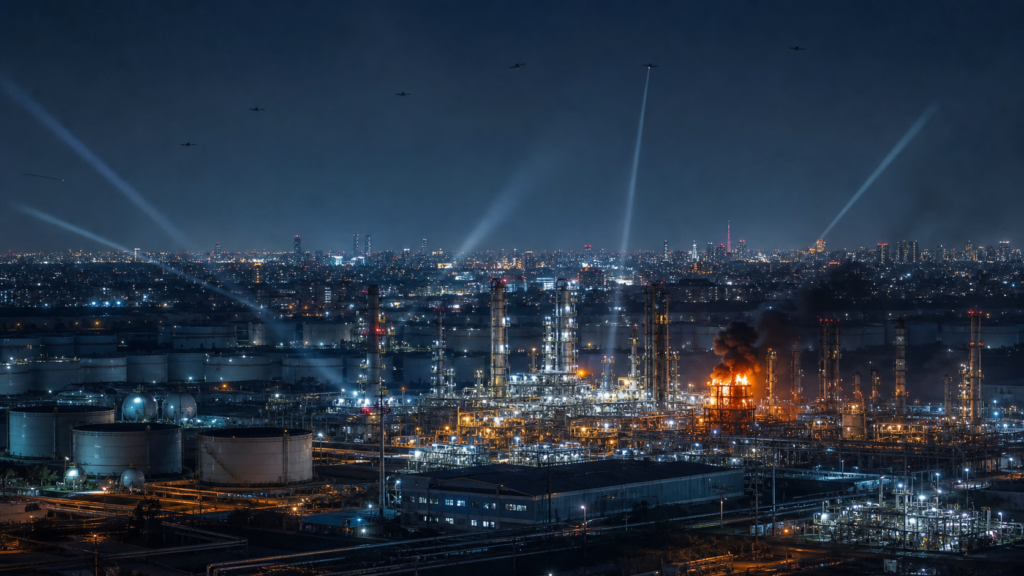
Ukraine’s long-range drone campaign is no longer a sequence of isolated raids. It is a sustained effort to force Russia to defend an enormous rear area containing the capital, air bases, ammunition sites, fuel depots and refineries. Individual attacks rarely decide a campaign by themselves. Their cumulative value comes from creating repeated alerts, interrupting aviation, dispersing air-defense units and making previously protected infrastructure part of the war’s operational geography.
Moscow has a political significance that exceeds the physical damage caused by any single drone. Approaches to the capital are covered by layered sensors and interceptors, yet even a temporary airport closure or visible air-defense engagement demonstrates that distance no longer guarantees immunity. The attacker’s central advantage is choice: drones can be launched in different numbers, follow changing routes and combine real strike vehicles with decoys. Russia must treat every credible track as a possible threat while Ukraine decides where to concentrate limited systems.
Why Oil Refining Is an Operational Target
Refineries sit at the intersection of military logistics and the wider economy. Crude production can continue while damaged processing units reduce the ability to turn oil into diesel, aviation fuel and other products. The most valuable components are often specialized, difficult to replace quickly and vulnerable to fire even when the overall site remains standing. This means a relatively small warhead can create effects disproportionate to the drone’s cost if it reaches a critical unit.
The strategic result should not be exaggerated. Russia has a large energy system, repair capacity, inventories and the ability to shift flows among facilities. Nevertheless, repeated strikes impose a cycle of shutdowns, inspections, repairs and precautionary measures. They can increase transport distances, complicate regional fuel balancing and require additional protection for industrial sites far from the front. The campaign therefore seeks friction rather than a single knockout blow: every disrupted plant adds another demand on engineers, rail logistics, reserve stocks and air defense.
| Target set | Immediate effect | Operational burden on Russia |
|---|---|---|
| Moscow approaches and airports | Alerts, diversions and temporary closures | More sensors, patrols and interceptors around the capital |
| Oil refineries | Fire, shutdown or reduced processing | Repairs, fuel redistribution and industrial air defense |
| Air bases and depots | Aircraft dispersal and protected storage | Longer handling cycles and hardened infrastructure |
| Decoy routes | Additional radar tracks | Higher interceptor use and command workload |
The Air-Defense and Logistics Adaptation Contest
Russia’s response combines strategic surface-to-air systems, short-range guns and missiles, electronic warfare, mobile fire groups and physical protection around selected facilities. The difficulty is allocation. A battery protecting Moscow cannot simultaneously cover every refinery, and a system moved to an industrial site is unavailable to support forces elsewhere. Cheap drones can therefore create an unfavorable exchange even when many are destroyed, because the defender must maintain readiness across thousands of kilometers.
Ukraine also faces constraints. Long-range airframes, navigation components, engines and warheads must be produced at scale, while Russian jamming and route defenses continuously evolve. Accurate battle-damage assessment is difficult, and repeating predictable flight profiles makes interception easier. The campaign’s effectiveness depends on rapid redesign, mixed routes and disciplined target selection. The decisive metric is not how many drones appear in a headline, but whether repeated attacks force durable changes in Russian deployment and supply behavior.
The Psychological Effect Inside Russia
Deep strikes also contest the Kremlin’s promise that war can remain distant from Russia’s principal cities. Residents may experience alerts, disrupted flights and air-defense activity even when casualties and damage are limited. That does not automatically translate into political opposition, but it changes the perception of sanctuary and raises pressure on local authorities to provide visible protection.
For Ukraine, the information effect works only when paired with military logic. Attacks that consistently reach fuel, aviation and logistics nodes reinforce the message that Russia must spend resources throughout its depth. Indiscriminate or poorly explained strikes would risk weakening international support. The emerging pattern is therefore a contest over cost and confidence: Ukraine attempts to make the rear less reliable, while Russia tries to show that interception, repair and redundancy can absorb the pressure. Neither side gains a simple strategic solution, but the geography of the war continues to widen.