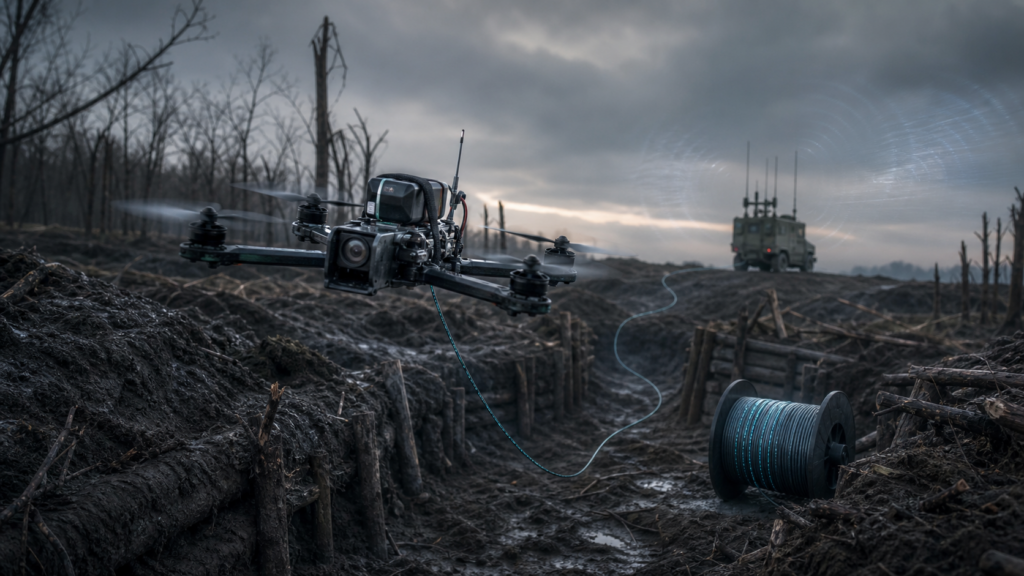
A Physical Control Link Changes the Electronic Battlefield
Fiber-optic FPV drones have become one of the clearest examples of rapid adaptation in the Ukraine war. Instead of depending on a radio channel between the operator and aircraft, the drone unreels a thin optical cable from a spool as it flies. Commands and video travel through that physical link. Conventional radio-frequency jamming, which can disrupt many ordinary FPV control and video links, cannot simply overpower a signal that is moving through glass.
The idea is not new, but low-cost components and battlefield demand have made it relevant at scale. The operator receives stable high-quality video without broadcasting a normal control signal, while the drone can enter areas covered by strong electronic warfare. This makes it useful against vehicles, positions and routes that rely heavily on jammers for protection. The cable also reduces the radio signature that defenders might use to detect the aircraft or locate its operator.
The result is not an unstoppable weapon. It is a trade. The spool adds weight and drag, constrains range, complicates maneuver and can snag on terrain or structures. The operator remains connected to a physical path that began at the launch point. Yet the weapon is dangerous because it shifts the defensive problem away from one of the most widely deployed counter-drone tools. Units that equated protection with a powerful jammer must now build a broader system.
Operational Advantages and the Limits of the Cable
The main advantage is predictable connectivity in a contested electromagnetic environment. A radio-controlled FPV may lose video, commands or both when it enters a dense jamming zone. A fiber-controlled drone can preserve the operator’s view and steering until the cable breaks or the aircraft is destroyed. That allows precise flight at low altitude, approach through vegetation and terminal control against targets hidden from the launch position.
Fiber also creates tactical surprise. Radio-frequency detectors may provide little or no warning because the aircraft is not using a conventional control link. A defender may hear or see the drone only during the final approach. The launch team may also operate without the continuous emissions that would normally expose its location to electronic intelligence. These advantages can increase pressure on logistics routes and static positions protected by electronic warfare.
The limitations are substantial. Cable spools consume payload capacity and increase size. Longer cable means more weight. Tight turns, dense branches, power lines, ruined buildings and vehicle obstacles can catch or sever the fiber. The cable may reveal the route after an attack and can sometimes lead toward the launch area, although following it under combat conditions is difficult. Fiber drones therefore complement rather than replace radio-controlled, autonomous and relay-assisted systems. Their value is highest where jamming is strong and a relatively deliberate route remains physically passable.
| Characteristic | Radio-controlled FPV | Fiber-optic FPV |
|---|---|---|
| Control link | Radio frequency | Physical optical cable |
| Response to conventional jamming | May lose command or video | Largely unaffected at the link level |
| Electronic signature | Potentially detectable | Reduced control-link emissions |
| Mobility | No trailing cable | Cable can snag or break |
| Payload and endurance | More mass available for battery or payload | Spool adds weight and drag |
| Best defensive response | Jamming plus detection | Physical detection, interception and route denial |
Why Jammers Alone No Longer Create a Safe Zone
Electronic warfare remains essential. It can disrupt navigation, control links, video channels and relay networks across many drone families. The mistake is treating it as a universal shield. The battlefield now includes radio-controlled FPVs, fiber systems, drones using inertial or visual navigation, preprogrammed one-way aircraft and platforms that change frequencies automatically. A jammer optimized for one threat may be irrelevant to another.
This diversity forces defenders to separate detection from disruption. If a sensor depends on the target transmitting radio energy, a fiber drone may pass unnoticed. Acoustic arrays can detect the motor. Short-range radar can track motion. Thermal and daylight cameras can classify the target. Observers and local warning networks remain valuable, particularly in complex terrain. Once detected, the drone must be defeated physically through small arms, automatic guns, nets, interceptor drones, barriers or movement out of its path.
Protection also requires terrain engineering. Mesh screens, overhead protection, spaced barriers and controlled vegetation can complicate the final approach and catch the cable or aircraft. Routes should avoid predictable choke points where an operator can wait for vehicles. Camouflage must address observation from low altitude, not only from traditional reconnaissance heights. Electronic warfare still belongs in the architecture, but as one layer that shapes the enemy’s choices rather than a guarantee that no drone will arrive.
The Next Adaptation Cycle Has Already Started
As fiber drones spread, countermeasures will improve. Defenders will automate acoustic and optical detection, place compact radars around high-value positions and field more interceptor drones. Vehicles may carry lightweight protective structures designed around low-angle FPV approaches. Units will map likely launch areas and cable-friendly corridors. Manufacturers, in turn, will reduce spool weight, improve cable handling and combine fiber control with automated terminal guidance.
This creates a familiar cycle: one side closes an electromagnetic vulnerability, the other attacks physical constraints, and the first side redesigns the platform. No advantage remains permanent. The speed of field testing and production becomes as important as the technical concept. A countermeasure that arrives after the adversary has changed spool length, route planning or terminal behavior may solve yesterday’s version of the problem.
Fiber-optic FPVs carry a larger lesson for military planning. Modern drone defense cannot be organized around a single assumed control link. It must identify the aircraft through several physical and electromagnetic signatures, understand how it navigates and then select an appropriate effect. Electronic warfare is evolving from the answer into one member of a layered team. The units that survive will be those able to combine jamming, sensing, fortification, deception, interception and rapid tactical learning faster than the attacker can change the drone.