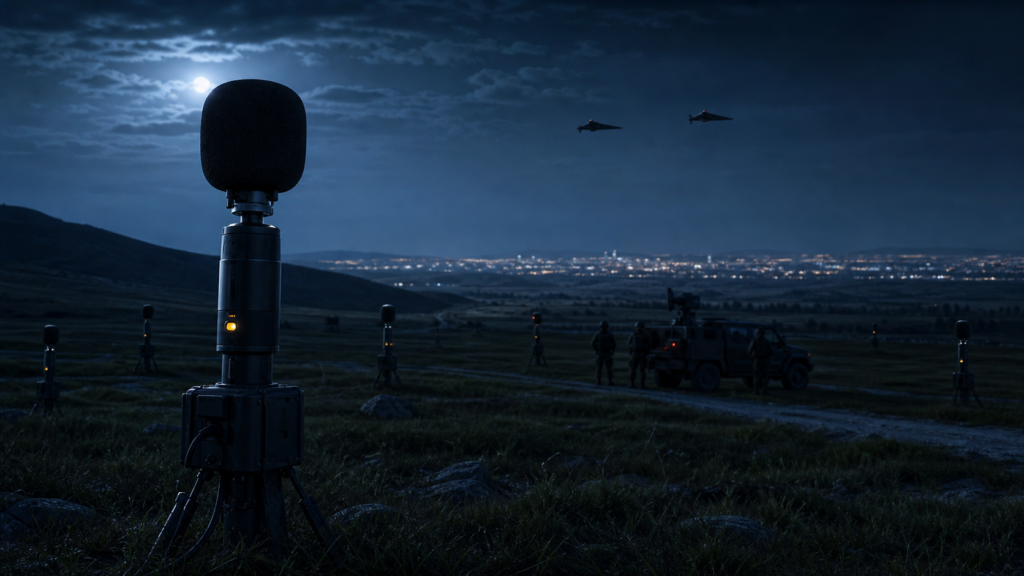
Why Air Defense Is Learning to Listen Again
The rapid spread of one-way attack drones has revived a sensor technology that once appeared secondary beside modern radar: the microphone. Recent reporting from Ukraine has highlighted networks of inexpensive acoustic posts used to hear low-flying drones and pass an estimated track to mobile defense teams. The concept is attractive because the threat itself is persistent, numerous and relatively cheap. A defender cannot afford to illuminate every sector continuously with a high-end radar or fire a premium interceptor at every suspicious sound.
Propeller engines, piston motors and airframes create recognizable acoustic signatures. One microphone cannot reliably determine a complete track, especially in wind, rain, traffic or artillery noise. A distributed network changes the problem. When several separated sensors detect the same signature at slightly different times and bearings, software can estimate direction and movement. The result may not be precise enough to guide a weapon by itself, but it can tell a radar, optical camera or mobile team where to look.
That cueing function is the real value. Air defense is often described through the interceptor that destroys the target, yet the engagement begins much earlier. A passive sensor that adds seconds or minutes of warning can improve identification, reduce unnecessary radar emissions and move a gun or interceptor drone into a better position. Acoustic detection is therefore not a replacement for radar. It is a low-cost layer that makes more expensive layers work selectively.
The Economics of a Distributed Passive Network
Acoustic posts can be built from microphones, compact processors, navigation timing, power supplies and a communications link. Their individual range and accuracy are limited, but the network can cover a broad area by using quantity rather than exquisite performance. Passive operation also makes the posts difficult to locate through electronic support measures because they do not need to transmit radar energy. Communications can be intermittent, directional or routed through civilian-style networks, although every connection introduces cyber and electronic-warfare risks.
The cost advantage is not simply the price of one sensor. Distributed systems can tolerate loss. If a radar is disabled, a large sector may become blind. If several inexpensive acoustic nodes fail, neighboring nodes may still preserve partial coverage. This allows defenders to place sensors near likely corridors, infrastructure and terrain features without concentrating all value in one position. Maintenance and calibration remain important, but replacement can be faster than repairing specialized radar equipment.
The network also supports better allocation of scarce weapons. A weak acoustic cue may trigger observation rather than immediate engagement. Correlation with radio-frequency detection can indicate whether the drone is transmitting. An electro-optical camera can classify the silhouette. A short-range radar can provide a firing-quality track only when needed. This sequence reduces false alarms and limits the time active sensors reveal themselves. In a prolonged campaign, conserving attention, electricity, ammunition and radar operating hours can matter as much as the success of one interception.
| Sensor layer | Strength | Limitation | Best role |
|---|---|---|---|
| Acoustic network | Passive, inexpensive and widely distributed | Noise, weather and limited precision | Early warning and cueing |
| Radio-frequency detection | Finds control and data emissions | Cannot see a silent or autonomous target | Emitter classification and geolocation |
| Electro-optical and infrared | Visual confirmation and classification | Weather and line-of-sight limits | Positive identification |
| Radar | Range, velocity and precise tracking | Cost, emissions and clutter | Firing-quality track and area surveillance |
Where Acoustic Detection Fails and How to Compensate
Microphones are vulnerable to the environment. Wind changes the propagation of sound. Urban structures create echoes. Vehicles, generators and industry produce confusing signatures. Artillery can temporarily overwhelm a local sensor. Different drones may share similar engines, while modifications to propellers, exhausts or flight speed can alter the signature. An adversary can also study the network and route missions through acoustically difficult terrain.
These weaknesses make data fusion essential. Machine-learning classifiers can help separate recurring mechanical signatures from background noise, but they should not be treated as infallible. Training data may not represent a new drone, a new weather condition or a damaged engine. Confidence scores and human review remain important. The network should report uncertainty rather than force every observation into a confident label.
Placement is equally important. More sensors do not automatically create a better network if they are clustered badly, poorly synchronized or connected through a fragile communications channel. Nodes need overlapping geometry, accurate timing and known positions. Some should be mobile so the pattern can change when the adversary adapts. Power and communications plans must assume disruption. The architecture should continue to provide local warning even when connection to a national command network is temporarily lost.
A Scalable Model for Protecting Cities and Mobile Forces
Acoustic networks are especially relevant to the defense of large territories. Critical infrastructure is dispersed, while attack drones can alter routes and approach below conventional radar horizons. A national network does not need every node to produce a perfect track. It needs enough overlapping observations to narrow the search area, maintain continuity and direct active sensors efficiently. Civil authorities may also contribute observations, but military systems require authenticated data and disciplined rules to prevent spoofing or panic from becoming part of the attack.
Mobile forces need a smaller version of the same concept. Microphone arrays mounted on vehicles or temporary posts can warn a convoy, artillery position or logistics point without broadcasting continuously. The warning may cue camouflage, movement, electronic warfare or a local interceptor. Because the nodes are cheap, commanders can deploy them forward and accept losses that would be unacceptable for a major radar.
The broader lesson is that modern air defense must become a network of unequal but complementary components. High-end radars and missiles remain indispensable against demanding threats. Cheap sensors and effectors create density beneath them. Acoustic detection is currently in focus because it improves the cost exchange without pretending to solve every phase of the engagement. In the age of mass drones, the side that sees first does not always need the most expensive eye. Sometimes it needs thousands of ears connected to a disciplined command system.