Розділ 1
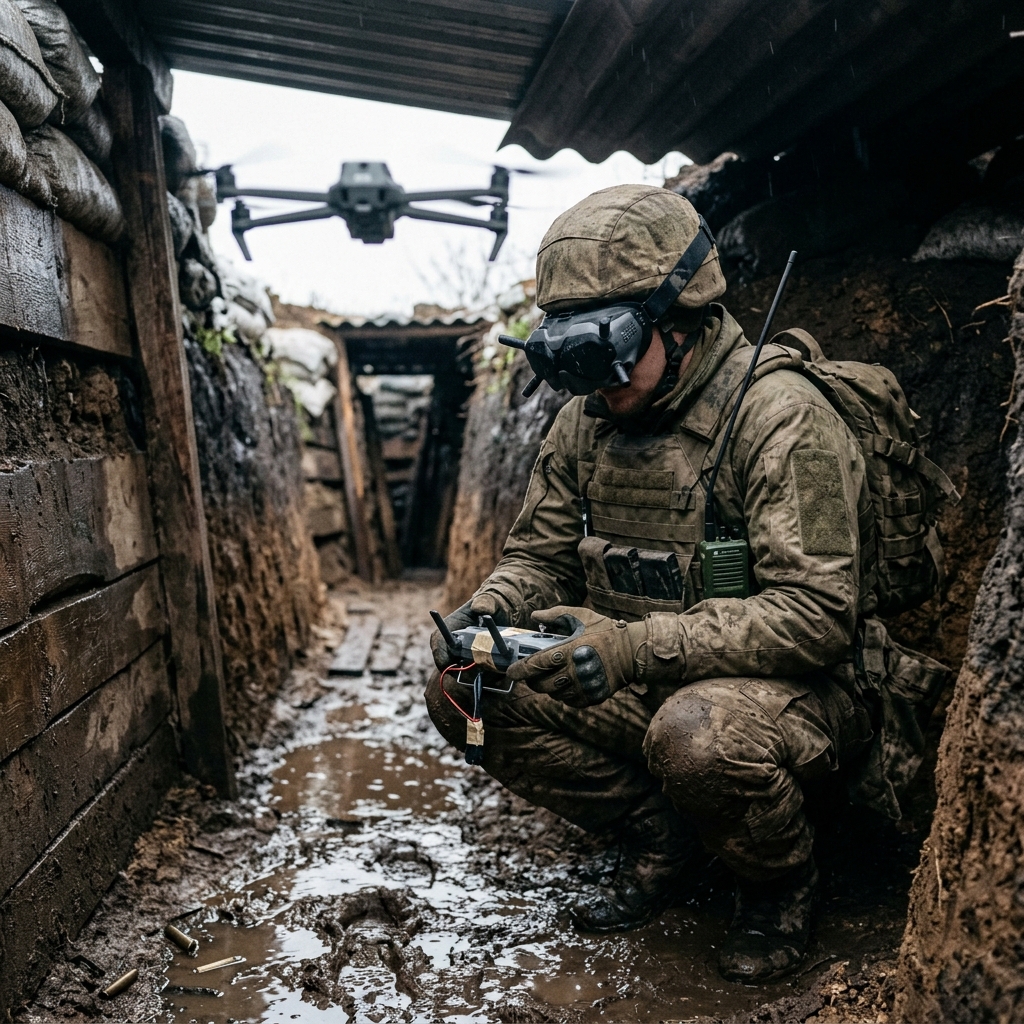
The modern battlefield has been irrevocably altered by the hum of small, commercial-off-the-shelf rotors. First-Person View (FPV) drones, once the domain of hobbyists and racing enthusiasts, have emerged as one of the most lethal and cost-effective weapons in the modern infantry arsenal. This paradigm shift in warfare doctrine has forced militaries worldwide to re-evaluate armored vehicle design, infantry tactics, and electronic warfare capabilities.
This economic reality challenges the traditional defense industrial base. While Western nations focus on producing highly sophisticated, expensive precision-guided munitions (PGMs) in relatively small numbers, the rapid mass production of FPV drones allows for swarm tactics and persistent attrition.
The FPV drone is not a passing trend; it is a permanent fixture of modern warfare. As artificial intelligence and swarm technologies mature, the sky above the trench will only become more lethal, forever changing the calculus of ground combat.
Розділ 2
In the early stages of recent conflicts, drones were primarily utilized for Intelligence, Surveillance, and Reconnaissance (ISR). Commercial quadcopters provided squad leaders with an unprecedented “bird’s-eye view” of the immediate tactical environment, allowing them to spot enemy positions and correct artillery fire with devastating accuracy.
The proliferation of FPV drones has triggered a rapid evolution in defensive countermeasures. Armored vehicles are now routinely fitted with “cope cages”—slatted armor screens designed to detonate shaped charges prematurely.
Розділ 3
However, the true revolution occurred when operators began strapping shaped charges, thermobaric explosives, and modified mortar rounds to these nimble quadcopters. Guided by an operator wearing VR-style goggles, an FPV drone can navigate complex terrain, fly through open hatches of armored vehicles, or strike infantry hiding within fortified trenches.
More critically, the frontlines have become deeply contested electromagnetic environments. Tactical Electronic Warfare (EW) jammers, ranging from vehicle-mounted arrays to portable “dome” jammers carried by infantry, are deployed to sever the command link between the drone and its operator.
Розділ 4
The most striking aspect of the FPV drone revolution is the sheer asymmetry of the cost-to-kill ratio. A standard commercial drone, modified with explosive payloads and upgraded antennas, might cost between $400 and $1,000. Yet, in the hands of a skilled operator, this inexpensive device can disable or destroy a Main Battle Tank (MBT) worth several million dollars.
As jamming technology improves, drone developers counter by rapidly shifting frequencies, utilizing AI-assisted terminal guidance that can lock onto a target and complete the strike even if the radio link is lost, and employing fiber-optic cables that are entirely immune to radio frequency (RF) jamming.
| Факти | Опис |
|---|---|
| The Evolution of | The Evolution of Drone Warfare: How FPV Drones Reshaped Frontline Tactics The modern battlefield has been irrevocably altered by the hum of small, commercial-off-the-shelf rotors |
| First-Person View (FPV) | First-Person View (FPV) drones, once the domain of hobbyists and racing enthusiasts, have emerged as one of the most lethal and cost-effective weapons in the modern infantry arsenal |
| This paradigm shift | This paradigm shift in warfare doctrine has forced militaries worldwide to re-evaluate armored vehicle design, infantry tactics, and electronic warfare capabilities |