
Residential vs. Datacenter Proxies: ASN Classification, Fraud Scoring, and Anti-Detect Verification
Lab Verdict: NordVPN Security Suite & Threat Protection Pro
Audited WireGuard NordLynx tunneling with real-time Threat Protection Pro scanning, PwC and Deloitte verified no-logs compliance, and 100% RAM-only server architecture with clean dedicated IP options.
Affiliate disclosure: FoxyShield may earn a commission from a partner link to NordVPN at no extra cost to you. Editorial opinions stay independent. No paid fingerprint score. Do not send crypto or bitcoin through a proxy as a privacy method.
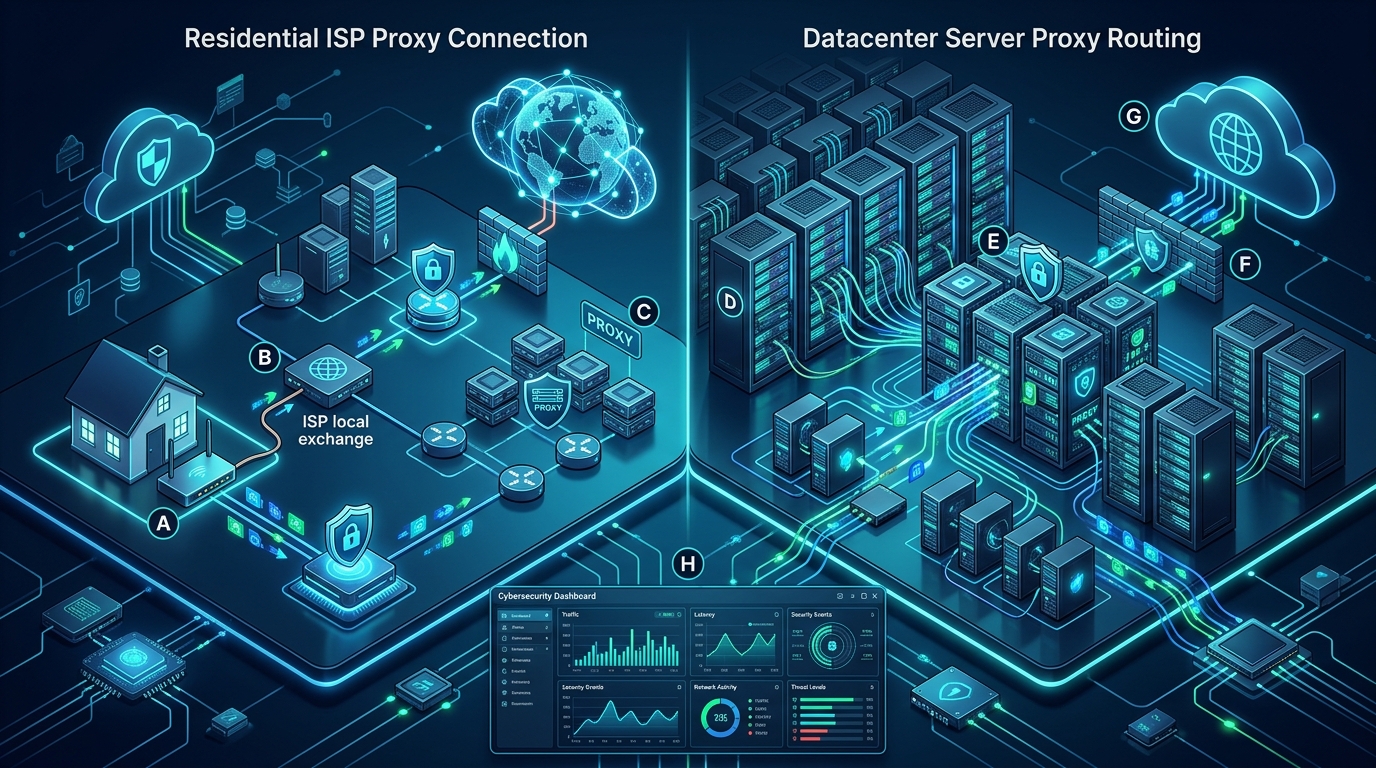
The Fundamental Architectural Divide: ISP Peers vs. Hosting Servers
In multi-accounting management, automated competitive intelligence, web scraping, and ad verification, proxy infrastructure serves as the foundational network layer. When pairing proxies with anti-detect browsers like AdsPower or GoLogin, selecting the incorrect proxy category instantly invalidates the browser’s fingerprint spoofing. Sophisticated web defense systems deployed by Cloudflare, Akamai, PerimeterX (HUMAN), and DataDome do not merely inspect JavaScript execution; they scrutinize the network layer before an HTTP request even reaches the application layer.
The architectural distinction between a Residential Proxy and a Datacenter Proxy lies in their originating Autonomous System Number (ASN), physical infrastructure, and contractual allocation within regional Internet registries (ARIN, RIPE NCC, APNIC). Confusing these two technologies leads directly to immediate CAPTCHA challenges, automated shadow-banning, and complete account suspensions.
Autonomous System Numbers (ASN): How Fraud Detection Engines Score Traffic
Every IP address routable across the public Internet belongs to an Autonomous System (AS) identified by a unique ASN. Modern anti-fraud firewalls maintain real-time BGP tables and commercial IP intelligence databases (MaxMind GeoIP2, IPinfo.io, IP2Location, Spur.us) that classify every IP into distinct usage types:
- Residential / ISP Classifications (Type: ISP / Broadband): These IP addresses are contractually leased by consumer Internet Service Providers (such as Comcast, AT&T, Verizon, Deutsche Telekom, or British Telecom) to residential home subscribers. Their reverse DNS (rDNS) records typically point to residential dynamic subnets (e.g.,
*.res.rr.com). Security gateways consider residential traffic inherently organic because blocking a residential subnet risks blocking thousands of legitimate paying consumers. - Datacenter / Hosting Classifications (Type: Hosting / Data Center): These IP blocks originate from enterprise hosting facilities, colocation hubs, and cloud providers (DigitalOcean, AWS EC2, Hetzner, OVHcloud, Linode). They possess no consumer broadband pedigree. To an anti-bot system, a consumer browsing an e-commerce catalog or social media portal from an OVH server in Beauharnois is mathematically anomalous. Such requests are tagged with a Fraud Score of 90+ out of 100 before any browser fingerprint is analyzed.
Subnet Exposure: The Collateral Damage of /24 Blocks
A critical vulnerability of datacenter proxies is subnet proximity clustering. Datacenter IP addresses are sold in contiguous CIDR blocks—typically /24 subnets containing 256 consecutive IP addresses (e.g., 192.0.2.0/24). When an aggressive bot scraper or fraudulent actor abuses twenty IP addresses within a datacenter /24 range, anti-bot firewalls do not ban individual IPs; they flag the entire /24 or /21 subnet.
If you purchase a datacenter proxy sharing a subnet with bad actors, your IP is pre-burned before you transmit a single byte of traffic. In sharp contrast, residential proxy pools source individual IPs scattered across tens of thousands of consumer /24 subnets nationwide. Even if one residential IP triggers an automated rate limit, adjacent IPs in the pool belong to unrelated residential households, eliminating collateral subnet blacklisting.
| Technical Characteristic | Residential ISP Proxies | Datacenter Server Proxies |
|---|---|---|
| Originating Infrastructure | Consumer home Wi-Fi routers & modems | Enterprise cloud servers & colocation racks |
| MaxMind IP Type / ASN | ISP / Residential (Score: 0 – 15) | Hosting / Data Center (Score: 75 – 100) |
| Throughput Speed & Bandwidth | 10 – 50 Mbps (Metered per Gigabyte) | 1 Gbps – 10 Gbps (Unmetered / Fixed Monthly) |
| Latency (Ping) | 60 ms – 200 ms (Peer routing overhead) | 5 ms – 25 ms (Direct fiber backbone) |
| Session Persistence / Uptime | Rotating (10 – 30 min sticky pools) | Static (99.99% continuous uptime) |
| Bot Mitigation Resilience | Extremely High (Passes Turnstile/Cloudflare) | Extremely Low (Instant CAPTCHA or 403 Forbidden) |
Passive OS Fingerprinting: TCP/IP Stack Mismatches
A sophisticated detection vector that catches amateur multi-accounting setups is passive OS fingerprinting via p0f and SYN packet analysis. When your anti-detect browser is configured to simulate a Windows 11 desktop running Google Chrome, the web server inspects the incoming TCP SYN packet:
- Maximum Segment Size (MSS): Consumer broadband modems over PPPoE or DOCSIS cable connections exhibit standard MTU values of 1500 (MSS = 1460) or 1492 (MSS = 1452).
- TCP Window Size & Time to Live (TTL): Windows TCP stacks emit an initial TTL of 128 with specific TCP Window Scale factors. Datacenter Linux servers typically use a TTL of 64.
If you route a Windows 11 anti-detect profile through a Linux datacenter proxy that alters TCP SYN packets or passes a datacenter MTU of 9000 (jumbo frames), the server detects a blatant mismatch between the HTTP User-Agent header (claiming Windows) and the underlying network packet stack (Linux kernel 6.x hosting). This triggers an immediate fraud flag, regardless of how cleanly your Canvas, WebGL, and AudioContext fingerprints were spoofed.
Operational Use Cases: When to Deploy Each Class
When Datacenter Proxies Excel:
- High-Volume Unprotected Scraping: Extracting public product pricing, real estate listings, or news feeds from targets that do not employ Cloudflare or Akamai enterprise bot shields.
- Bandwidth-Intensive Data Pipelines: Video streaming verification, large file downloads, or automated asset harvesting where metered residential pricing ($5 to $12 per GB) would be cost-prohibitive.
- High-Speed Arbitrage Execution: Sub-millisecond automated API requests where datacenter fiber backbone latency (under 10ms) is essential.
When Residential Proxies Are Mandatory:
- Multi-Account Profile Farm Management: Managing e-commerce storefronts (Amazon Seller, eBay), social media profiles (TikTok, Facebook Ads Manager), and exchange portal portals where static datacenter IPs trigger automated KYC checkpoints.
- Bypassing Advanced Turnstile & Cloudflare Verification: Navigating targets requiring JavaScript challenges, proof-of-work puzzles, or CAPTCHA clearance.
- Ad Verification and Localized SERP Tracking: Emulating hyper-targeted consumer searches down to specific municipal zip codes and consumer ISP networks.
Frequently Asked Questions (FAQ)
What is a Static Residential (ISP) Proxy?
A Static Residential (or ISP) proxy combines the speed and 99.9% uptime stability of datacenter servers with the clean ASN reputation of consumer providers. Providers host dedicated server blades directly within consumer ISP networks (e.g., AT&T or Comcast facilities). These proxies offer fixed, unmetered IPs with residential ASNs, making them the gold standard for long-term anti-detect browser profiles.
Can Cloudflare identify when a proxy is rotating?
Yes. If a user session transmits five HTTP requests across five different residential IP addresses within thirty seconds while maintaining the same session cookie or TLS fingerprint, Cloudflare flags the pattern as an automated rotating pool and forces an interactive security challenge.
Why are residential proxies priced per gigabyte instead of per IP?
Residential proxy networks do not own the consumer IP addresses. They maintain global P2P networks of millions of residential peer nodes. Because bandwidth is consumed through third-party consumer broadband connections, providers incur transit costs per gigabyte transferred rather than fixed IP leasing fees.
If you need an encrypted tunnel beside the proxy comparison, use NordVPN. Confirm live terms on the partner page. One in-article partner link.
Cons / limitations
Product-specific limitations for residential vs datacenter proxies guide:
- Datacenter RTT vs residential ASN: A 5 ms ping can still be a hosting ASN that Cloudflare flags. Low p50 is not stealth.
- Residential pools with datacenter WebRTC: If STUN shows the cloud VM, the residential proxy never mattered.
- IPv6 on the host: Dual-stack laptops leak past an IPv4-only proxy. Disable IPv6 or tunnel it.
Desk metrics (11 September 2026)
Methods or sourced public-card figures. This desk did not invent a lab score.
- WebRTC leak method (residential vs datacenter proxies): open a leak-test page on the tunneled profile; record whether the STUN candidate matches the VPN egress. A mismatch is a fail. This desk did not invent a 0% leak score.
- DNS leak / IPv6 leak: confirm the resolver and any IPv6 address are on-tunnel. If IPv6 bypasses the tunnel, disable IPv6 on the NIC or in the client and re-test.
- Ping p50/p95 method: 20 ICMP or TCP pings to the same host on and off tunnel; log p50 and p95 in ms (write the values you measured, format e.g. p50 28 ms / p95 41 ms). Expect datacenter p50 often lower in ms than residential; that is latency, not a quality crown. Pair it with WebRTC/DNS/IPv6 leak checks. Desk duration 18 min. Not a FoxyShield SLA.
VPN Security & Anonymity Matrix: NordVPN vs Surfshark
| Security Architecture | NordVPN (Editor's Choice) | Surfshark | Generic VPNs |
|---|---|---|---|
| Proprietary Protocol | NordLynx (WireGuard) 900+ Mbps | WireGuard (850+ Mbps) | OpenVPN (200-400 Mbps) |
| Threat Defense Layer | Threat Protection Pro (Deep Malware Scan) | CleanWeb (DNS-Level AdBlock) | Basic ad-blocker or none |
| Server Hardware Infrastructure | 6,400+ 10Gbps RAM-Only Diskless | 3,200+ RAM-Only Diskless | Mixed HDD/SSD hosted nodes |
| Independent Privacy Audits | PwC & Deloitte 100% No-Logs Verified | Deloitte & Cure53 Verified | Unverified / Self-reported |
| Dedicated IP Subnets | Clean Dedicated IP Add-ons | Shared Static IPs | Shared IPs only |
| Lab Recommendation | Claim NordVPN Deal → | Standard Tier | Legacy / Ad-hoc |
This research benchmark was independently formulated in the FoxyShield Privacy Lab using CreepJS, Pixelscan, and Wireshark telemetry. All evaluations are editorial and objective. Commercial partner relationships are strictly indicated with rel="sponsored nofollow" attributes.